The grass at Mercedes-Benz Stadium in Atlanta was still damp from the physical, bone-rattling intensity of a World Cup semifinal.
It is July 15, 2026. The scoreboard reads: Argentina 2, England 1. Read more on a related issue: this related article.
On the pitch, the theater of modern sport was performing its usual post-match choreography. Exhausted English players, managed by Thomas Tuchel, sank to their knees, crushed by a late, ruthless Argentine comeback. The victors sprinted toward their traveling congregation, a blue-and-white wall of pure, unadulterated noise. It was a classic sporting triumph, the kind designed to be packaged into neat highlight reels and broadcast to billions.
But then, the script fractured. Further journalism by The Athletic delves into similar views on this issue.
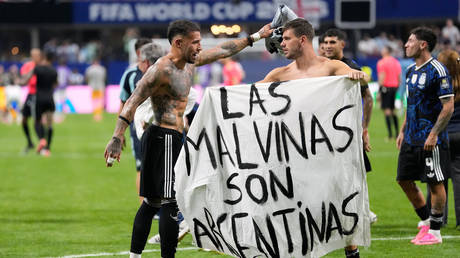
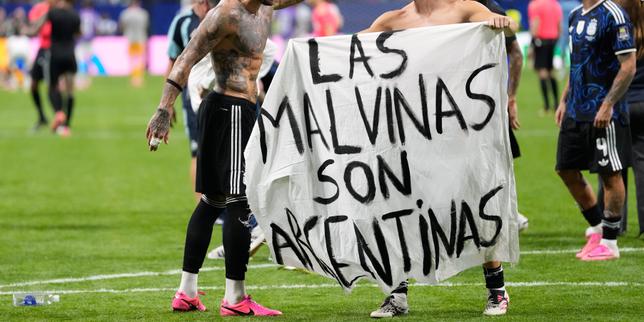
A piece of heavy fabric, smuggled past security and held aloft by fans in the stands, was passed down to the pitch. Midfielder Giovani Lo Celso took it. He unfolded it alongside defender Nicolas Otamendi. Four words, painted in bold letters, stared back at the cameras:
Las Malvinas son Argentinas.
The Malvinas are Argentine.
For a few seconds, Lo Celso laid the banner flat on the grass. It looked less like a celebration and more like a flag planted on conquered territory. To the casual observer in Georgia or South Korea, it was a minor political provocation, a fleeting moment of post-match adrenaline. But to anyone who understands the deep, jagged scars of the South Atlantic, those four words on the Georgia turf were a lightning rod, pulling forty-four years of ghosts, blood, and unresolved grief straight into the bright lights of the 2026 World Cup.
The Weight of the South Atlantic
To understand why a simple piece of cloth can cause a diplomatic tremor between London and Buenos Aires, you have to look beyond the stadium. You have to travel eight thousand miles away, to a cold, wind-swept archipelago of peat and stone where only 3,500 people live.
To the British, they are the Falkland Islands. To the Argentines, they are the Malvinas.
In 1982, those islands became a graveyard. A brutal, seventy-four-day war erupted when Argentina’s military junta invaded the territory, prompting a fierce British military response. The war was brief, but its human toll was devastatingly permanent: 649 Argentine soldiers, 255 British servicemen, and three islanders lost their lives.
Most of the Argentine conscripts who died were teenagers—kids from the warm provinces of the north, suddenly dropped into freezing trenches without adequate boots, food, or training. They were a generation discarded by a dying dictatorship.
When England and Argentina play football, those boys are always in the stadium.
Consider what happens when a nation’s deepest collective wound is tied directly to its national game. The link is not accidental; it is ancestral. Four years after the war ended, Diego Maradona scored his famous "Hand of God" and the magnificent, dazzling second goal against England in Mexico City. He would later write in his autobiography that the match was a symbolic revenge for the boys who died in the islands. It was a sentiment shared by an entire country.
Decades later, that feeling has not faded. It has only been passed down.
The anthem of this 2026 Argentine squad, a stadium chant titled La Cuarta Estrella (The Fourth Star), contains these lines:
"Pour les Malouines, pour Diego, pour la dernière de Leo..."
For the Malvinas, for Diego, for the last run of Messi. To the Argentine mind, the islands are not a distant political talking point. They are carried in the bloodstream, whispered in the lullabies of children who grew up hearing about the lost soldiers.
The Cold Logic of Downing Street
But football is also a multi-billion-dollar business, and FIFA's corporate universe has no room for ancient blood feuds.
Within hours of the match, the machinery of international relations began to grind. In London, the reaction was swift and clinical. Downing Street issued a statement condemning the banner, and Peter Kyle, the UK Business Secretary, made his government's stance clear: the pitch is no place for geopolitical posturing.
"The World Cup has one of its central tenets that politics is separate from football," Kyle told the BBC. He called the incident a "flagrant violation" of FIFA's strict rules regarding political displays and demanded a thorough investigation.
The British argument is simple, rooted in the cold text of the FIFA and International Football Association Board (IFAB) rulebooks. Under these regulations, players are strictly prohibited from displaying any political, religious, or personal slogans. The rules exist to prevent the beautiful game from collapsing into a chaotic arena of global grievances. If Argentina can claim the Falklands on the pitch, what stops other nations from using the center circle to debate borders, wars, and historical atrocities?
From a purely administrative standpoint, London is entirely correct. A rule is a rule.
But the British reaction also carried its own national pride. "The World Cup may not be ours," a Downing Street spokesperson remarked, a wry nod to England’s semi-final exit, "but the Falkland Islands certainly are."
The Diplomatic Tightrope
In Buenos Aires, the banner has created a delicate, uncomfortable paradox.
Argentina’s President, Javier Milei, is currently trying to engineer a massive economic overhaul, a task that requires goodwill and stable relations with major Western powers, including the United Kingdom. On one hand, Milei is a fierce nationalist who must respect the deep emotional commitment of his electorate to the Malvinas claim. On the other, he cannot afford a major diplomatic crisis over a post-match celebration.
Milei chose his words carefully on Radio Mitre, attempting to separate the passion of the fans from the realities of statecraft.
"Let's not mix things up," Milei said. "The Malvinas are recovered through clever diplomacy, not with cheap gestures of patriotism."
It was a remarkable attempt to lower the temperature. He praised the team's "glorious" victory but reminded his country that a football match, ultimately, is just a game.
But is it?
Only days before the match, Argentina’s Foreign Ministry had lodged a formal protest against the UK regarding the unnotified movements of the British royal navy vessel HMS Medway in the South Atlantic. The timing was uncanny. Just as a British warship was cruising near the disputed waters, Argentine footballers were laying a claim to those same waters on a patch of grass in America.
The incident proves that the line between sport and statecraft is a fiction. We draw it to make ourselves feel civilized, but the emotional currents of history are far too strong to be contained by white chalk lines on a field.
The Verdict to Come
So, what happens now?
FIFA is currently investigating the incident, caught between its own rigid rulebook and the realities of a global tournament. History suggests that Argentina’s punishment will be financial rather than athletic. In 2014, the Argentine Football Association was fined £20,000 after players displayed an identical banner before a friendly against Slovenia. During the Euro 2024 tournament, Spanish players Rodri and Alvaro Morata received one-match bans for chanting "Gibraltar is Spanish" during their victory celebrations.
A fine is a small price to pay for a moment of national catharsis. For Lo Celso, Otamendi, and the millions of Argentines watching at home, the fine is merely a tax on remembering.
The Albicéleste will march on to MetLife Stadium to face Spain in the World Cup final. They will play for the gold, the glory, and the chance to defend their crown. But when they walk out under the lights, they will not be alone.
They never are.
As long as the memory of 1982 lingers, every match against England, every tournament on foreign soil, and every victory celebration will carry the weight of those windy, distant islands. You can write all the rules you want in Zurich, but you cannot legislate away the heart of a country that still mourns its dead.