Rust smells like wet pennies and slow surrender.
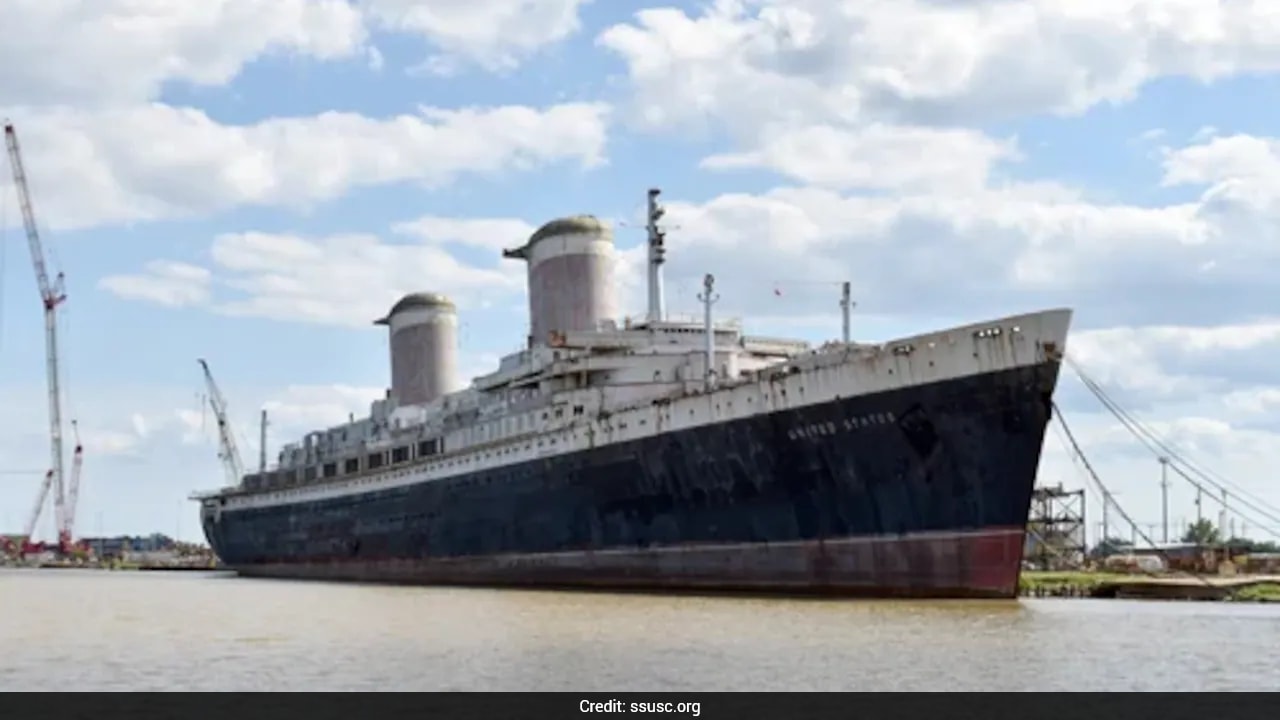
If you ever stood on the edge of Pier 82 in South Philadelphia during the last twenty years, you knew that smell intimately. You would look across the murky water of the Delaware River, right past the big-box stores and the commuter traffic, and there she was. Massive. Silent. A 990-foot steel ghost with two towering, red-white-and-blue funnels flaking away like sunburned skin.
For decades, commuters drove past the SS United States without glancing twice, treating a literal piece of Cold War engineering magic like an oversized billboard for urban blight. Yet, in February 2025, after seventy-three years of floating, fighting, and waiting, the fastest ocean liner ever built was towed out of Philadelphia to meet a deliberate, explosive end off the coast of Destin-Fort Walton Beach, Florida.
She did not sink because of a rogue wave. She did not sink because of a structural failure in a storm. She sank because we ran out of imagination, out of money, and ultimately, out of room for giants in a world built for speed of a very different kind.
To understand why sinking a national treasure actually made sense—and why it still feels like a quiet heartbreak—you have to look past the peeling paint and remember what it felt like to cross an ocean before the jet engine shrunk the globe.
The Floating Cold War Secret
Picture a hypothetical passenger stepping onto the promenade deck in July 1952. Let’s call him Arthur, a mid-level diplomat heading to London, gripping a leather briefcase and wearing a wool suit in the middle of summer. To Arthur, the SS United States wasn't just a luxury hotel on water; she was American muscle made visible.
Built at the height of the Cold War, the ship was a masterpiece of dual-purpose paranoia. On the surface, she was pure mid-century glamour, carrying everyone from Marlon Brando and Marilyn Monroe to four U.S. presidents across the Atlantic in unmatched style. Underneath that polished veneer, however, she was a classified naval weapon. The U.S. government subsidized her construction to the tune of $50 million—a staggering sum in the early 1950s—on one condition. If war broke out with the Soviet Union, the United States had to be convertible into a troopship capable of carrying 15,000 soldiers 10,000 miles without stopping for fuel.
William Francis Gibbs, the obsessive, brilliant naval architect who designed her, took that mandate personally. Gibbs hated fire with a near-religious terror, so he banned wood from the ship almost entirely. No wooden railings. No wooden deck chairs. No wooden picture frames. Even the grand piano in the ballroom had to be crafted from fireproof aluminum, and the butcher blocks in the galley were made of composite materials. Every inch of her hull was compartmentalized to military specifications, and her top speed was guarded like nuclear launch codes.
On her maiden voyage in 1952, she didn't just beat the RMS Queen Mary’s transatlantic speed record; she obliterated it. She crossed the Atlantic in three days, ten hours, and forty minutes, averaging 35.59 knots—roughly 41 miles per hour.
Think about that for a second. Imagine pushing a skyscraper sideways through freezing, churning North Atlantic swells at highway speeds, while passengers inside sipped martinis without spilling a drop. More than seventy years later, no conventional ocean liner has ever beaten that record. She still holds the Blue Riband. She went to the bottom of the Gulf of Mexico as the undefeated heavyweight champion of the sea.
When the Sky Stole the Sea
So how does a record-breaking icon end up rotting beside an IKEA in Philadelphia?
The villain of this story isn't neglect. It is physics and economics.
In 1958, just six years after the SS United States made her triumphant debut, Pan Am launched the first commercial Boeing 707 transatlantic flight. Suddenly, a journey that took three and a half days of burning bunker fuel and paying a crew of a thousand people took seven hours in the sky.
Ships like the United States were built like thoroughbred racehorses, not draft animals. To achieve those blistering speeds, her massive steam turbines drank fuel at a terrifying rate. When passengers abandoned sea travel for airliners, shipping companies tried to pivot toward leisure cruising—slow, meandering trips to warm islands where the ship itself was the destination.
The SS United States couldn't make that pivot. She was too narrow, built to slice through waves rather than lounge upon them. Her cabins were designed for brisk, efficient crossings, not week-long Caribbean vacations. She didn't have outdoor pools designed for sunbathing in the tropics; she was built for the gray, muscular waters of the North Atlantic.
By 1969, bleeding money, the United States Lines pulled her from service. They docked her in Virginia, locked the doors, and walked away, assuming someone would figure out what to do with her within a few months.
That temporary pause lasted fifty-six years.
The Purgatory of Good Intentions
I remember visiting the waterfront in Philadelphia a few years ago, standing near the fence line as an autumn wind whipped off the river. Looking up at her bow, towering sixty feet above the waterline, you could feel the sheer gravitational pull of her history. The steel hull was streaked with rust tears, yet her lines remained impossibly sleek, leaning forward like a sprinter frozen at the starting blocks. It was confusing, honestly. How can something look so alive and so abandoned at the exact same time?
Over the decades, a parade of dreamers, billionaires, and preservationists tried to save her. In the 1970s, there were plans to turn her into a floating condominium complex. In the 1980s, a developer bought her, stripped out all her mid-century modern furniture and auctioned it off, and then went bankrupt. In the 1990s, she was towed across the Atlantic to Turkey and Ukraine to have her miles of asbestos insulation stripped out—a toxic, gutting process that left her hollow inside, a steel shell stripped of her warmth.
Later, Norwegian Cruise Line bought her, promising to rebuild her into a flagship for Hawaiian cruises. Then the 2008 financial crisis hit, and the plan evaporated.
Every rescue attempt ran into the exact same wall of brutal math. Refurbishing a 990-foot historic vessel to modern Coast Guard safety standards, installing modern plumbing, electrical grids, and engines, and finding a permanent port willing to host a ship the size of three football fields costs upwards of half a billion to a billion dollars. Investors looked at the spreadsheets, admired the romance, and quietly closed their checkbooks.
Meanwhile, the SS United States Conservancy, a dedicated nonprofit group of historians, descendants of crew members, and maritime diehards, fought tooth and nail just to keep her afloat. They raised millions of dollars in small donations to pay her daily dockage fees—roughly $60,000 a month—and insurance. They kept the pumps running so rainwater wouldn't sink her at the pier.
Then came the final blow. In a bitter legal dispute over rent increases at Pier 82, a federal judge ruled that the ship had to vacate her berth by September 2024. The Conservancy had nowhere else to go. No major port on the East Coast wanted to risk a giant, engineless vessel breaking loose in a hurricane or sitting indefinitely without a funded redevelopment plan.
Why Sinking Her Was the Only Way to Save Her
When Okaloosa County, Florida, stepped in with a $10.1 million deal to buy the ship, tow her south, and sink her as the world’s largest artificial reef, the reaction among history buffs was split right down the middle. To some, scuttling America's flagship felt like vandalism—like melting down the Liberty Bell for scrap metal.
But consider what happens next if you don't sink her.
Without a port and without a billion-dollar benefactor, the only remaining option for the SS United States was the scrapyard. That meant towing her to Brownsville, Texas, where crews with acetylene torches would slice her into manageable chunks of steel over eighteen months, melting down William Francis Gibbs's masterpiece into rebar and razor blades. Her story would end in a dusty industrial yard, erased completely from the map.
Becoming an artificial reef offered a third path—one that honors her engineering instead of erasing it.
Before a ship like this can touch the ocean floor, it undergoes a massive environmental remediation process in Mobile, Alabama. Crews spend months stripping out every trace of fuel, oil, wiring, plastics, and hazardous materials so the hull is completely clean. Then, strategically placed explosives breach the hull, allowing seawater to rush in and guide her upright onto a flat, sandy stretch of the Gulf floor, roughly twenty nautical miles south of Destin-Fort Walton Beach.
In a matter of months, what was once a symbol of decay transforms into an explosion of life. Barnacles, sponges, and corals anchor onto that tough, military-grade steel. Baitfish swarm into the cavernous, gutted engine rooms where steam turbines once roared. Red snapper, grouper, amberjack, and sea turtles move into the darkened corridors where diplomats and movie stars once strolled.
She trades one kind of speed for another. Above the water, she was built to outrun time; beneath it, she becomes a permanent anchor for an entire marine ecosystem, drawing divers from around the world who can swim past her massive propellers and trace the lines of a ship that refused to vanish quietly.
The Weight of Letting Go
There is a hard truth buried inside the story of the SS United States, and it has less to do with maritime engineering than with how we treat our own ambitions. We love building monuments to the future, yet we are terrible at maintaining them once the future arrives.
When those tugboats finally pulled her away from Pier 82, breaking the stillness of the Delaware River for the first time in nearly thirty years, crowds lined the bridges and riverbanks to watch her pass. People stood in the cold, holding up phones, waving flags, and wiping away tears for a ship most of them had never set foot on. They weren't mourning a piece of scrap metal. They were mourning an era when engineering felt heroic, when a nation poured its brightest minds into building something faster, safer, and bolder than anything the world had ever seen.
Soon, the surface of the Gulf of Mexico will close over those iconic red-white-and-blue funnels for the last time. The sunlight will fade into deep emerald water, the bubbles will rise and pop against the waves, and the fastest ocean liner in human history will finally come to rest in the quiet dark—still unbroken, still undefeated, waiting for the tide to bring her back to life.