Silence.
In the Oval Office, when the heavy wooden doors click shut and the aides finally step backward into the colonnade, the silence has a physical weight to it, pressing against the tall, curved windows that look out onto the Rose Garden. Imagine, for a moment, a hypothetical night watchman walking the West Wing hallways at three in the morning on January 20, 2021. He passes the portraits of dead men who survived civil wars, depressions, and nuclear standoffs, his flashlight beam catching the brass hardware on doors that have just been stripped of one family’s history and prepared for another’s. Every four or eight years, the most powerful building on earth undergoes an abrupt, almost violent amnesia. Boxes are taped. Photographs are lifted from mantels. And then, right before the helicopter lifts off from the South Lawn, one man sits down at a massive oak desk built from the timbers of a nineteenth-century British Arctic exploration ship and leaves behind a single sheet of paper.
For more than three years, the contents of the letter Donald Trump left for Joe Biden remained one of Washington’s most tightly guarded secrets, a phantom artifact sitting inside a vault while the country tore itself apart over what had happened two weeks earlier at the Capitol.
People wondered. They speculated wildly in cable news green rooms and quiet suburban kitchens alike. Was it an apology? A warning? A final, bitter accusation?
When Joe Biden stepped into that office on Inauguration Day, the nation was bruised, exhausted, and deeply skeptical of its own survival. He told reporters later that afternoon that his predecessor had written a "very generous letter," adding that because it was private, he would not talk about it until he spoke with Trump directly. That conversation never happened. The envelope stayed sealed in the public imagination, becoming a Rorschach test for an entire era of American politics. If you despised Trump, you assumed Biden was simply being polite about a piece of crumpled spite. If you admired Trump, you suspected the letter held a coded message of defiance or magnanimity that the press refused to acknowledge.
Then came the memoirs, the leaked transcripts, and the slow, inevitable erosion of executive secrecy that always follows an administration out the door.
A Tradition Built on Graceful Surrender
To understand why a single piece of heavy cream stationery matters so much, you have to strip away the partisan noise and look at what the White House actually is. Think of the presidency not as a crown, but as a relay baton passed at a dead sprint in the middle of a hurricane. If the runner ahead of you drops the stick—or worse, throws it into the crowd—the race doesn't just slow down. The entire track collapses.
Modern presidential transition letters are a surprisingly recent invention, born in 1989 when Ronald Reagan, ever the romantic institutionalist, scribbled a note to his vice president and successor, George H.W. Bush, on stationery featuring a cartoon elephant. "Don't let the turkeys get you down," Reagan wrote, blending warmth with insider humor. Four years later, Bush—stung by a bruising, deeply personal defeat to Bill Clinton—sat at that same desk and wrote a letter so gracious it still makes hardened political operatives tear up when they read it aloud. "Your success now is our country's success," Bush told the man who had just ended his career. "I am rooting hard for you."
Clinton passed the torch to George W. Bush. Bush passed it to Barack Obama. Obama passed it to Trump in 2017, wishing him luck and reminding him that "we are just temporary occupants of this office."
Every single one of those letters relied on an unspoken agreement. You lose. It hurts. Your ego is shattered in front of four hundred million people, your staff is updating their resumes, and the moving trucks are idling outside on Pennsylvania Avenue. Yet you sit down, pick up a pen, and tell the person taking your chair that the survival of the republic matters more than your pride.
January 2021 shattered that script.
Trump did not attend Biden’s inauguration, becoming the first outgoing president to skip the ceremony since Andrew Johnson in 1869. There was no coffee in the Blue Room. No shared limousine ride up Capitol Hill. No smiling photo op on the North Portico where the outgoing First Lady hands a blue Tiffany box to her successor while cameras click like locusts. The entire choreography of peaceful transfer—the visual proof we show ourselves and the rest of the world that democracy works—had vanished overnight.
Which made that lonely envelope on the Resolute Desk the only remaining thread connecting two presidencies.
Inside the Envelope
When details of the 2021 letter finally surfaced through subsequent insider accounts and memoir revelations—most notably illuminated by accounts from Trump’s final days in office and corroborated across multiple Washington chronicles—the reality turned out to be far more complex, and strangely more human, than either side had predicted.
Trump did not write a screed. Nor did he write a confession.
Instead, according to the accounts that emerged from both camps, Trump followed the traditional template with surprising precision, writing a multi-paragraph note on official White House stationery that wished Biden well in the job ahead. He wrote about the tremendous responsibility of the office, expressed hope that Biden would have success in leading the country, and highlighted the accomplishments of his own administration—specifically pointing to the rapid development of the COVID-19 vaccines and the strength of the economy prior to the pandemic—as a foundation upon which the new president could build.
Read that again.
After months of contesting the election results, after lawsuits, rallies, and a historic rift that left Washington ringed in barbed wire and Patrolled by twenty-five thousand National Guard troops, the man who refused to shake Joe Biden’s hand on the Capitol steps still sat down alone in the quiet of the West Wing and wrote a note wishing him luck.
Why?
I have spent years watching leaders in moments of acute crisis, and if there is one thing I have learned about human behavior under extreme pressure, it is that people are rarely single-note instruments. We want our heroes to be marble statues and our villains to be cartoon monsters because consistency is comforting. It makes the world easy to sort. When someone violates every norm in public, we assume they have no reverence for tradition in private.
We are almost always wrong about that.
The Architecture of a Divided Mind
Consider the sensory reality of that final morning in the White House. It is cold in Washington in January—a damp, gray chill that seeps into your coat even when the wind isn't blowing. Inside the Oval Office, the paintings have been taken down, leaving slightly lighter rectangles on the fabric-covered walls where history used to hang. The phones have stopped ringing because everyone who needs a favor is already calling the incoming team across town.
In that vacuum, the weight of the office hits you differently.
For four years, the Resolute Desk is the center of the known universe. Decisions made across its polished surface send aircraft carriers across oceans, move global markets in milliseconds, and determine whether millions of families can afford their mortgages. When you know you are about to walk out that door for the last time, the petty grievances of a campaign suddenly look very small next to the sheer, terrifying scale of the job itself.
Trump understood the weight of that chair. Whatever else divided him from his predecessors, he knew what it felt like to sit there at midnight when a crisis broke on the other side of the world. In his 2017 inaugural week, Trump had openly marveled at the letter Barack Obama left for him, showing it off to visitors in the Oval Office and calling it "beautiful." To him, the letter wasn't a political concession. It was an initiation rite into the world’s most exclusive club—a fraternity of men who had carried an impossible burden and survived it.
By writing a generous, forward-looking note to Biden, Trump wasn't admitting defeat in the election. He was asserting his place in the lineage of presidents.
It is an intuitive distinction once you see it, though it confused almost everyone watching from the outside. In public, admitting grace felt like weakness. In private, leaving a dignified letter was a way of saying: I was here, I held this power, and now I am handing you the keys to the machine I built.
What the Historians Saw—and Missed
When word leaked out about the letter’s warm tone, reactions split immediately along predictable fault lines. Critics dismissed it as hollow theater, arguing that a polite note on heavy paper could not erase months of rhetoric that undermined public faith in American elections. Supporters seized on it as proof that Trump’s detractors had misjudged his character all along, pointing to Biden’s own description of the letter as "very generous" as validation.
Both sides missed the deeper, more unsettling truth sitting right in front of them.
Look at the timeline of events. Even as political polarization reached levels unseen since the nineteenth century, the gravitational pull of American institutions remained strong enough to compel a deeply reluctant outgoing president to perform one of democracy’s quietest, most sacred rituals. He skipped the parade. He skipped the oath. He boarded Marine One while his successor waited at St. Matthew’s Cathedral. Yet he could not bring himself to leave the desk empty.
Think about what that tells us about the durability of norms.
Norms are like the guardrails on a mountain highway. Most days, you barely notice them; you stay in your lane because the road is straight and the weather is clear. When a storm hits and the tires start to skid, you suddenly realize those thin strips of steel are the only thing standing between you and a thousand-foot drop. In January 2021, the tires were screaming against the asphalt. Almost every visible guardrail bent or broke. And yet, inside a quiet room with no cameras rolling, an invisible guardrail held.
I confess that for a long time, I found this contradiction hard to swallow. Like millions of other people watching the news that winter, I felt a cold knot of dread whenever I thought about how fragile our civic agreements had become. It felt naïve to take comfort in a private piece of stationery when the public square was on fire. How can a single letter matter when millions of neighbors no longer agree on basic facts?
The answer lies in what happens next.
The Ripple Effect of a Private Gesture
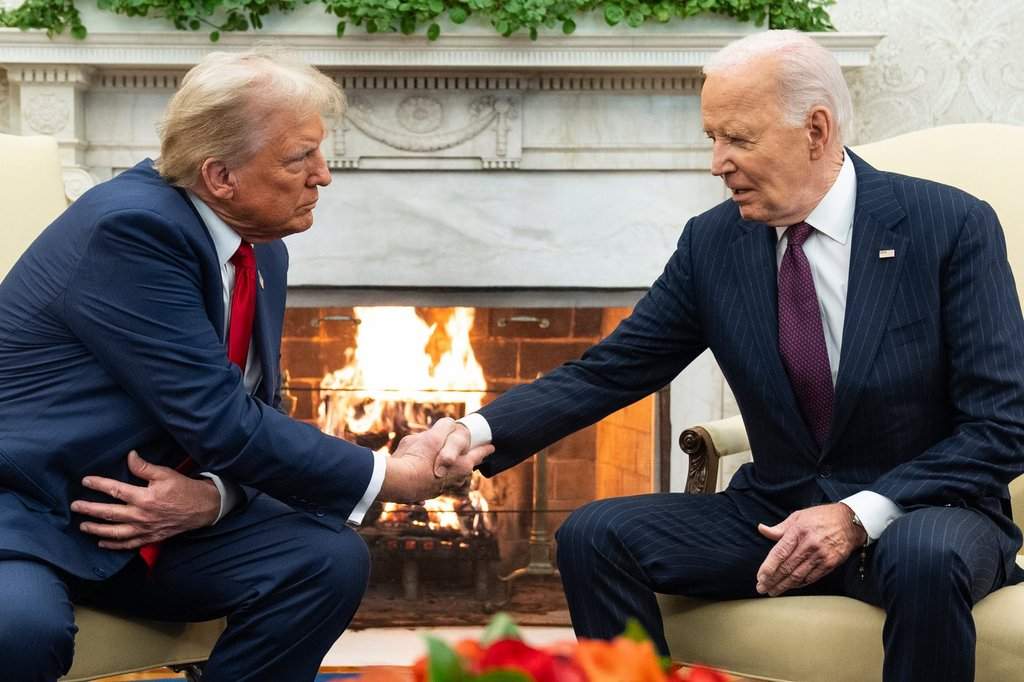
Joe Biden read that letter on his first afternoon as president, sitting in the very chair Trump had vacated hours earlier. Regardless of the fierce political battles that followed over the next four years—battles over legislation, courts, border policy, and eventually a dramatic rematch for the White House itself—that initial moment set a quiet baseline between two men who otherwise shared almost no common political ground.
Neither man ever released the full text of the letter to the press. Even when memoirs and investigative books peeled back the curtain on its contents, both Trump and Biden maintained a surprising degree of restraint around the physical document itself. Trump occasionally referenced it in interviews, noting that he had written a nice letter and wished Biden well, while Biden kept his promise not to divulge its exact wording without permission.
In an era where every private text message, angry email, and off-the-record phone call is weaponized within minutes for clicks and outrage, two bitter political rivals kept a secret together.
Stop and appreciate how rare that is.
We live in a culture of total exposure, where nothing is sacred if it can score points in the next news cycle. Yet the tradition started by Ronald Reagan on a whim in 1989 survived its hardest test precisely because both men understood that some things belong to the office, not the campaign.
The Empty Chair
Every four years, the moving vans come back.
The carpets in the Oval Office are swapped out. A new president chooses which bust sits near the fireplace—Lincoln or Churchill, Martin Luther King Jr. or Robert F. Kennedy—and decides whether to bring back the red drapes or stick with gold. The clocks keep ticking on the mantel, indifferent to party affiliation, measuring out the brief, frantic span of time each occupant gets to leave a mark before history sweeps them out into the hallway.
When the noise dies down and the pundits move on to the next outrage, what remains isn't the speeches or the cable news chyrons. It is the quiet continuity of the office itself—a single sheet of paper resting on dark oak, waiting for the next person brave or foolish enough to sit down and pick up the pen.