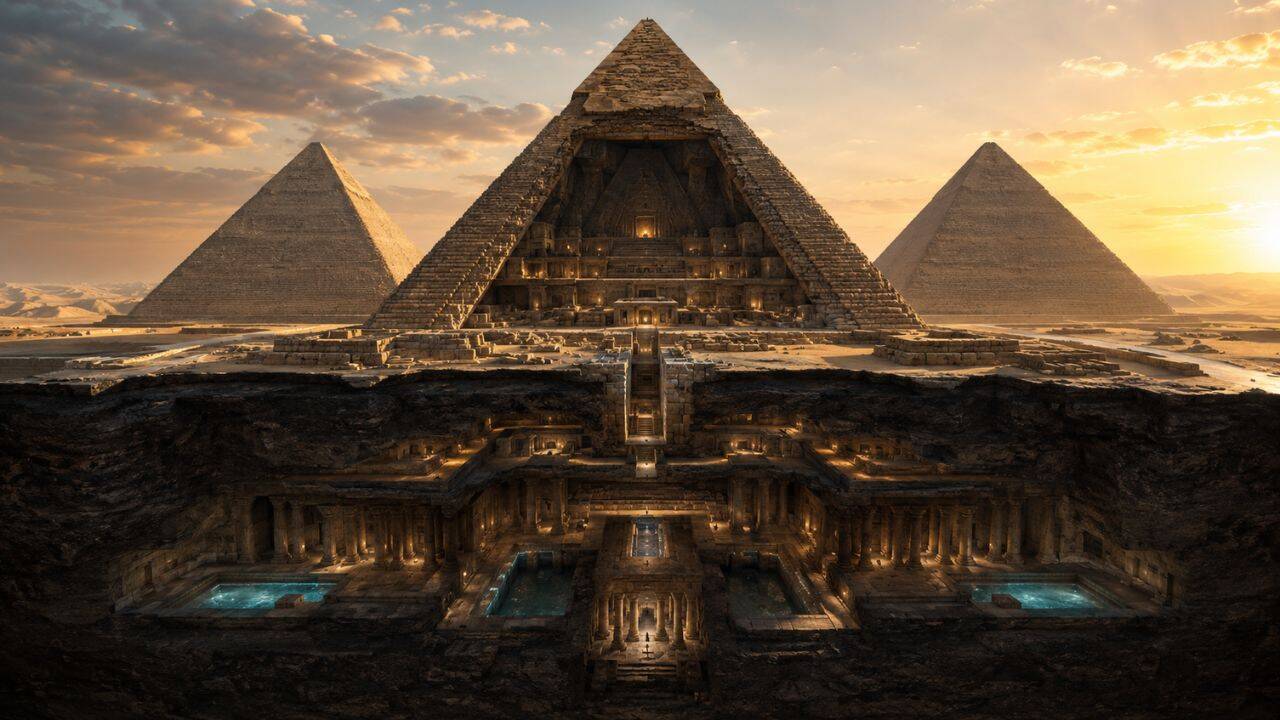
The desert does not like to give up its dead.
If you stand near the Western Cemetery of Giza just as the sun dips below the horizon, the wind carries a sound that is half-sigh, half-hiss. It is the friction of millions of quartz grains shifting across limestone. For forty-five centuries, this plateau has been scraped by thieves, mapped by emperors, and trampled by millions of tourists wearing sensible shoes. We collectively assumed we had broken its spirit. We thought we knew exactly what lay beneath the dust.
We were wrong.
In the shadow of the Great Pyramid, just beyond the neat rows of mastabas—the flat-roofed tombs of ancient elites—lies a patch of land that looks remarkably like nothing. It is a vacant lot of antiquity. For decades, archaeologists used it as a staging area, parking their trucks and pitching their equipment tents directly over it.
Then a team of researchers from Higashi Nippon International University, Tohoku University, and the National Research Institute of Astronomy and Geophysics in Egypt walked onto the dirt. They were not carrying shovels. They carried instruments that look like lawnmowers designed by science fiction writers.
They found a ghost.
What the Ground Kept Secret
To understand what happened next, you have to appreciate the sheer stubbornness of the Egyptian earth. The Giza plateau is not a uniform block of stone. It is a Swiss cheese of natural fissures, ancient quarry marks, forgotten shafts, and tunnels carved by tomb robbers who died thousands of years ago. Finding something specific here is like looking for a particular whisper in a crowded stadium.
Professor Motoyuki Sato and his team spent years dragging ground-penetrating radar and electrical resistivity tomography equipment across the blinding white expanse. These technologies do not produce crystal-clear photographs. They do not show you a golden sarcophagus waiting in the dark. Instead, they spit out jagged lines, graphs of resistance, and anomalies in the electrical current.
Imagine screaming into a deep canyon and trying to map the shape of the rocks purely by how the echo bounces back to your ears.
In 2024, the data started bouncing back strange.
Right there, under the flat, unremarkable ground next to the Western Cemetery, the instruments registered a massive structural blind spot. It was an anomaly of undeniable mathematical precision. Nature loves chaos; humans love straight lines. And these lines were remarkably straight.
The data revealed a two-tiered mystery. The first layer sits roughly six feet beneath the surface. It is an L-shaped structure, roughly thirty-three feet wide and forty-nine feet long. It is not an empty room. The radar indicates it was deliberately filled with fine, dry sand after it was built.
But it is what lies beneath the sand that makes the skin prickle.
Directly below this L-shaped structure, descending deeper into the bedrock, sits another anomaly. The instruments show a highly resistive mass. It could be a void. It could be a chamber packed with dense material. It reaches down to a depth of nearly thirty-three feet into the stone.
The upper structure appears to be a monumental gate, a deliberate ceiling, meant to block access—or perhaps to hide—whatever is waiting below.
The Weight of What We Do Not See
Consider the people who built this. We often view the ancient Egyptians through the lens of Hollywood or textbook glossaries, treating them as a monolithic workforce operating under a collective religious fever.
But look closer at the Western Cemetery. This was a neighborhood of the dead. It was a highly organized, deeply bureaucratic space where high-ranking officials, priests, and royal family members scrambled for real estate close to King Khufu’s pyramid. Space was a premium. Prestige was everything.
Why, then, was this specific plot left entirely empty on the surface?
Imagine a modern city street where every square inch is packed with luxury high-rises, except for one pristine, manicured plot of land that everyone refuses to build on. You would naturally ask what was buried underneath the asphalt.
The archaeologists working the site feel this tension daily. The heat at Giza is heavy, a physical weight that presses against your neck by nine in the morning. The dust gets inside your teeth, your watch, your camera lenses. You spend months moving centimeters at a time, your knees in the dirt, staring at screens that show gray blurs.
Most days yield nothing but broken pottery shards and the crushing realization that a previous excavator beat you to the spot a century ago.
But then the computer screen refreshes. The resistance numbers spike. You trace the shape with a dirty finger on a rugged monitor. An L-shape appears. You realize you are looking at something that no human eye has seen since the Old Kingdom.
The Fine Print of the Unknown
The discovery has sparked the predictable wave of internet hysteria. Speculation runs wild across social media platforms, with theories ranging from hidden treasuries of Khufu to extraterrestrial outposts.
The reality is far more grounded, though no less thrilling.
Archaeologists suspect the upper L-shaped structure may be an entranceway to a large mastaba tomb that was later built over or intentionally concealed. In ancient Egypt, the construction of a tomb was a race against time. A noble would begin building their eternal home the moment they secured power or wealth. If they died suddenly, the plans changed. If they fell out of political favor, their successors might literally erase them from the landscape, filling their monuments with sand and building over them.
There is also the very real possibility of disappointment. The lower anomaly could be a natural cave formation, a cavernous pocket in the limestone that the ancient builders encountered and decided to seal off out of fear or structural necessity. The plateau is riddled with such geological surprises.
This uncertainty is the hardest part of the job. Science moves at a glacial pace, especially when dealing with world heritage sites. You cannot simply bring in a backhoe and dig a hole to satisfy your curiosity. Every square centimeter must be meticulously mapped, permitted, and analyzed.
The team must wait. The world must wait.
The Shadows that Remain
We live in an era that feels entirely mapped. Satellites can zoom in on our backyards, and algorithms predict our next thoughts. We have developed a collective arrogance that there are no mysteries left on the surface of our planet.
Yet, a few hundred yards from the most heavily studied monument on Earth, a massive structural secret has been sitting quietly under the tires of parked SUVs for thousands of years.
It reminds us that history is not a closed book. It is a floor we are walking on, entirely unaware of the empty spaces beneath our feet.
The Giza sands will eventually be excavated at this new site. Shovels will break the crust. Brushes will sweep away the fine sand filling that upper L-shaped structure. We will find out whether the deep anomaly is a treasury, a forgotten royal burial, or merely an empty limestone cave.
Until then, the ghost remains in the data. It is a silent shape in the dark, waiting just beyond the edge of our headlights, proving that the ancient world is still very much alive, and still very capable of keeping us in suspense.