The grease under a mechanic’s fingernails smells different when the car is meant to die.
In a quiet workshop in Vilnius, Lithuania, a technician tightens a bolt on a standard, civilian SUV. It is the kind of vehicle you see idling in school pickup lines or parked outside grocery stores. It has a chipped bumper and a coffee stain on the passenger seat. But this vehicle is not going to the supermarket. It is being prepared for a zone where human presence is an invitation to tragedy.
For decades, the concept of military autonomy belonged to the realm of billionaires and defense conglomerates. We watched multi-million-dollar drones circle the sky, controlled by pilots sitting in air-conditioned trailers thousands of miles away. We marveled at custom-built, sci-fi tanks that cost more than the annual GDP of small towns.
We got it backward. The true evolution of the modern frontline isn't a purpose-built machine of war. It is an afterthought. It is the ability to take a discarded hatchback, a rusted pickup, or a dented delivery van, and give it a brain.
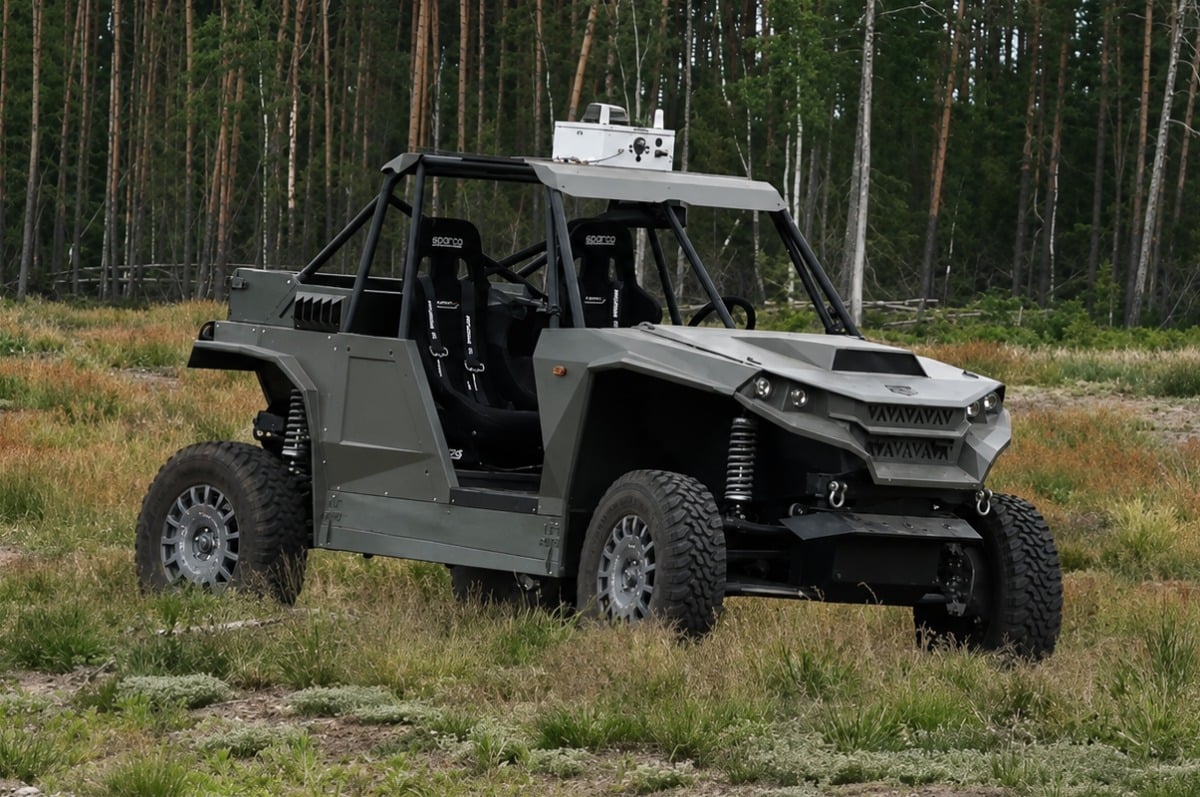
A Lithuanian defense firm recently demonstrated a kit that accomplishes exactly this. They can take any standard steering wheel, any pair of pedals, any basic internal combustion engine, and turn it into a remote-controlled robot in a matter of hours. No factories required. No specialized assembly lines. Just a black box, some actuators, and an internet connection.
This changes the calculus of survival.
The Economics of Blood and Iron
Consider a hypothetical driver named Tomas.
Tomas is twenty-four. He used to fix laptops in Kaunas, but now he sits in a concrete bunker, staring at three monitors. On his screens, he sees a dusty dirt road through the lens of a camera mounted to the hood of a beaten-up civilian sedan. His hands rest on a steering wheel identical to the one you use to drive to work, plugged into a computer via USB.
Two miles ahead of Tomas, that sedan is bouncing over potholes. It is loaded with medical supplies, fresh water, and ammunition.
If an artillery shell strikes that road, the sedan will disintegrate. A tire will fly into a ditch. The engine block will crack. The supplies will be lost.
But Tomas will stand up, stretch his back, drink a sip of cold coffee, and walk out of the bunker to smoke a cigarette. He will go home to his family.
Historically, resupply runs are among the most lethal assignments in any conflict zone. Convoys are slow, predictable, and loud. They are magnets for ambushes. When you look at the data from modern conflicts, a staggering percentage of casualties occur not during grand, coordinated offensives, but during the mundane, repetitive task of moving boxes from Point A to Point B.
The Lithuanian kit strips the human target out of the equation. It works by attaching mechanical limbs—glorified, highly precise motors—to the existing controls of a car. One motor pulls the brake. Another presses the accelerator. A geared belt loops around the steering column.
It is crude. It is beautiful. It is terrifyingly practical.
By using civilian vehicles, logistics teams solve two problems at once. First, they blend in. A military transport truck sticks out on a satellite feed like a flare in the dark. A twenty-year-old station wagon looks like background noise. Second, the financial math shifts entirely. A military-grade autonomous vehicle can cost upwards of half a million dollars. A used European sedan costs less than a decent laptop.
If it gets blown up, you don't call a congressional hearing. You just find another one on a classifieds website.
The Technical Reality Behind the Magic
How do you make a machine trust a civilian chassis?
The skepticism is natural. Anyone who has ever owned a used car knows they are temperamental beasts. One has a loose steering rack. Another has a brake pedal that requires you to pump it twice before it catches. A third pulls slightly to the left whenever you hit forty miles per hour.
The software inside these conversion kits has to be incredibly forgiving. It cannot assume it is operating a pristine, factory-calibrated machine. It learns the quirks of the vehicle in real-time.
When the operator moves the remote steering wheel five degrees to the right, the system monitors the vehicle's actual trajectory via GPS and onboard gyroscopes. If the car fails to turn enough because the tie-rods are worn out, the software instantly compensates, pulling harder. It treats the vehicle's mechanical failures as environmental variables, like wind or mud.
This brings up a question that often bugs engineers: why not just build cheap, purpose-built remote cars from scratch?
The answer lies in the global supply chain. If a custom military robot breaks a suspension arm in the field, that robot is dead until a specialized component arrives from a warehouse across the ocean. But if a converted civilian hatchback breaks a control arm, you can walk into any abandoned garage, strip the part off a civilian wreck with a crescent wrench, and have the machine running again before sundown.
The infrastructure already exists. The world is covered in gas stations, repair shops, and spare tires designed precisely for these vehicles. The Lithuanian firm didn't build a new tool; they built a parasite that can inhabit any host.
The Weight of the Invisible Driver
We need to talk about the psychological shift this causes.
There is a distinct human element to driving that we take for granted. When you are behind the wheel, you feel the road through your seat. You hear the engine straining before a hill. You notice the subtle slip of gravel under the rear tires.
Remote operators lose almost all of this sensory data. They are flying blind, relying entirely on a video feed that might have a fraction of a second of latency. A delay of three hundred milliseconds doesn't sound like much when you are loading a webpage. When you are driving a two-ton vehicle at fifty miles per hour toward a washed-out bridge, three hundred milliseconds is the difference between crossing safely and nose-diving into a ravine.
To bridge this gap, the software has to act as a translator. It filters out the noise but amplifies the danger signs. If the vehicle tilts past a certain angle, the operator's screen flashes red. If the engine overheats, an alarm sounds in the bunker.
But even with these safeguards, the experience is uncanny. Operators report a strange sense of dissociation. They are violently steering through mud, watching explosions on a screen, while hearing nothing but the hum of the server rack next to them and the fluorescent lights overhead.
It feels like a video game. But the stakes are profoundly real.
If the connection drops, the kit is programmed to execute a dead-man's switch. It doesn't just coast to a halt, leaving a valuable asset sitting in the middle of a road to be captured or analyzed. It can be set to lock the brakes, steer into a ditch, or follow a pre-programmed GPS path back to its starting point without any human intervention at all.
The Democratization of Autonomy
This technology exposes a deeper truth about the future of engineering: the hardware bottleneck is officially broken.
For a long time, the nation with the biggest factories won the technological race. If you couldn't forge specialized steel or manufacture complex microchips at scale, you were left behind. Today, the code is what matters. The physical world has become modular.
The implications stretch far beyond Eastern Europe. What happens when these kits become open-source? What happens when the components can be 3D-printed in a basement?
We are looking at a future where the distinction between a civilian tool and a military asset is entirely erased by a piece of software. A tractor in a field, a delivery van in the city, a garbage truck—all of them are just waiting for the right line of code to become autonomous actors.
It is a messy, uncertain reality. It forces us to look at the ordinary objects around us with a slight tinge of suspicion. That parked sedan on the corner, the one with the faded paint and the dented door—it might just be waiting for someone to log in from a bunker miles away.
The workshop in Vilnius is quiet again. The technician packs away his tools, wipes the grease from his hands, and closes the hood of the SUV. To anyone walking past the window, it looks like a standard tune-up. But as the garage door rolls down, the vehicle sits in the dark, its new digital veins wired into the steering column, waiting for the phantom turn of a wheel that no one in the room can see.