Silence.
That is the most terrifying sound in Southern California, especially when eighty thousand people are supposed to be screaming their lungs out inside a concrete bowl built for gladiators. If you have ever stood near the tunnel of the Los Angeles Memorial Coliseum on a crisp November afternoon, watching a fourth-quarter lead evaporate in three breathless plays, you know that specific quiet. It tastes like warm asphalt, stale beer, and the sudden, collective realization that the past is not coming back to save you.
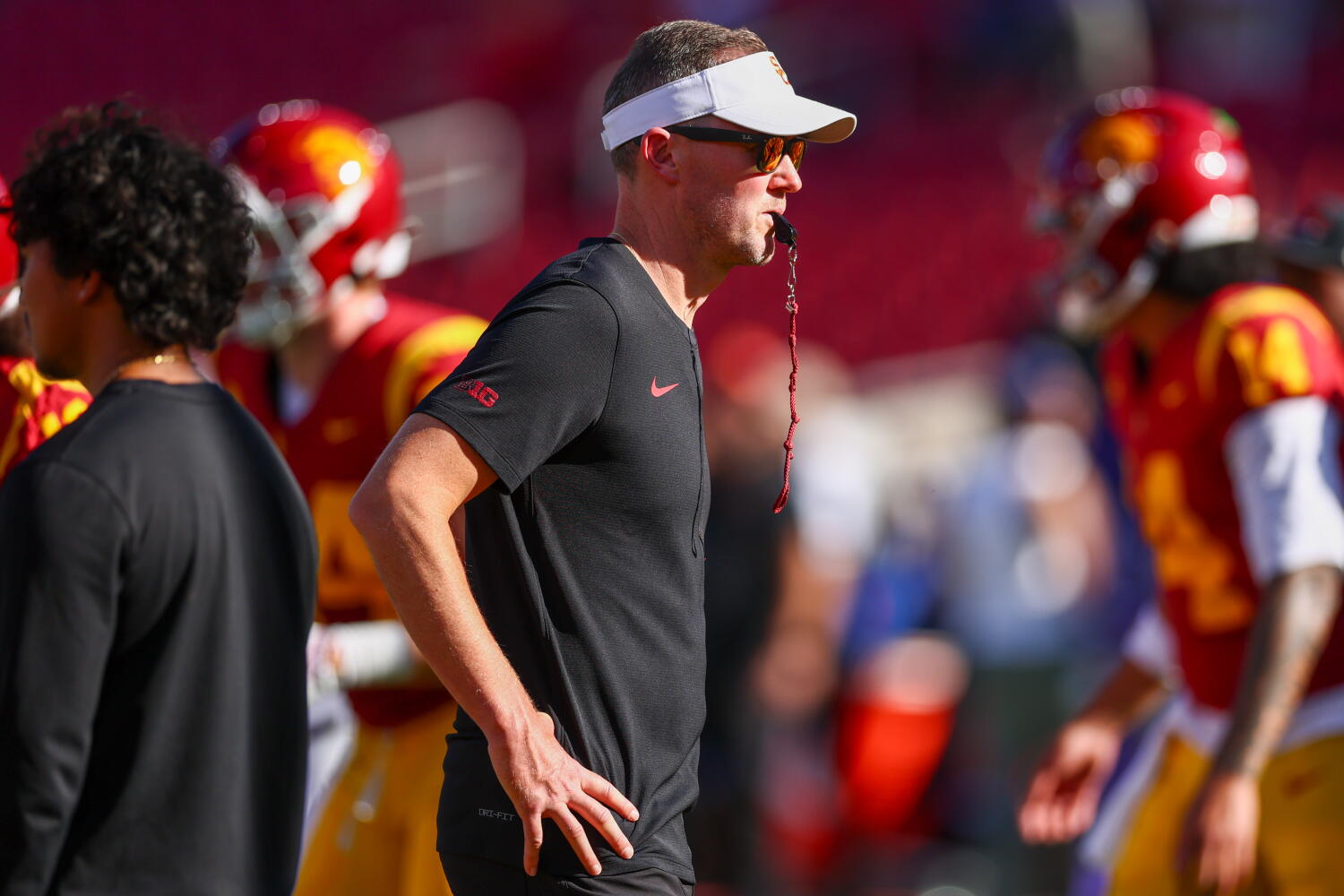
I have spent the better part of two decades covering college football from press boxes that smelled of burned coffee and from bleachers where the aluminum vibrated beneath my boots. I have watched dynasties rot from the inside out and watched saviors arrive on private jets, their smiles blinding in the midday sun. Yet nothing quite compares to the peculiar, boiling venom directed at Lincoln Riley.
To understand why the letters to the sports editor keep arriving—ink dripping with grievance, keyboards hammered until the plastic cracks—you have to look past the box scores. You have to look past the third-down conversion percentages and the missed tackles in the secondary. The debate surrounding USC’s head coach is no longer about football. It is a trial about memory, money, and the unbearable weight of a ghost that refuses to leave Los Angeles.
The Myth of the Instant Miracle
Rewind to November 2021. USC was wandering through a self-inflicted wilderness, bruised by administrative scandals, coaching carousels, and a stadium that often looked half-empty against mediocre competition. When athletic director Mike Bohn pulled off the heist of the century—luring Lincoln Riley away from the blue-blood comfort of Oklahoma—the city did not just celebrate. It exhaled.
Riley was the boy king of offensive football. He had sculpted three Heisman Trophy finalists in Norman. He possessed the kind of effortless, modern swagger that Hollywood understands instinctively. For a reported ten-year contract worth roughly $110 million, a private jet, and a sprawling mansion overlooking the Pacific, USC bought itself a time machine. They did not buy a rebuild; they bought an immediate resurrection.
And for twelve glorious months, the magic worked.
Caleb Williams arrived in Riley’s wake, spinning out of collapsed pockets like a greased-up magician, turning broken plays into forty-yard touchdowns. In 2022, USC went 11-3. Williams won the Heisman. The Coliseum roared again, shaking the peristyle arches with a sound that hadn't been heard since Pete Carroll roamed the sidelines in his crisp white sneakers.
Think of that first season like a crash diet that drops thirty pounds in a month. You look fantastic in the mirror, your friends shower you with compliments, and you throw away your old clothes. You convince yourself you are cured. What you ignore is that you haven't built a single ounce of muscle, your metabolism is quietly imploding, and the moment you eat a normal meal, the whole structure is going to collapse.
Riley had patched over a depleted, soft roster with elite transfer portal talent and a generational quarterback. He had masked the foundational rot of the program with sheer offensive fireworks. When the fireworks finally ran out of powder, the smoke cleared to reveal a terrifying truth: the house still had no foundation.
Anatomy of a Saturday Meltdown
Consider a hypothetical Saturday afternoon in the autumn of 2026, two years into USC’s grinding migration to the Big Ten.
Let us introduce a character—call him Arthur. Arthur is sixty-eight years old, a retired civil engineer from Pasadena who has held season tickets in Section 14 since the Reagan administration. He still wears a faded cardinal windbreaker with a stitched Trojan emblem over the heart. To Arthur, USC football is not entertainment; it is a civic religion, a direct bloodline connecting him to his late father, who took him to see O.J. Simpson run through the fog in 1968.
Arthur sits in his seat, watching the fourth quarter unfold against a visiting team from the Midwest—a team built on corn-fed offensive linemen, muddy jerseys, and four-yard gains that feel like slow suffocation. USC holds a ten-point lead with six minutes left. The offense, orchestrated by Riley’s brilliant mind, has moved the ball effortlessly for three quarters.
Then, the script flips.
USC gets the ball back, needing only two first downs to bleed the clock dry and seal the victory. Instead of handing the ball to a bruising tailback behind a physical line, Riley calls three consecutive pass plays. An incomplete slant. A blown protection that results in a nine-yard sack. A screen pass sniffed out before the receiver even turns his head. Punt. Two minutes off the clock.
The visiting team takes over, marches eighty yards in seven plays—converting a fourth-and-six over the middle where two Trojan linebackers collide with each other—and scores the winning touchdown with nineteen seconds left.
Arthur does not throw his drink. He does not scream profanities at the twenty-year-old kids walking off the turf. He simply folds his arms, stares at the empty green grass, and goes home to write a letter to the sports editor.
When readers send scathing emails demanding Riley’s head, journalists often dismiss them as irrational fanatics. They are wrong. Those letters are grief counseling in disguise. Arthur is not angry because USC lost a football game; he is angry because he watched his team lose its identity. For half a century, USC football meant imposing your physical will on the opponent. Under Riley, the Trojans became a delicate track team playing a collision sport, capable of scoring fifty points on a Friday night and getting bullied in a phone booth on Saturday afternoon.
The Structural Flaw Nobody Wanted to See
To understand how a certified offensive genius ended up as the most polarizing figure in college sports, you have to look at the stubbornness that accompanies brilliance.
Every great architect has a blind spot. For years, Riley’s blind spot had a name: Alex Grinch. Despite mounting statistical evidence across both Oklahoma and Los Angeles that his defensive coordinator’s scheme produced missed tackles, blown coverages, and historical collapses—culminating in a 2023 season where USC’s defense ranked near the very bottom of the entire Football Bowl Subdivision—Riley clung to his loyalty. He defended the indefensible in post-game press conferences, his jaw tight, his answers clipped, treating legitimate questions about physicality as personal insults.
Even after he finally made the painful decision to part ways with Grinch and hire D'Anton Lynn away from rival UCLA—a move that immediately injected competence, structure, and toughness into the defense—the damage to Riley’s public persona was already etched in stone.
Look at the cold, hard numbers of the Lincoln Riley era after that magical 2022 debut:
- A dizzying slide from 11-3 in 2022 to 8-5 in 2023, followed by a bruising 7-6 debut in the Big Ten in 2024 that required a late bowl-game rally just to finish above .500.
- A disturbing pattern of late-game collapses, repeatedly surrendering fourth-quarter leads against ranked opponents and unranked spoilers alike.
- A glaring disconnect between elite offensive efficiency and baffling clock management when protecting a lead.
I remember sitting in a media room after one of those stinging fourth-quarter losses, watching Riley field questions under the harsh fluorescent lights. Up close, away from the glossy recruiting graphics and the sun-drenched practice fields, he looked exhausted. Not the tired of a man who didn't work hard—by all accounts, Riley sleeps in his office and obsesses over film until dawn—but the tired of a man realizing that the rules of the game have changed beneath his feet, and his old magic tricks no longer fool the crowd.
The Big Ten Reality Check
When USC left the Pac-12 for the Big Ten, the move was sold as a financial masterstroke. More television revenue, bigger national stages, deeper recruiting footprints. What the spreadsheets failed to calculate was the sheer physical tax of that transition.
Playing in the old Pac-12 was like fencing in a brightly lit ballroom; speed, space, and finesse ruled the night. Playing in the Big Ten is like getting locked in a basement with someone holding a lead pipe. You do not fly to Ann Arbor, Columbus, or State College in November and win purely with clever route combinations and perimeter screens. You win at the line of scrimmage, in the cold, when your fingers are numb and the opponent knows exactly what play you are going to run and dares you to stop them anyway.
Riley built a Maserati for the Pacific Coast Highway, only to find himself entered in a demolition derby in the Midwest.
This is where the "hate" mentioned in the sports pages transforms from mere frustration into something much darker and more personal. Fans look at the $110 million contract. They look at the buyout figure—a staggering sum north of $80 million that effectively makes Riley untouchable regardless of the record—and they feel trapped. In the modern era of college athletics, where fans are openly asked to donate their own hard-earned money to Name, Image, and Likeness collectives just to keep competitive rosters together, patience has evaporated.
If you ask a working-class alumnus to chip in five hundred dollars so a nineteen-year-old defensive tackle can afford a nicer apartment, that alumnus stops viewing the head coach as a beloved leader. He views him as an overpaid executive failing to deliver a return on investment.
The Thin Line Between Genius and Hubris
Let us pause here and admit something uncomfortable, because honesty requires us to step outside the echo chamber of sports talk radio: firing Lincoln Riley right now would likely be catastrophic for USC.
I know how unpopular that sentence is in certain corners of Southern California. When the blood is up and the letters to the editor are flying, nuance is the first casualty. People want blood. They want the dramatic press conference, the interim coach, the clean slate.
Yet history is littered with programs that burned down their own houses because they hated the color of the paint. Look at Nebraska after firing Bo Pelini, or Tennessee wandering through a fifteen-year desert after ousting Phillip Fulmer, or Texas churning through Charlie Strong and Tom Herman before finally finding stability. Stability in college football is not a luxury; it is oxygen.
Riley’s flaws are glaring, undeniable, and maddening. He can out-think himself on third-and-short. He sometimes treats the running game like a chore he has to finish before he is allowed to play with his passing concepts. His press conferences can feel guarded, overly manicured, devoid of the raw accountability that fans crave when their hearts are broken on a Saturday night.
And yet, the man can still coach offense better than ninety-nine percent of the human beings walking the earth. Under his guidance, backup quarterbacks look like All-Americans. Four-star receivers turn into first-round draft picks. When USC finally marries Riley’s offensive architecture with genuine, sustained trench warfare on both sides of the ball, the ceiling isn't just a bowl game in Las Vegas—it is the College Football Playoff.
What the Letters Are Really Saying
The tragedy of the Lincoln Riley era so far is not a lack of talent, nor is it a lack of effort. It is a clash of expectations born from an impossible promise.
USC hired a savior when they needed a carpenter. They wanted the glamour of 2004 without the years of bruised knuckles and unglamorous recruiting battles it took Pete Carroll to build that juggernaut. And Riley, seduced by the bright lights and the historic pedestal, believed he could skip the dirty work and go straight to the parade.
Both sides are now paying the interest on that loan.
Every Monday morning, the letters still arrive in the sports editor's inbox. Some demand his immediate firing. Others defend him fiercely, pointing to recruiting rankings and defensive improvements as proof that the corner is finally being turned. The bitterness between the two camps is real because the stakes feel existential. USC is a proud institution fighting desperately to prove it is not a museum piece—that its greatest days are not trapped forever in grainy highlight reels of Reggie Bush leaping into the end zone.
Walk past the Coliseum on a Tuesday morning, when the tourists are gone and the campus is quiet. Look up at the Olympic cauldron, cold and still above the stone arches. The stadium does not care who is making ten million dollars a year, and it does not read the letters in the morning paper. It simply waits for Saturday, indifferent and massive, ready to swallow whole anyone who mistakes flash for substance.