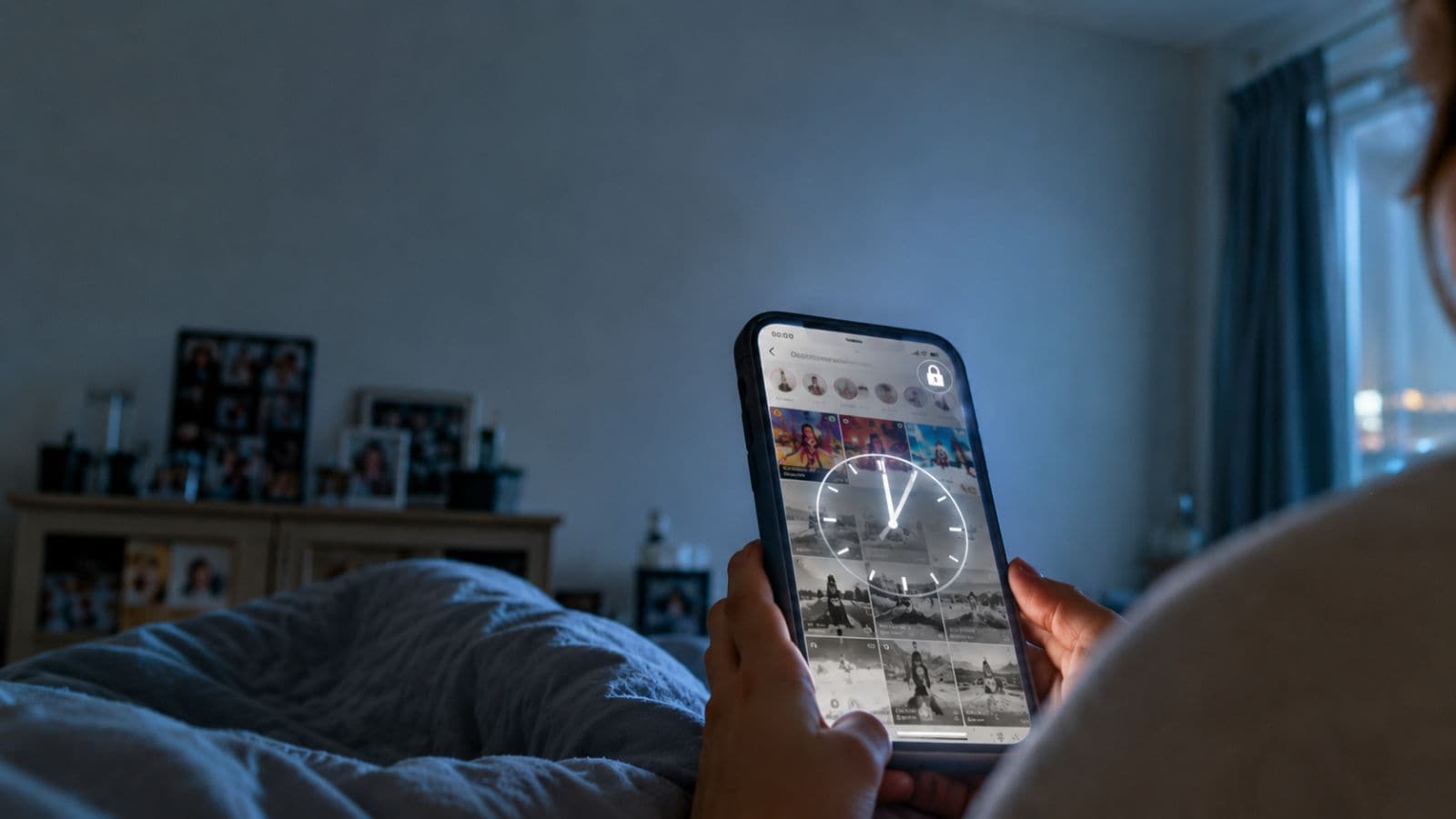
Midnight. The house is entirely still. The floorboards do not creak. The refrigerator hums its low, mechanical song from the kitchen. Down the hallway, a sliver of blue-white light escapes from underneath a closed bedroom door. It is not the warm, amber glow of a reading lamp, nor the shifting shadows of a television screen. It is the sterile, hypnotic luminescence of an infinite feed.
Inside that bedroom sits a fifteen-year-old child. Let us call her Maya, though she could just as easily be your son, your niece, or the kid across the street. Maya’s eyes are fixed. Her thumb moves in a practiced, mechanical twitch—up, up, up. A dance video. A sarcastic rant about high school chemistry. A stylized summary of a movie she has never seen. Her brain is soaking in a torrential downpour of dopamine, courtesy of an algorithm designed by some of the sharpest minds on the planet to ensure she never, ever looks away.
She is exhausted. Her eyelids feel like sandpaper. Her algebra test is in seven hours. She knows she should sleep. But she cannot stop. The architecture of the screen has conquered the architecture of her will.
For years, we have watched this happen with a mixture of horror and helpless paralysis. We told ourselves it was just a phase. We blamed bad parenting. We suggested turning off the Wi-Fi router at ten o'clock, as if a motivated teenager could not bypass a firewall with a paperclip and sheer desperation. We treated smartphone addiction like a bad habit, akin to chewing fingernails or leaving wet towels on the floor.
It is not a bad habit. It is an engineering triumph. And the architects are finally starting to sweat.
Meta recently floated a proposal that sounds almost absurdly reasonable on the surface. They want to put a curfew on teenage scrolling. A digital bedtime. A hard stop where the servers go quiet for minors, locking them out of Instagram and Facebook until the sun comes up.
Stop for a moment and consider the sheer irony of the situation. The arsonist is walking into the room carrying a fire extinguisher, asking if we would like help putting out the blaze.
Why now? Why would a multi-trillion-dollar corporation, whose entire business model relies on extracting every available second of human attention, willingly suggest turning off the tap for its most vulnerable users? Because the walls are closing in. Lawsuits are piling up in courtrooms across the country, stacked high with internal documents proving what whistleblowers whispered for years: tech companies knew their products were damaging young minds, and they optimized them anyway. The pressure is mounting. Public outrage is no longer a low murmur; it is a roar.
Yet, the moment Meta suggests locking the door after dark, a more pressing question hangs in the humid air of the digital age. Will TikTok and YouTube follow?
To answer that, you have to understand how these platforms make their money. They do not sell software. They sell time. Your time. Your children's time. Every minute a teenager spends watching a makeup tutorial or a hyperactive gaming streamer is a minute monetized through targeted advertising. If TikTok pulls the plug at midnight while Meta keeps the lights on, teenagers will simply migrate. Digital natives are remarkably adaptable creatures; they will follow the dopamine wherever the servers are still humming.
This creates a terrifying prisoner's dilemma. No single tech giant wants to blink first. If YouTube implements a curfew and loses two billion hours of teenage nocturnal engagement to competitors, their shareholders will riot. Voluntary self-regulation in the attention economy is about as reliable as asking a casino to turn off the slot machines at two in the morning because the patrons look tired.
Unless, of course, everyone is forced to do it. Or unless the public narrative shifts so dramatically that failing to act becomes a fatal corporate liability.
Think about what actually happens to a teenage brain in the dead of night. During the day, there is friction. Teachers interrupt. Friends demand eye contact. Sunlight forces a baseline reality check. But at two in the morning, that friction vanishes. The prefrontal cortex—the part of the brain responsible for impulse control, long-term planning, and weighing consequences—is still under construction in adolescents. It will not finish building until they reach their mid-twenties.
When you pit an under-construction adolescent brain against a supercomputer engineered by behavioral psychologists, the outcome is not a fair fight. It is a slaughter.
The consequences spill far beyond mere tiredness. Pediatricians are seeing an epidemic of chronic sleep deprivation that mimics clinical exhaustion. Anxiety rates have spiked in lockstep with smartphone adoption curves. The nocturnal hours are particularly cruel because they are intensely private. In the dark, isolation mixes with curated perfection. Maya scrolls past dozens of peers living seemingly flawless lives, wondering why her own reality feels so fractured, so messy, so entirely inadequate. The midnight scroll is a loneliness machine.
So when a tech titan suggests a curfew, our first reaction should not be gratitude. It should be intense, probing skepticism.
What does a curfew actually look like in practice? Does it mean the app locks completely, or does it just lower the resolution? Does it apply to everyone under eighteen, or can a teenager simply tap a button saying "I am an adult" with zero verification, exactly the same way they bypass age restrictions on pornography websites?
If the proposed curfews are porous—if they are designed more for public relations than for actual protection—they are worse than useless. They are a fig leaf. They provide cover for executives to stand before congressional committees and declare, "Look, we solved the problem," while the glowing blue light continues to spill out from underneath bedroom doors across the world.
We have been down this road before with other industries. We watched tobacco companies fund their own safety studies. We watched social media platforms introduce "screen time reminders" that users quickly learned to swipe away like annoying gnats. Every time the public catches up to the harm, the industry invents a new vocabulary of concern. They talk about digital well-being, mindful scrolling, and balanced ecosystems.
They use every word in the dictionary except the correct one: addiction.
If TikTok and YouTube decide to follow Meta down this path, it will not be out of the goodness of their corporate hearts. It will be because they read the tea leaves, saw the oncoming freight train of regulation, and decided to salvage what they could of their public reputations. They want to be seen as responsible stewards before the government steps in and writes rules so strict they cannot evade them.
But waiting for Silicon Valley to save our children from Silicon Valley is a fool's errand.
The real power does not rest in a boardroom in Menlo Park or Beijing. It rests in the quiet, awkward, sometimes agonizing conversations happening across kitchen tables. It rests in the willingness of parents to be the bad guys, to confiscate devices at bedtime, to endure the eye-rolls and the teenage sighs of absolute devastation.
Back in that dark hallway, the sliver of blue light remains. Maya is still watching. She is waiting for the next video to load, searching for a connection that the algorithm promises but never quite delivers.
The servers hum on. The morning light is still hours away. And the choice of whether to open that door, to step into the room, and to reclaim the night remains entirely our own.