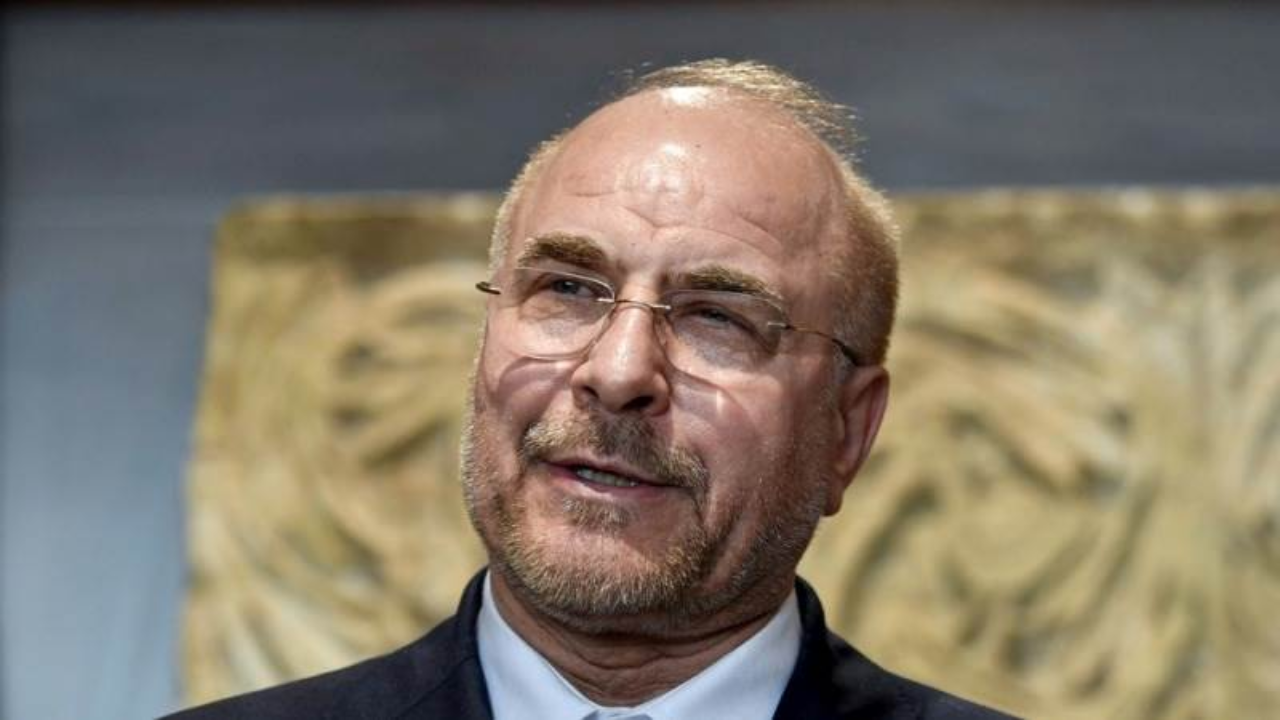
Mohammad Bagher Ghalibaf represents the transition of the Islamic Republic from a purely ideological revolutionary state to a "Securitized Technocracy." While Western observers frequently mislabel him as a "moderate" due to his pragmatic rhetoric or a "hardliner" due to his Revolutionary Guard (IRGC) pedigree, neither label captures his functional utility to the Iranian power structure. Ghalibaf is the primary architect of a governance model that seeks to preserve the clerical system by optimizing its administrative efficiency and military-industrial integration. This model—The Ghalibaf Doctrine—posits that the survival of the regime depends not on ideological purity alone, but on the state’s ability to deliver infrastructure and security while negotiating from a position of "Rational Defiance."
The current Iranian political landscape is defined by a vacuum between the aging clerical elite and a disillusioned youth population. Ghalibaf’s strategic positioning is designed to fill this gap by presenting a "Neo-Principalist" framework. This framework prioritizes three operational pillars: the militarization of civil management, the centralization of the legislative-executive feedback loop, and the use of tactical diplomacy to alleviate economic bottlenecks without compromising the core tenets of the 1979 Revolution.
The Triple Constraint of the Ghalibaf Presidency
To understand Ghalibaf’s potential trajectory, one must analyze the three structural constraints that dictate his decision-making. These are not merely political preferences; they are the boundaries of his operational reality.
- The Legitimacy Deficit: Participation in recent Iranian elections has hit historic lows. Ghalibaf’s primary mandate is to restore a "Performance-Based Legitimacy." Unlike the reformists who promised social liberalization, Ghalibaf promises a "Khaljih-style" (Gulf-style) development model—authoritarian efficiency coupled with tangible infrastructure projects.
- The Sanction-Induced Fiscal Trap: Iran’s economy suffers from a structural reliance on oil exports that are systematically throttled by the U.S. Treasury. Ghalibaf’s strategy involves "Sanctions Neutralization" rather than "Sanctions Removal." This distinguishes him from the Rouhani era; he seeks to build internal supply chains that make the cost of Western pressure higher for the West than for Iran.
- The Succession Shadow: The most critical variable in Iranian politics is the eventual succession of the Supreme Leader. Ghalibaf is positioning himself as the "Stabilizing Hand"—the figure who can manage the IRGC’s interests during a period of high systemic vulnerability.
The Mechanics of Securitized Technocracy
Ghalibaf’s tenure as Mayor of Tehran and Speaker of the Parliament provides a longitudinal data set for his governance style. He operates on the principle of "Command and Control Infrastructure." In this model, the distinction between a military operation and a civilian public works project is erased.
The IRGC-Municipality Pipeline
During his time as Mayor, Ghalibaf pioneered the use of IRGC-linked firms, such as Khatam al-Anbiya, for massive urban projects. This created a symbiotic relationship where the military gained economic depth, and the city gained the ability to bypass traditional bureaucratic hurdles. The cost of this efficiency is a lack of transparency and the entrenchment of a "Shadow Economy." For a data-driven analyst, the takeaway is clear: a Ghalibaf-led executive branch would accelerate the transfer of state assets to the military-industrial complex under the guise of "national development."
The Legislative Hammer
As Speaker of the Parliament (Majlis), Ghalibaf transformed a traditionally consultative body into a proactive roadblock for "soft" diplomacy. He was instrumental in passing the "Strategic Action Plan to Lift Sanctions," which mandated an increase in uranium enrichment. This was not a move of irrational aggression, but a calculated "Leverage Optimization." By hardening Iran’s nuclear position through law, he provided the Iranian negotiating team with a "Good Cop/Bad Cop" dynamic, where the diplomats could claim their hands were tied by a defiant legislature.
The Dealmaker Myth vs. Tactical Pragmatism
The comparison between Ghalibaf and Donald Trump is conceptually flawed because it ignores the institutional constraints of the Iranian Velayat-e Faqih system. Trump operated as an insurgent against his own bureaucracy; Ghalibaf is the ultimate product of his bureaucracy. However, the "Dealmaker" label persists because Ghalibaf understands the "Transaction Cost of Resistance."
He views the Joint Comprehensive Plan of Action (JCPOA) not as a bridge to the West, but as a "Variable-Rate Contract." When the benefits (sanctions relief) outweigh the costs (nuclear restrictions), he is a proponent. When the contract is breached, he advocates for "Maximum Pressure Reciprocity."
The Cost Function of Iranian Foreign Policy
Ghalibaf’s foreign policy can be expressed as an optimization problem. He seeks to minimize the Probability of Kinetic Conflict ($P_c$) and the Rate of Economic Contraction ($R_e$) while maximizing Regional Strategic Depth ($D_s$).
$$V = \frac{D_s}{(P_c \times R_e)}$$
Under this logic, a deal with the West is only valuable if it increases the total value of $V$. If a deal requires sacrificing $D_s$ (support for regional proxies like Hezbollah), Ghalibaf will reject it, as he views $D_s$ as the primary deterrent against $P_c$. This is a fundamental departure from the "Global Integration" model favored by Iranian moderates.
The Internal Friction of the Hardline Coalition
Ghalibaf’s ascent is not unopposed within the conservative camp. He faces a "Purity Challenge" from the more radical, ideological elements often associated with the Paydari (Stability) Front. These groups view his pragmatism as a "Creeping Liberalism" or, more accurately, as a "Corrupt Technocracy."
The primary point of friction is the Transparency vs. Efficiency Trade-off. Ghalibaf’s career has been dogged by allegations of financial irregularities in the Tehran Municipality. For the Paydari hardliners, these represent a moral failing. For Ghalibaf, they represent the necessary cost of doing business in a sanctioned economy. This internal rivalry will be the defining feature of the next Iranian administration, as the "Hardline" label is not a monolith but a spectrum ranging from ideological purists to securitized technocrats.
The Strategic Shift: From Defensive to Proactive
Ghalibaf’s potential presidency represents a shift from a "Defensive Crouch" to a "Proactive Consolidation." This is not a liberalization, nor is it a blind march toward war. It is an attempt to build a "Fortress Iran" that can survive the transition of its supreme leadership while maintaining a high-threshold deterrent against its adversaries.
The Ghalibaf Doctrine can be broken down into three specific phases of implementation:
- Administrative Centralization: Streamlining the relationship between the IRGC and the Executive branch to eliminate the "dual state" friction that characterized the Khatami and Rouhani eras. This involves placing military-aligned technocrats in key economic ministries.
- Infrastructure-as-Diplomacy: Leveraging Iran’s geography to become a transit hub for the International North-South Transport Corridor (INSTC) and China’s Belt and Road Initiative (BRI). By making Iran indispensable to the Eurasian trade network, Ghalibaf seeks to create a "Geopolitical Shield" that Western sanctions cannot penetrate.
- Calibrated Escalation: Using the nuclear program as a "Negotiating Tether." He will push enrichment levels to the brink of weaponization not to build a bomb, but to force the West into a "Functional Normalization" where they accept a "Nuclear-Threshold Iran" in exchange for regional stability.
Tactical Playbook: The Ghalibaf Presidency
If Ghalibaf consolidates executive power, his first 100 days will focus on "Systemic De-risking." He will likely introduce a series of "Economic Resilience" laws designed to further integrate the Iranian banking system with non-Western alternatives like the BRICS Pay system. This is a move toward a "Post-Dollar Hegemony" reality.
For foreign observers and policymakers, the Ghalibaf presidency will be the most difficult to counter. Unlike the ideological radicals, he speaks the language of management and deliverables. Unlike the moderates, he has the full backing of the security apparatus. He is the "Competent Hardliner"—a profile that represents the most significant challenge to the Western strategy of "Maximum Pressure" to date.
The "Ghalibaf Effect" on the oil market will be one of "Structured Volatility." He will not attempt to flood the market but will use Iranian production capacity as a tool for "Energy Diplomacy," trading guaranteed supply for long-term infrastructure investment from Asian powers. This is a shift from selling oil for cash to selling oil for "National Durability."
The strategic move for external actors is to recognize that Ghalibaf is not seeking a return to the 2015 JCPOA. He is seeking a "Security-Centric Settlement." This means any future negotiation will not be about "behavior change," but about "risk management." The Ghalibaf administration will be defined by its ability to maintain the status quo through superior administrative and military coordination, making the cost of regime change prohibitively high for any internal or external actor.
Would you like me to map the specific IRGC-linked companies that would benefit most from a Ghalibaf-led administrative centralization?