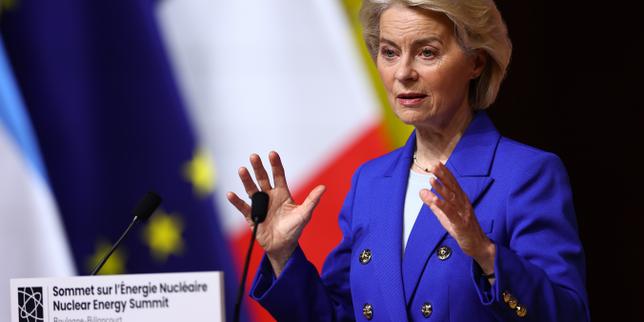
Germany’s refusal to listen to Ursula von der Leyen regarding nuclear power isn't a principled stand for the environment. It is a slow-motion act of economic self-immolation that is dragging the rest of the European Union into the dark. While Berlin patting itself on the back for shuttering its last three reactors, the reality on the ground is far more cynical: they’ve traded carbon-free, reliable baseload power for a volatile mix of Russian gas (now laundered through intermediaries) and the dirtiest coal on the continent.
The "lazy consensus" suggests that Germany is simply undergoing a "difficult transition" toward a renewable future. That is a lie. You cannot run a G7 industrial economy on intermittent breezes and hope. By killing its nuclear fleet, Germany has effectively signaled the end of its status as an industrial powerhouse.
The Lignite Lie
When the German government claims to be a leader in the energy transition, or Energiewende, they conveniently skip over the data regarding lignite. Lignite is the "brown coal" that is significantly more carbon-intensive and polluting than hard coal.
I have seen energy traders in Frankfurt laugh at the "green" labels applied to German electricity. On a day when the wind doesn't blow—a phenomenon known as Dunkelflaute—Germany’s carbon intensity spikes to levels that make the United States look like a tropical rainforest. They are currently burning more coal than they have in years to compensate for the missing 4,000-plus megawatts of nuclear capacity they retired in a fit of post-Fukushima hysteria.
Nuclear power provides a steady, predictable supply of electricity. This is what engineers call "baseload." Without it, the grid becomes fragile. To stabilize a grid reliant on solar and wind, you need massive battery storage that does not yet exist at scale, or you need "peaker" plants. In Germany’s case, those peaker plants burn gas.
Follow the Money and the Physics
The German ideological obsession with killing nuclear power has a direct cost: the highest electricity prices in the industrialized world. If you are a CEO of a mid-sized manufacturing firm in Baden-Württemberg, your energy bill is now a death warrant. We are seeing a massive flight of capital. German industry is moving to the U.S. and China, not because they want to, but because they can no longer afford to turn the lights on at home.
The physics are stubborn.
$$E = mc^2$$
The energy density of nuclear fuel is orders of magnitude higher than anything else we possess. A single uranium pellet the size of a gummy bear contains as much energy as a ton of coal or 149 gallons of oil. When Berlin ignores this, they aren't being "progressive." They are being scientifically illiterate.
Why von der Leyen Is Actually Right
The European Commission President is often a target for criticism regarding over-regulation, but on nuclear, she is the only adult in the room. She recognizes that the "Green Deal" is a mathematical impossibility without nuclear energy.
The German "no" to von der Leyen is framed as a democratic choice. It’s actually a hostage situation. Because the European power grid is interconnected, Germany’s instability is exported. When Germany doesn't produce enough power, it sucks energy from its neighbors. When it produces too much wind power on a stormy Tuesday, it dumps that excess into the Polish and Czech grids, threatening to blow their transformers.
Germany is the neighbor who refuses to fix their plumbing but expects you to let them use your shower every morning.
The Myth of the "Nuclear Waste Problem"
The most common argument used by the German Greens is the "unsolved" problem of nuclear waste. This is a ghost story designed to frighten people who don't understand volume. All the spent fuel produced by the U.S. nuclear industry over the last 60 years would fit on a single football field stacked less than 10 yards high.
Compare that to the waste from "green" energy. Solar panels contain lead, cadmium, and other heavy metals. They have a lifespan of 20 to 25 years. We are currently facing a mountain of millions of tons of non-recyclable solar waste by 2050. Where is the German outrage for that? It doesn't exist, because solar panels look like progress, whereas a cooling tower looks like a 1950s nightmare.
The Geopolitical Suicide
By dismantling its nuclear infrastructure, Germany didn't just hurt its economy; it surrendered its sovereignty. For decades, the German plan was to use cheap Russian gas as the "bridge" to a renewable future. That bridge didn't just collapse; it was blown up.
Now, instead of restarting their perfectly functional reactors—which would have taken mere months of technical preparation—they are building LNG terminals at record speed to import fracked gas from America and Qatar.
Let’s be clear: Importing gas across an ocean to burn it for electricity is objectively worse for the planet than running a domestic nuclear plant. The methane leakage from the LNG supply chain alone negates any "green" gains Germany claims to be making.
The Real Cost of "Safety"
The German public is terrified of a meltdown. Let’s look at the numbers. Nuclear energy is, statistically, the safest form of power generation ever devised.
| Power Source | Deaths per TWh (estimated) |
|---|---|
| Coal | 100 |
| Oil | 36 |
| Natural Gas | 4 |
| Solar | 0.44 |
| Wind | 0.15 |
| Nuclear | 0.07 |
More people die falling off roofs installing solar panels or falling from wind turbines every year than have been killed by nuclear power in the history of the European industry. The German "exit" is a policy based on vibes, not variables.
The Coming Blackout of Reason
I have sat in boardrooms where executives discuss "de-industrialization" as a foregone conclusion for Central Europe. They aren't planning for a green future; they are planning for an exit. When the manufacturing base of Europe—the steel, the chemicals, the automotive parts—leaves for cheaper shores, the tax base goes with it.
You cannot fund a generous social safety net on the tax revenue of a few artisanal vegan bakeries and some software startups. You need heavy industry. And heavy industry needs reliable, cheap, high-density power.
Stop Asking if Nuclear is Green
The question isn't whether nuclear is "green." It is. The EU has already labeled it as such in its taxonomy. The real question is: Why is Germany allowed to sabotage the entire continent’s climate goals to satisfy the internal polling of a minority political party?
The German "Non" to von der Leyen isn't a victory for the environment. It is a victory for coal, a victory for gas, and a victory for every global competitor watching Europe dismantle its own competitive advantage.
The lights aren't just going out in the reactors. They are going out on the German dream of being a rational, science-led nation. If you want to see the future of energy, don't look at Berlin. Look at the countries actually building: the UAE, China, and even a resurgent France. Germany is no longer a leader; it is a cautionary tale of what happens when romanticism replaces engineering.
Stop pretending this is a debate about safety. It is a debate about whether Europe wants to remain a museum of 20th-century ideas or a functioning 21st-century economy. Germany has made its choice. It chose the museum.
Don't let them take the rest of the continent down with them.


