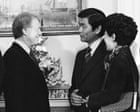
George Ariyoshi just died at 100, and the obituary writers are already tripping over themselves to polish the same old plaque. They call him the "first Asian American governor." They talk about "representation." They frame his career as a victory for identity politics before the term even existed.
They are missing the entire point of his life and his legacy.
To view Ariyoshi through the lens of a "first" is to treat a master tactician like a diversity hire. It’s a lazy, reductionist take that ignores the cold, hard mechanics of how power actually shifted in the mid-20th century. If you think Ariyoshi’s rise was about a change in social sentiment, you haven't been paying attention to how political machines are built.
Ariyoshi didn't break a glass ceiling. He built a new house.
The Consensus Is Wrong About Power
The standard narrative suggests that Hawaii naturally evolved into a progressive paradise where an AJA (American of Japanese Ancestry) candidate could finally succeed. This is a comforting lie.
Power is never given; it is seized through the control of labor and the strategic use of bureaucracy. Ariyoshi wasn't a symbol of a changing Hawaii; he was the primary architect of its consolidation. While his predecessor, John A. Burns, was the visionary who broke the "Big Five" (the white-owned corporations that ruled the islands), Ariyoshi was the operator who turned that rebellion into a permanent, unshakeable establishment.
The "first" label is a distraction. It suggests that the most important thing about Ariyoshi was his bloodline. In reality, the most important thing about him was his ability to discipline a state’s economy into a specific, controlled shape. He wasn't a trailblazer for identity; he was the high priest of Growth Management.
The Land Use Strategy No One Understands
Most people hear "land use" and their eyes glaze over. That’s why they fail in politics and business. Ariyoshi understood that in a finite geography like Hawaii, land use is the only game in town.
During his three terms (1974-1986), Ariyoshi implemented some of the strictest land-use laws in the United States. The "lazy consensus" says he did this for environmentalism. That is a partial truth at best.
The reality? He used land-use policy as a tool of centralized economic control.
By restricting where and how development could happen, he ensured that the state—and by extension, the Democratic Party of Hawaii—held the keys to every major business venture in the islands. If you wanted to build, you didn't just need capital. You needed a relationship with the machine.
This wasn't about "preserving the Aina" in a vacuum. It was a masterclass in limiting supply to ensure that the existing power structures maintained their leverage. I’ve seen developers in the modern era try to replicate this level of control with "sustainable growth" initiatives, but they lack Ariyoshi’s clarity. He wasn't hiding behind buzzwords. He was openly stating that the state should decide the limits of growth.
The Japanese American "Quiet Style" Was a Weapon
Critics and historians often describe Ariyoshi’s demeanor as "low-key" or "stolid." They mistake a lack of charisma for a lack of force.
In the world of high-stakes governance, the loudest person in the room is usually the one with the least actual leverage. Ariyoshi utilized a cultural archetype—the disciplined, humble public servant—to mask an incredibly aggressive legislative agenda.
While the mainland was reeling from the post-Watergate distrust of government, Ariyoshi was expanding the state’s footprint into every facet of life. He didn't need to be a populist firebrand. He had the unions. He had the land board. He had the budget.
If you’re waiting for a "charismatic leader" to change your industry or your state, you’re looking for a performer. Ariyoshi was a technician. Technicians win because they don't care if you like them; they only care if you are dependent on the systems they manage.
Why Representation Is a Failed Metric
We are currently obsessed with "firsts." Every time a person of color or a woman takes a high-ranking position, we treat the event itself as the victory.
Ariyoshi’s career proves that representation is the beginning of the work, not the end. If he had merely been "the first Asian American governor" and nothing else, he would be a footnote in a history book about sociology. He is a giant because of what he did with the office:
- He institutionalized the Democratic machine. He moved it from a rag-tag group of veterans and union organizers into a professionalized, permanent governing class.
- He diversified the economy (on his terms). He pushed for high-tech and alternative energy decades before they were trendy, not because he was a futurist, but because he knew tourism was a volatile, fickle master.
- He managed the "Ariyoshi 100." He lived to a century by maintaining the same discipline in his private life that he used to stifle political opposition.
If you are a leader today, stop asking how to "break barriers." That’s a reactive mindset. Start asking how to create new systems of dependency.
The Brutal Truth of the Hawaii Model
Hawaii’s current economic stagnation—the brain drain, the insane cost of living, the regulatory capture—is the direct descendant of the Ariyoshi era. This is the part the obituaries won't tell you.
His "controlled growth" policies worked too well. By creating a system where the state has the final say on everything, he created a paradise for insiders and a nightmare for entrepreneurs. The high cost of entry for any new business in Hawaii is a feature of the system he perfected, not a bug.
This is the trade-off. You get stability, you get a seat at the table, and you get "representation." In exchange, you give up the dynamism of a free market. Ariyoshi chose stability. He chose the machine.
I have watched dozens of CEOs try to "disrupt" highly regulated markets by being the loudest voice in the room. They fail. They get chewed up by the "Ariyoshis" of the world—the quiet bureaucrats who have spent forty years mastering the internal rules of the game.
Stop Looking for Trailblazers
The lesson of George Ariyoshi isn't that "anyone can make it." The lesson is that if you want to hold power for twelve years and influence a state for fifty, you must be willing to be boring.
You must be willing to focus on the minutiae of the State Land Use Commission rather than the optics of the evening news. You must be willing to prioritize the longevity of the institution over the immediate gratification of a "win."
Ariyoshi’s death marks the end of an era of serious, disciplined, and often ruthless governance. We replaced it with a culture of "influencer" politicians who care more about their "first" status than their ability to actually move the levers of the state.
He didn't represent a "new" Hawaii. He was the one who made sure the old power didn't just disappear, but simply changed clothes.
If you want to honor the man, stop talking about his heritage and start studying his tax policies. Stop looking at his face and start looking at his maps.
The man lived to 100 because he knew how to conserve energy and how to expend it only when it resulted in total control. That isn't a story of "breaking barriers." It’s a manual for building a fortress.
Study the fortress. Or get used to living outside its walls.