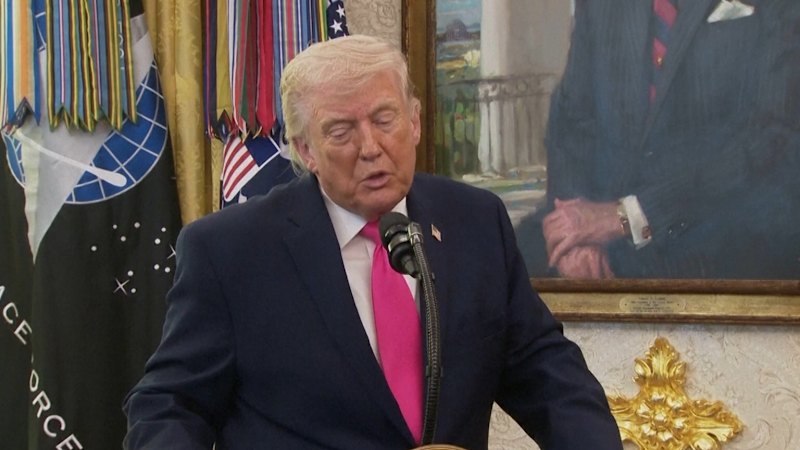
Donald Trump claims Iran gave the United States a "gift." The mainstream media is currently obsessing over the optics of this statement, debating whether it’s a sign of weakness or a masterstroke of "Art of the Deal" diplomacy. They are both wrong. They are playing checkers while the regional architecture is being rewritten in ink that hasn’t dried yet.
Calling a calculated military pause a "gift" isn't just colorful rhetoric; it’s a fundamental misunderstanding of how Islamic Republic strategy operates. It assumes that Tehran acts out of charity or fear. In reality, what Trump calls a gift is a tactical pivot designed to preserve their long-term proxy network while the West gets distracted by the next news cycle.
The Myth of the Submissive State
The "lazy consensus" among pundits suggests that Iran backed down because they were terrified of a specific set of sanctions or a singular kinetic threat. This perspective is dangerously myopic. If you’ve spent any time analyzing the Quds Force or the way the Supreme Leader navigates the "Gray Zone," you know that Tehran doesn't "back down." They recalibrate.
When a superpower views a lack of immediate explosions as a "gift," it creates a false sense of security. It’s the equivalent of a CEO seeing a competitor stop a marketing campaign and assuming they’ve gone bankrupt, rather than realizing the competitor is actually retooling their entire product line for a hostile takeover.
The reality? Iran’s "gift" was a strategic breathing room. By lowering the temperature, they ensured the survival of their most critical assets. This wasn't a surrender; it was a maintenance break.
Why "Maximum Pressure" is a Misnomer
The term "Maximum Pressure" sounds impressive in a press briefing. In practice, it often functions as a pressure cooker with a broken valve. I’ve seen analysts in DC argue that economic strangulation leads to regime change. History—and the current state of the Rial—suggests otherwise.
Extreme economic pain doesn't always lead to a popular uprising that favors Western interests. Often, it just consolidates power within the most radical elements of the IRGC (Islamic Revolutionary Guard Corps). They control the black markets. They control the smuggling routes. When the formal economy dies, the shadow economy—and the people who run it—become the only game in town.
By labeling their temporary restraint as a "gift," Trump inadvertently validates the idea that the US is reactive. We are waiting for them to move so we can characterize it, rather than setting the tempo ourselves.
The Cost of Predictability
In geopolitics, predictability is a liability. If Tehran knows that a slight reduction in hostility will be met with "gift" rhetoric and a softening of the immediate stance, they will use that rhythm to their advantage.
- Cycle of Provocation: Launch a minor strike or seize a tanker.
- Cycle of De-escalation: Pull back just enough to avoid a full-scale war.
- The Pivot: Collect the "gift" of time and eased tension to move assets into Lebanon, Yemen, or Iraq.
This is not a win for the West. It is a managed stalemate that favors the party with the most patience. And if there is one thing the Iranian leadership has, it is a timeline that spans decades, not four-year election cycles.
The Proxy Shell Game
The competitor article ignores the most vital component: the proxies. While the headlines focus on what Trump said about Iran directly, the real action is happening in the periphery.
Imagine a scenario where a corporation claims it has settled its legal disputes, but its subsidiaries are still filing lawsuits under different names. That is the Iranian "gift." While the central government in Tehran might offer a rhetorical or tactical lull, their "subsidiaries"—Hezbollah in Lebanon, the Houthis in Yemen, and various militias in Iraq—remain fully funded and operational.
To call this a gift is to ignore the fact that the bullets being fired at US interests are still being manufactured in the same factories. We are congratulating ourselves on the tiger not biting us today, while ignoring the fact that its cubs are eating our lunch.
The Trap of the "Big Deal"
Everyone wants the "Big Deal." The grand bargain that fixes the Middle East forever. It’s a fantasy sold by diplomats to justify their own existence.
The status quo is not a problem to be "fixed" with a single treaty or a lucky "gift" from an adversary. It is a condition to be managed. When we frame international relations in terms of gifts and favors, we move away from the cold, hard logic of national interest and into the realm of ego-driven negotiation.
The "brutally honest" answer to the "People Also Ask" questions regarding Iranian intent is simple: They want the US out of the region. Every move they make is filtered through that lens. If "giving a gift" helps move that needle by making the US feel like the job is done, they will give that gift every single time.
Real-World Mechanics of the "Gift"
If you want to understand what’s actually happening, stop reading the transcripts and start looking at the shipping manifests and the centrifuges.
- Enrichment Levels: If enrichment continues while the rhetoric softens, the "gift" is a distraction.
- Missile Proliferation: If the range of the drones being exported increases during a "lull," the "gift" is a smokescreen.
- Regional Integration: If Tehran is signing trade deals with Beijing while the US is talking about "gifts," the "gift" is a strategic diversion.
Stop Looking for a Exit Ramp
The biggest mistake Western leaders make is assuming the other side wants the same "exit ramp" we do. We assume everyone wants to return to a globalized, peaceful trade order.
The Iranian hardliners don’t want your exit ramp. They want the highway. They view tension not as a hurdle, but as a tool for domestic mobilization. When the US calls a tactical pause a "gift," it signals that we are looking for a way out. It tells the adversary that our "Maximum Pressure" has a shelf life, and that our patience is thin.
If you are an investor, a policy-maker, or just an informed citizen, you need to recognize that in this theater, there are no gifts. There are only concessions, traps, and tactical pauses.
The moment you think your enemy is doing you a favor is the moment you’ve already lost the next round. Stop thanking them for the "gift" and start wondering why they want you to feel so grateful.
The "gift" isn't the peace we think we're getting; the gift is the blindfold they just handed us.
Take the blindfold off. Look at the proxies. Look at the enrichment. Ignore the "gift" and watch the hands.