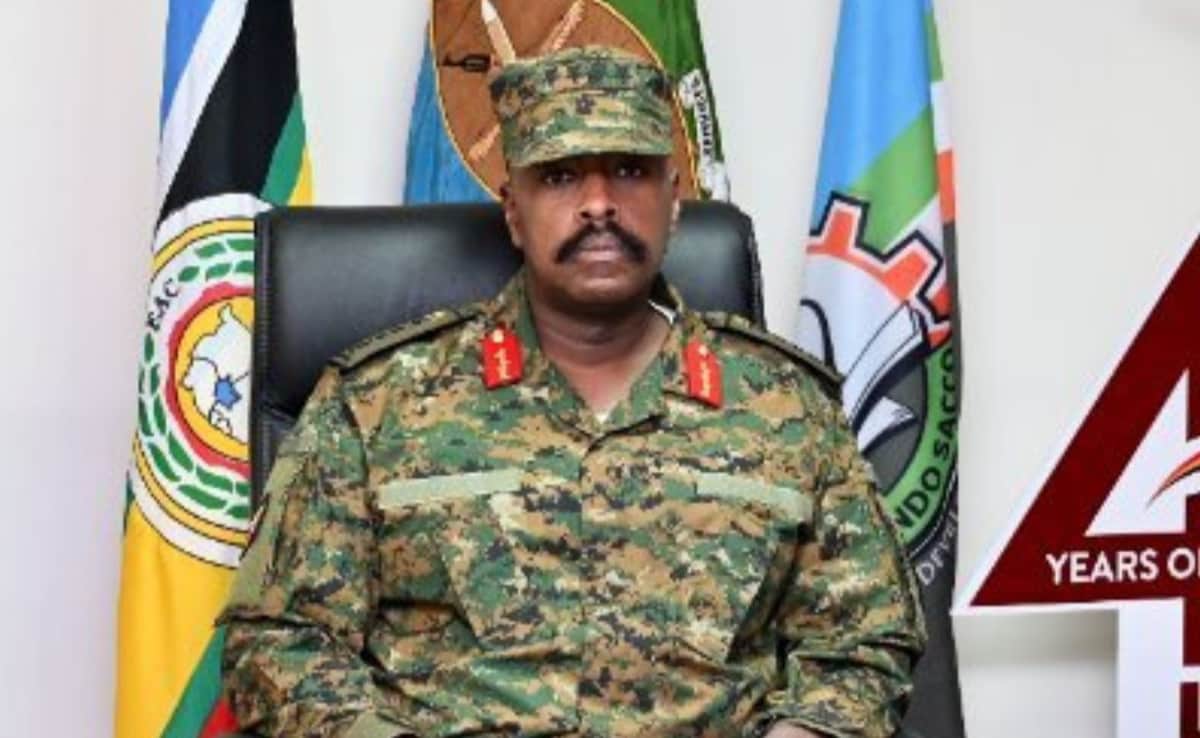
The recent public overture by General Muhoozi Kainerugaba, Chief of Defence Forces (CDF) of the Uganda Peoples' Defence Forces (UPDF), directed toward the Turkish government, serves as a high-stakes case study in non-traditional diplomacy and the personalization of statecraft. By articulating a specific "price" for his support—composed of a $1 billion investment and a symbolic marriage alliance—Kainerugaba departs from the standard vernacular of international relations to engage in a form of hyper-transactionalism. This approach functions less as a formal diplomatic request and more as a stress test of Turkey’s expanding influence in the Horn of Africa and the Great Lakes region.
Analyzing this event requires moving past the superficial eccentricity of the social media posts to examine the structural incentives at play. The proposal identifies two distinct classes of capital: liquid financial assets ($1 billion) and social-political legitimacy (the marriage proposal). Each serves a specific function within the internal logic of the Ugandan military-political complex. Don't forget to check out our earlier article on this related article.
The Financial Calculus of the $1 Billion Request
The demand for a $1 billion investment from Turkey represents a calculated assessment of Turkey’s "entry fee" into the Ugandan security sector. Turkey has aggressively positioned itself as an alternative to traditional Western and Chinese partnerships in Africa, utilizing a mix of defense exports (specifically Bayraktar TB2 drones) and infrastructure development.
- Capital Injection for Defense Modernization: The UPDF is currently engaged in multi-theatre operations, including the ongoing "Operation Shujaa" against the Allied Democratic Forces (ADF) in the Democratic Republic of Congo. A $1 billion liquidity event would allow for a rapid scaling of hardware procurement, shifting the dependency from aging Soviet-era inventory to modern Turkish aerospace and electronic warfare systems.
- Economic Diversification and Dependency Mapping: Uganda’s external debt is largely concentrated in Chinese and multilateral institutional holdings. By soliciting a massive, singular investment from Ankara, the Ugandan defense leadership is attempting to create a geopolitical hedge. This creates a competitive environment where Turkey must weigh the cost of the billion-dollar outlay against the long-term strategic benefit of securing a primary foothold in one of East Africa’s most stable military apparatuses.
- The Utility of Direct Investment: Unlike World Bank or IMF loans, which are tethered to governance benchmarks and transparency requirements, bilateral military-adjacent investments often operate with higher degrees of executive discretion. The $1 billion figure is likely not a random integer but a valuation of the perceived "loyalty" or "exclusivity" Kainerugaba is offering to the Turkish state.
Marriage as a Mechanism of Social-Political Alliance
The second component of the General’s proposal—the request for a "beautiful wife" from Turkey—is frequently dismissed as social media bluster. However, within the framework of historical statecraft and regional political culture, this represents the Kinship-Statecraft Model. If you want more about the background of this, NBC News provides an informative breakdown.
In traditional governance structures, particularly those where power is centralized and personalized, marriage is the ultimate instrument of de-risking a partnership. A matrimonial alliance between the leading military figure of a sovereign nation and a representative of a foreign power serves three technical functions:
- Information Asymmetry Reduction: Family ties create internal communication channels that bypass formal bureaucratic friction.
- Asset Lock-in: It signals a "blood commitment" that is significantly harder to dissolve than a standard memorandum of understanding (MoU).
- Symbolic Parity: By asking for a wife, Kainerugaba is asserting a status of parity with Turkish leadership. It is a demand for social integration into the Turkish elite, rather than a subordinate "client-state" relationship.
The phrasing—"most beautiful woman"—is a rhetorical device used to heighten the perceived value of the exchange. It elevates the transaction from a cold procurement deal to a romanticized alliance of civilizations.
The Turkey-Uganda Geopolitical Pivot
Turkey’s presence in Africa has grown exponentially since 2005, driven by the "Africa Opening" policy. Ankara sees Uganda as the gateway to the African Great Lakes. For Turkey, the Muhoozi proposal creates a complex decision matrix.
The Opportunity Cost of Non-Engagement
If Turkey ignores the overture, it risks alienating the heir apparent to the Ugandan presidency. In personalized regimes, the personal feelings of the military chief often dictate national procurement policy. A snub could lead the UPDF to pivot toward competitors like Iran or Russia, who have shown a willingness to engage in similar transactional diplomacy without the pretense of Western-style decorum.
The Risks of Transactional Diplomacy
Engaging with the "Muhoozi Model" presents significant reputational and operational risks for Ankara.
- Institutional Instability: Relying on the whims of a single individual rather than institutional treaties makes the relationship vulnerable to sudden shifts in that individual’s temperament or political standing.
- Diplomatic Protocol Breakdown: Formal diplomacy is designed to be predictable. When a military chief uses Twitter to bypass the Ministry of Foreign Affairs, it creates a precedent that can lead to chaotic policy-making and unpredictable escalations.
Strategic Divergence in Communication Styles
The contrast between Turkey’s measured, institutional response and Kainerugaba’s disruptive, direct-to-consumer communication reveals a gap in diplomatic maturity. Turkey operates as a middle power with aspirations of global leadership; it must adhere to certain norms to maintain its standing in NATO and the UN. Kainerugaba, conversely, utilizes "Diplomatic Disruption," a strategy where a smaller actor creates noise to force a larger actor to the negotiating table.
This disruption serves to:
- Test Turkey's Sincerity: It forces Ankara to decide if their "strategic partnership" with Africa is merely rhetorical or if they are willing to engage with the actual power players on their own terms.
- Internal Power Consolidation: By projecting himself as an international figure capable of demanding billions from global powers, Kainerugaba reinforces his image as a powerful, autonomous leader to his domestic constituency.
Mapping the Outcome of the Billion-Dollar Gambit
The success of this strategy is measured not by whether Kainerugaba receives a wife or exactly $1 billion, but by the shift in the gravity of the bilateral relationship. The proposal has already achieved the following:
- Forced Recognition: Turkey can no longer view Uganda through a generic "East Africa" lens; it must now address the specific demands of the military leadership.
- Market Signaling: Other regional powers (Kenya, Rwanda, Ethiopia) are now observing Turkey’s reaction. If Turkey yields to any part of this demand, it sets a floor for future negotiations across the continent.
The core tension remains the friction between Turkish institutionalism and Ugandan personalization. Turkey is unlikely to fulfill the proposal in its literal form, as doing so would compromise its international standing. However, the proposal acts as a "high anchor" in a negotiation. By asking for $1 billion and a wife, Kainerugaba makes a $200 million drone deal and a high-level state visit look like a conservative compromise.
The strategic play for Turkey is to ignore the matrimonial request while fast-tracking the economic and military components of the deal. By rebranding the $1 billion "request" as a "joint infrastructure and defense fund," Ankara can satisfy the financial appetite of the Ugandan military without appearing to succumb to an unorthodox social demand.
For Uganda, the play is to maintain the pressure of unpredictability. The CDF has effectively signaled that his loyalty is for sale, but the price is not merely financial—it is a demand for total recognition as a global peer. This transition from "regional partner" to "transnational power broker" is the true objective of the Kainerugaba doctrine. Future interactions will be defined by whether Turkey can provide enough "prestige capital" to satisfy an actor who no longer finds traditional diplomatic rewards sufficient.
The UPDF will likely continue to use these public-facing demands to gauge which global powers are most desperate for a foothold in the Nile Basin. Those who can navigate the eccentricity to find the underlying material request will secure the next decade of defense contracts in the region. Turkey's next move—specifically the volume of military hardware promised in the next fiscal quarter—will be the true answer to Kainerugaba’s public demand.