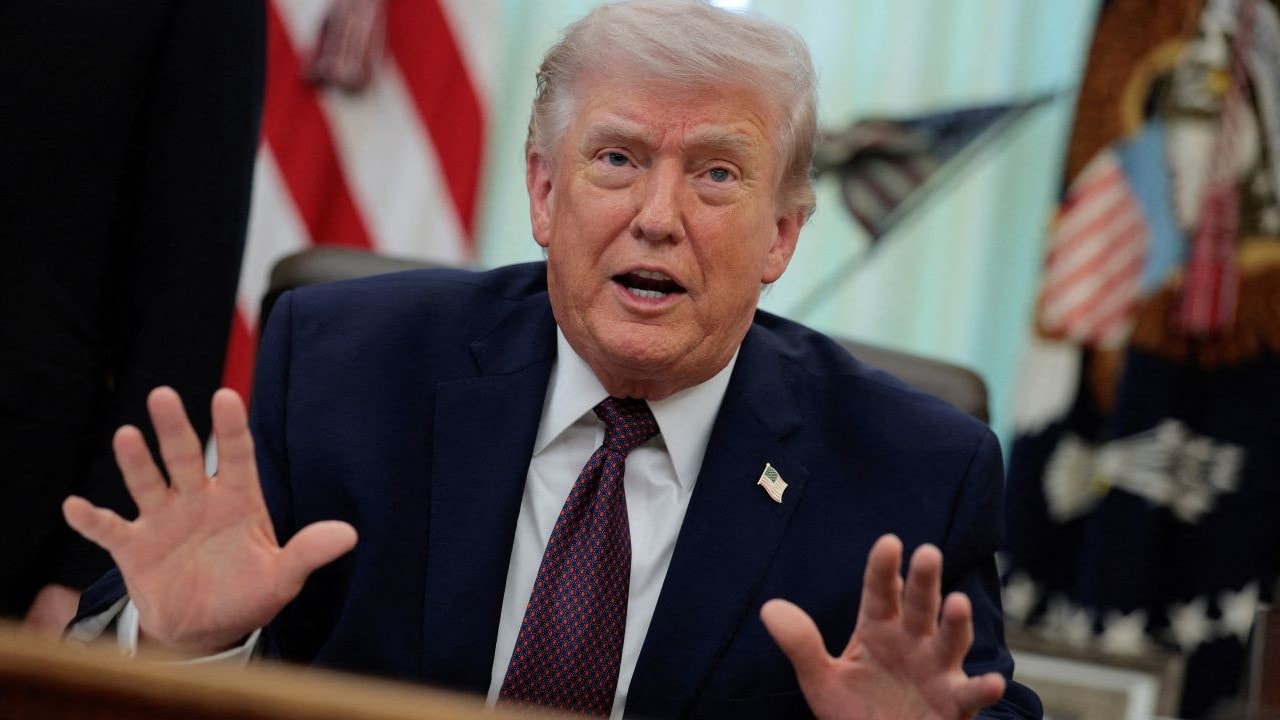
The security of the Strait of Hormuz is not a regional preference but a global economic necessity defined by a singular, rigid constraint: approximately 21 million barrels of oil and significant volumes of Liquified Natural Gas (LNG) transit this 21-mile-wide choke point daily. President Trump’s 'Project Freedom' initiative represents a shift from passive regional containment to an active, tech-integrated escort and deterrence model. By examining the operational friction of the Strait, the economic cost functions of maritime insurance, and the tactical deployment of autonomous systems, we can map the actual efficacy of this policy beyond the headlines.
The Choke Point Calculus
To understand why Project Freedom is being initiated, one must first quantify the vulnerability of the Strait. It is a geographic bottleneck where the shipping lanes consist of two-mile-wide channels for inbound and outbound traffic, separated by a two-mile-wide buffer zone. This proximity to the Iranian coastline subjects commercial vessels to a specific set of asymmetrical threats:
- Fast Inshore Attack Craft (FIAC): Small, high-speed vessels used for swarming tactics.
- Limpet Mines and Unmanned Underwater Vehicles (UUVs): Low-signature explosives that target hulls.
- Electronic Warfare (EW): GPS spoofing that can drive a vessel into territorial waters, creating a legal pretext for seizure.
The primary objective of Project Freedom is to reduce the "Risk Premium" applied to these transits. Currently, the cost of moving goods through the Strait is dictated by War Risk Insurance premiums. When a single tanker is seized or a hull is breached, these premiums can spike by 100% to 500% within 24 hours. Project Freedom aims to flatten this volatility by establishing a permanent, US-led security "tunnel" that guarantees safe passage through physical presence and technical overwatch.
The Three Pillars of Maritime Sovereignty
The initiative functions through three distinct operational layers designed to counteract asymmetrical threats.
1. The Autonomous Perimeter
Instead of relying solely on billion-dollar destroyers to play "zone defense," Project Freedom emphasizes the deployment of high-endurance Unmanned Surface Vessels (USVs) and aerial drones. These platforms create a persistent sensor mesh. By utilizing computer vision and automated signal intelligence (SIGINT), the US Navy can identify "dark ships"—vessels that have turned off their Automatic Identification System (AIS) to conduct illicit maneuvers—miles before they reach the commercial lanes.
2. Kinetic Deterrence and The Escalation Ladder
The policy establishes clear red lines regarding "hostile intent." Historically, maritime engagement rules have been reactive, requiring a vessel to be fired upon before a response is authorized. Under Project Freedom, the threshold for intervention is lowered to "interference with navigation." This allows US escorts to employ non-kinetic electronic jamming or physical interception the moment a threatening craft enters a defined safety bubble around a commercial tanker.
3. Diplomatic Burden-Sharing
A critical component of this strategy is the "User-Pays" logic. The US provides the command-and-control infrastructure, but participating nations—specifically those whose energy security depends on the Strait (Japan, South Korea, and India)—are expected to provide the hulls or the funding. This shifts the Strait from a "US-guarded lake" to an internationalized utility, reducing the political friction of American presence in the Middle East.
Economic Impact and The Cost Function of Security
The success of Project Freedom is measured by the delta between the cost of the military operation and the savings in global energy prices. A total closure of the Strait of Hormuz is estimated to send oil prices toward $150 or $200 per barrel. However, even "gray zone" harassment—short of total closure—adds a "friction tax" to every gallon of gasoline.
The logic follows a basic cost function:
$C_{total} = C_{freight} + C_{insurance} + C_{risk_delay}$
Project Freedom targets $C_{insurance}$ and $C_{risk_delay}$. By providing a predictable, escorted schedule (reminiscent of the 1980s "Operation Earnest Will"), the US removes the uncertainty that insurers use to justify high premiums. If a ship knows it will be met at the entrance of the Gulf of Oman and escorted to the Persian Gulf, the "risk of seizure" variable drops toward zero.
Technological Limitations and The Salami Slicing Tactic
No security framework is absolute. The primary risk to Project Freedom is not a full-scale naval battle, but "Salami Slicing"—a series of small, non-lethal provocations that are each too insignificant to warrant a military strike but collectively undermine the perception of safety.
- Cyber-Kinetic Hybrid Attacks: If an adversary can hack the ballast system of a tanker via remote malware, no amount of physical escort can prevent the ship from listing or blocking a channel.
- Swarm Density: There is a mathematical limit to how many targets a single Aegis-equipped vessel can track and engage simultaneously. If an adversary launches 50 low-cost suicide drones at a single high-value tanker, the cost-exchange ratio favors the attacker.
Project Freedom attempts to solve this via "distributed lethality," spreading defensive capabilities across many smaller, cheaper platforms rather than a few massive ones.
Strategic Realignment of Energy Flows
The announcement of Project Freedom also serves a secondary purpose: it signals a long-term US commitment to the fossil fuel infrastructure of the Middle East, even as domestic US production remains high. This provides a "floor" for regional stability. When the US guarantees the Strait, it effectively subsidizes the stability of the global manufacturing chain, particularly in Asia.
This creates a geopolitical leverage point. By controlling the security of the Strait, the US maintains a "kill switch" over the energy supplies of its primary economic rivals. If a nation refuses to participate in the Project Freedom framework or acts against US interests, their tankers may find themselves outside the protected "tunnel," suddenly facing the full weight of unmitigated market risk and physical threat.
Tactical Execution and Logistics
The rollout of the project involves the establishment of forward-operating bases for drone maintenance in allied nations like the UAE and Bahrain. The operational cadence follows a strict 72-hour cycle:
- Intelligence Prep: Satellites and high-altitude drones map every vessel in a 200-mile radius.
- The Assembly: Commercial vessels gather in "protected clusters" at the mouth of the Strait.
- The Transit: A "shield" of USVs and manned destroyers surrounds the cluster, using EW to jam any incoming threats.
- Dispersal: Once clear of the Iranian coast, the escort returns to the mouth to pick up the next cluster.
This move from "patrolling" to "conveying" is the fundamental shift. Patrolling is reactive; conveying is proactive. It forces any aggressor to make a deliberate choice to attack a US-protected asset, rather than claiming a "mistake" or "territorial violation" against an isolated merchant ship.
The Bottleneck of Sovereign Debt and Funding
The long-term viability of Project Freedom depends on its fiscal sustainability. Maintaining a constant naval presence is capital-intensive. If the US cannot successfully transition this to a multilateral funding model, the project risks being defunded during the next domestic budget cycle. The strategy here is to link the "Freedom of Navigation" (FON) operations to trade agreements. Nations that want preferential access to US markets may be required to contribute to the maritime security fund that powers Project Freedom.
The Pivot to Permanent Oversight
Project Freedom is not a temporary surge but a blueprint for a new era of maritime trade. The integration of AI-driven threat detection and the shift toward internationalized funding represents a move toward "Security as a Service" (SaaS) on a global scale. The US is moving away from being the "world's policeman" in a general sense and toward being the "world's logistics coordinator" in a specific, high-value sense.
The final move in this strategy is the deployment of "Digital Twins" of the Strait. By creating a real-time, 3D simulation of every moving object in the region, US Central Command can run thousands of "what-if" scenarios every hour. This allows for the pre-positioning of assets before a threat even manifests. The goal is to make the cost of interference so high, and the chance of success so low, that the Strait of Hormuz ceases to be a lever of geopolitical blackmail and returns to being a boring, high-efficiency transit corridor.
The strategic play is now clear: the US is hardening the world’s most vital energy artery, not through diplomacy alone, but through a techno-military enclosure that forces every other global power to either pay in, or risk being locked out of the global energy market. The era of the "unprotected tanker" is officially over; the era of the "escorted global economy" has begun.