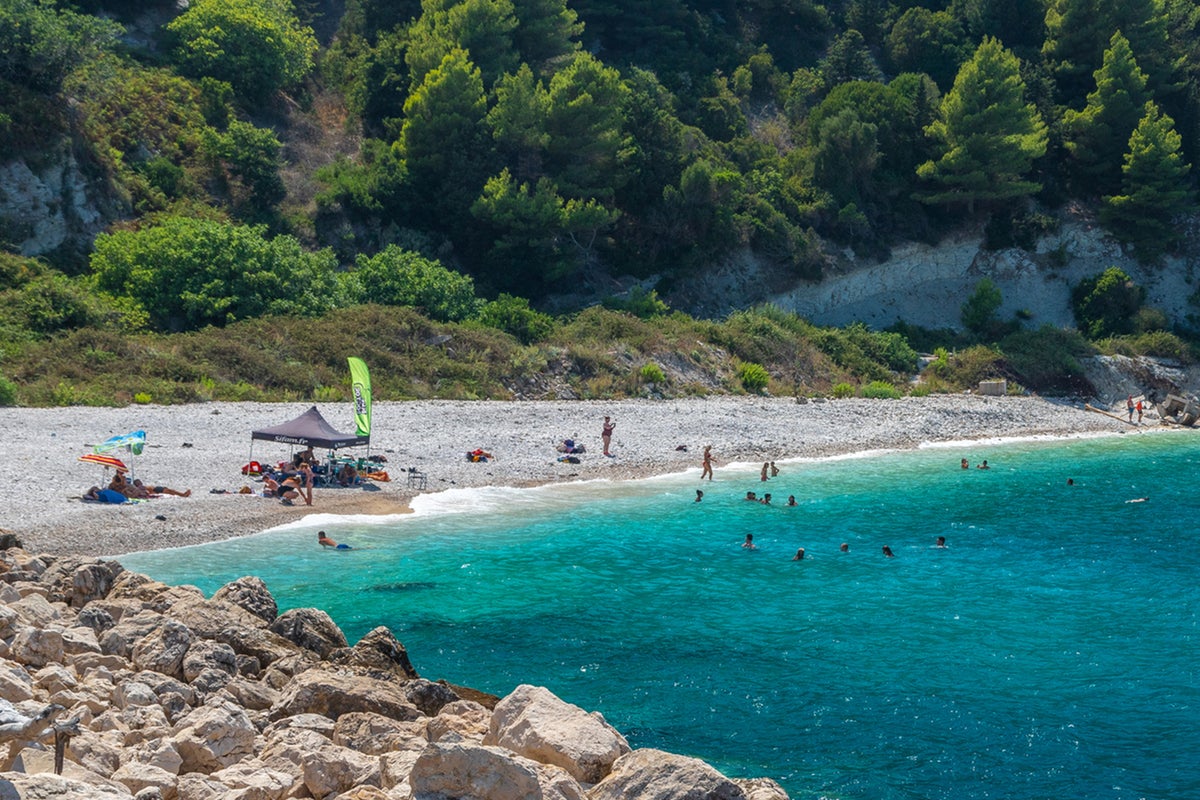
Jared Kushner and Ivanka Trump are moving forward with a $1.4 billion luxury real estate development on Sazan Island, a former communist military base off the coast of Albania, despite escalating local protests and a newly launched anti-corruption investigation. While the couple frames the project as an eco-conscious passion project discovered during a casual Mediterranean boating trip, the reality on the ground involves a complex web of legal maneuvering, geopolitical positioning, and fierce domestic resistance. Albania’s Special Prosecution Office Against Corruption and Organized Crime (SPAK) is officially investigating the deal, focusing on legislative changes that stripped the island and its neighboring coastline of environmental protections.
The transaction is not a simple real estate acquisition. It represents a highly calculated intersection of private international capital and state-level concessions, engineered at a time when Albania is actively seeking both European Union integration and strong political alignment with Washington.
The Cold War Relic Handed to American Capital
Sazan Island occupies a highly strategic point where the Adriatic and Ionian seas meet. For nearly a century, it was a closed military zone, utilized sequentially by Italian, Soviet, and Albanian forces. During the paranoid regime of communist dictator Enver Hoxha, the 1,400-acre rock was fortified with an estimated 3,500 concrete bunkers, a network of underground tunnels, and housing for a garrison of over 2,000 soldiers. When communism collapsed, the island became a ghost town, its military structures left to decay while the surrounding waters were designated as part of the Karaburun-Sazan National Marine Park.
The transition from a heavily fortified military fortress to a playground for the global ultra-wealthy required rapid bureaucratic intervention.
In late 2024, the Albanian government declassified Sazan Island for civilian use. Almost simultaneously, Prime Minister Edi Rama’s administration pushed through significant legislative amendments that altered the legal status of previously protected coastal lands. By December 30, 2024, an investment entity linked to Kushner’s private equity firm, Affinity Partners, was granted Strategic Investor status. This designation allowed the project to bypass standard bureaucratic hurdles, fast-tracking development permits before a comprehensive business plan or environmental feasibility study had ever been submitted to the public.
The Money and the Mandate
The venture is operating under an affiliate named Atlantic Incubation Partners LLC. It outlines an ambitious footprint that extends beyond Sazan Island into the pristine Vjosa-Narta lagoon near Vlorë on the mainland.
+-----------------------------------------------------------------------+
|                       THE ALBANIAN RESORT PORTFOLIO                   |
+------------------------------------+----------------------------------+
| SAZAN ISLAND RESORT                | VJOSA-NARTA COASTAL DEVELOPMENT  |
+------------------------------------+----------------------------------+
| • Former Cold War military base    | • Environmentally fragile lagoon |
| • Managed by ultra-luxury Aman Brand| • Key stopover for migratory birds|
| • Adaptive reuse of army bunkers   | • Heavy machinery clearing coast |
| • Private villas & premium marina  | • Mass public opposition site    |
+------------------------------------+----------------------------------+
| ESTIMATED INVESTMENT: €1.4 Billion | COMBINED CAPACITY: 10,000 Rooms  |
+------------------------------------+----------------------------------+
The administration of Prime Minister Edi Rama has vociferously defended the multi-billion-euro initiative, arguing that the injection of foreign capital will transform the country into a premier Mediterranean tourist destination.
Critics, however, view the sudden legislative shifts with deep skepticism. SPAK’s corruption inquiry is specifically probing how these protected territories were carved out for development and whether the privatization process violated national laws. The political pressure intensified when heavy machinery arrived on the mainland coast to install barbed-wire fencing, cutting off public access to miles of pristine beach. The subsequent sight of private security forces physically dragging local demonstrators away from the construction site ignited mass protests in the capital city of Tirana.
Environmental Compromise and the Shadow of Belgrade
The environmental stakes are remarkably high. The Vjosa-Narta lagoon is one of the Adriatic coast's most critical wetlands, serving as a vital nesting and feeding ground for endangered migratory birds, including large flocks of pink flamingos. Environmental organizations across Europe have warned that the construction of hotels, roads, and a luxury marina will inflict irreversible damage on a fragile ecosystem that had been protected for decades precisely because the military isolation of the region kept industrial commercialism at bay.
There is also a stark historical parallel that hangs over this development.
Just months prior, a separate Kushner-linked luxury high-rise development in Belgrade, Serbia, imploded after becoming entangled in a major domestic corruption scandal. Serbian prosecutors charged four individuals, including a government minister, with abusing their office and forging documents to lift cultural heritage protections from a bombed-out former military headquarters. Kushner ultimately withdrew from the Belgrade deal after the political fallout became untenable. The unfolding investigation by Albania's SPAK suggests that the legal scaffolding supporting the Sazan Island venture may face a similarly rigorous judicial test.
A Geopolitical Premium
For Albania, courting high-profile American investors is often less about the immediate financial return and more about locking in diplomatic leverage. The country has long punched above its weight in pro-Western alignment, and hosting a multi-billion-dollar luxury asset tied directly to the family of the American president provides an informal, yet potent, geopolitical insurance policy. Prime Minister Rama has made it clear that he has no intention of backing down, stating publicly that the project will not be halted as long as he remains in office.
The conflict now rests between a state determined to fast-track its way into ultra-luxury global tourism, an independent judiciary testing its teeth against high-level corruption, and a local population increasingly unwilling to see public lands traded for private foreign equity. Sazan Island’s bunkers, once built to repel foreign invaders, have now become the backdrop for a very modern battle over sovereignty, capital, and ecological survival.


