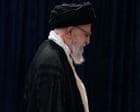
The removal of Ayatollah Ali Khamenei from the Iranian political apparatus—whether by kinetic strike or natural progression—triggers an immediate systemic transition from a centralized autocracy to a fragmented security state. While political rhetoric often focuses on the immediate shock of the event, the actual stability of the region depends on the internal rebalancing of the Islamic Revolutionary Guard Corps (IRGC), the legitimacy of the Assembly of Experts, and the technical continuity of the Deep State infrastructure. The survival of the Islamic Republic is not a question of ideology, but a function of institutional inertia and the control of coercive capital.
The Dual-Power Equilibrium: Clerical vs. Praetorian
The Iranian state operates under a unique structural duality known as Velayat-e Faqih (Guardianship of the Jurist). Khamenei’s role is not merely symbolic; he serves as the ultimate arbiter between competing power centers. His absence creates a vacuum in three distinct pillars of governance:
- The Arbitrator Function: Khamenei maintains the balance between the "pragmatists" within the bureaucracy and the "ideologues" within the IRGC. Without a singular authority to settle inter-departmental disputes, the state risks a "horizontal civil war" where agencies compete for budget, jurisdiction, and survival.
- The Financial Pipeline: The Office of the Supreme Leader (the Beit-e Rahbari) controls vast economic conglomerates, such as Setad and the Mostazafan Foundation. These entities operate outside parliamentary oversight. The transfer of these assets is the primary driver of internal friction.
- The Command Chain: As Commander-in-Chief, the Supreme Leader is the only figure capable of overawing the regular military (Artesh) and the IRGC simultaneously.
The immediate risk following a decapitation strike is not popular uprising, but Institutional Paralysis. If the Assembly of Experts—the 88-member body responsible for electing a successor—cannot reach a consensus rapidly, the IRGC is incentivized to bypass the constitution to ensure "security stability." This transforms Iran from a theocratic republic into a transparent military stratocracy.
The IRGC Cost Function: Survival Over Ideology
The IRGC is often viewed through a religious lens, yet its primary drivers are economic and operational. It controls roughly 30% to 50% of the Iranian economy through various front companies and engineering firms like Khatam al-Anbiya. In a post-Khamenei environment, the IRGC’s "Cost Function" shifts toward minimizing external intervention while maximizing domestic asset protection.
The IRGC’s response to a sudden leadership void follows a predictable escalation ladder:
- Phase 1: Information Blockade. Total shutdown of the National Information Network (NIN) to prevent decentralized mobilization. This is a technical maneuver rather than a political one, utilizing BGP hijacking and deep packet inspection to isolate the Iranian intranet from the global web.
- Phase 2: Praetorian Consolidation. Deployment of the Basij paramilitary to high-density urban nodes. The objective is not to govern, but to raise the "cost of protest" to a level that outweighs the "benefit of change" for the average citizen.
- Phase 3: Proxy Activation. Utilizing the "Axis of Resistance" (Hezbollah, Houthi movements, and Iraqi PMFs) to create external distractions. By increasing the threat profile in the Levant and the Bab el-Mandeb, the IRGC forces global powers to focus on regional de-escalation rather than supporting internal Iranian dissidents.
This suggests that a missile strike, as claimed in various political narratives, does not necessarily lead to the collapse of the "Deep State." Instead, it often hardens the resolve of the mid-tier officer corps who view their personal survival as inextricably linked to the survival of the regime's infrastructure.
Technical Limitations of the Succession Mechanism
Article 111 of the Iranian Constitution dictates that a council consisting of the President, the head of the Judiciary, and one member of the Guardian Council shall temporarily perform the duties of the Leader. However, this legalistic framework ignores the informal power dynamics that actually govern Tehran.
The "Succession Bottleneck" is defined by two variables:
- Marja'iyat (Religious Standing): The successor must ideally be a high-ranking cleric. However, the pool of candidates with both religious credentials and political loyalty is shrinking.
- Administrative Competence: Khamenei has spent thirty years perfecting the art of "managing by conflict." A successor like Mojtaba Khamenei (his son) or Ibrahim Raisi (prior to his death) would lack the independent power base required to keep the IRGC in check.
When the constitutional path conflicts with the security interests of the IRGC, the latter wins. We should expect the emergence of a Collective Leadership Council. This council would likely be a facade for an IRGC-led junta, utilizing a weak clerical figurehead to maintain a veneer of religious legitimacy while the military apparatus manages the economy and foreign policy.
The Regional Kinetic Feedback Loop
A kinetic strike on Iranian leadership changes the calculus for every regional actor. The "Rational Actor" model suggests that Iran would retaliate; however, the nature of that retaliation is governed by its degraded conventional capabilities versus its asymmetric strengths.
The Iranian military doctrine relies on Integrated Firepower:
- Anti-Access/Area Denial (A3/AD): Utilizing anti-ship cruise missiles and swarming drone tactics to close the Strait of Hormuz.
- Strategic Depth: Using proxy forces to launch attacks from non-Iranian soil, thereby providing Tehran with "plausible deniability" to avoid a total war scenario.
The danger of a decapitation strike is the Decentralization of Command. If the central authority is severed, local commanders of the IRGC-Quds Force may act autonomously. This "Freelance Kineticism" increases the probability of a miscalculation that leads to a full-scale regional conflict. Without a central "Off" switch in Tehran, tactical successes by local commanders can lead to strategic catastrophes for the state.
Economic Indicators of Regime Durability
To measure the actual stability of Iran during a transition, one must look past the headlines and focus on the Rial-to-USD exchange rate on the Bonbast (informal) market and the Price of Gold in Tehran.
Significant capital flight is the first indicator of regime fatigue. If the merchant class (the Bazaaris) begins to divest from Iranian assets, the regime's ability to fund its security apparatus collapses. The IRGC requires hard currency to pay its foreign proxies and its domestic enforcers. A strike on the leadership that coincides with a total collapse of the Rial creates a "Pincer Effect":
- Top-Down: Loss of command and control.
- Bottom-Up: Hyperinflation fueling civil unrest.
The regime has historically survived by prioritizing the second over the first. They can lose a leader, but they cannot lose the ability to pay the men with the rifles.
The Strategy of Managed Chaos
The international community often treats Iranian regime change as a binary event—either the regime stays or it goes. This is a flawed heuristic. The more likely outcome is a Slow-Motion Fragmentation.
The IRGC will likely pursue a "Managed Chaos" strategy. By allowing a controlled level of instability, they make themselves indispensable to the international community as the only entity capable of preventing a "failed state" scenario in a nuclear-threshold country. This creates a paradox for Western policymakers: the more the regime is weakened, the more dangerous its eventual collapse becomes.
The strategic play here is not to expect a democratic transition, but to prepare for a Securitized Transition. This involves:
- Identifying the "Sanction-Resilient" factions within the IRGC who are willing to trade regional de-escalation for economic survival.
- Hardening regional energy infrastructure against the "Hormuz Shutdown" scenario.
- Establishing direct lines of communication with the Iranian regular military (Artesh) to provide a counterweight to IRGC radicalization during the vacuum.
The primary objective is the containment of the IRGC’s "Retaliation Function" while the internal clerical power struggle plays out. The focus must remain on the Command and Control (C2) nodes rather than just the symbolic leadership. If the C2 remains intact, the "missile strike" is merely a change in management; if the C2 breaks, the entire Middle East faces a decade of unpredictable kinetic entropy.
Operationalize for a scenario where the IRGC ceases to be a state actor and becomes a transnational corporate-military syndicate. This involves shifting intelligence priorities from "clerical intent" to "logistical flows" and "private equity networks" managed by the Guards. The transition of Iran is less a revolution and more a hostile takeover in a vacuum of sovereignty.