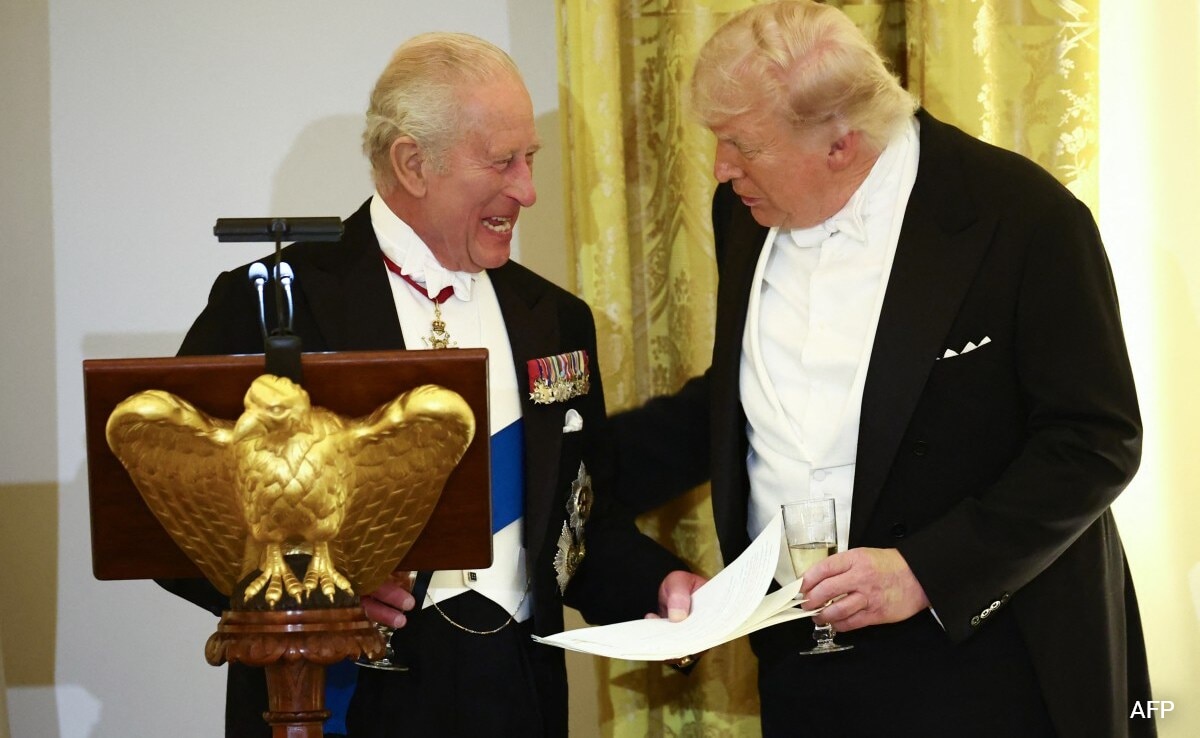
The convergence of political power and genealogical heritage operates as a tool for legitimacy, shifting public perception from temporary elected officialdom to a perceived continuity of leadership. When Donald Trump addressed reports suggesting a shared ancestry with King Charles III, the response—characterized by a brief, appreciative validation—served a specific strategic function. This phenomenon is not merely a quirk of tabloid journalism but a calculated intersection of soft power, branding, and the historical "Special Relationship" between the United States and the United Kingdom.
The Framework of Dynastic Branding
Modern political communication utilizes lineage as a shorthand for stability. In the context of the Trump-Windsor connection, the narrative relies on three distinct pillars:
- Historical Continuity: Linking a populist political figure to a thousand-year-old monarchy provides a sense of permanence that transcends electoral cycles.
- Cultural Synchronicity: It reinforces the Anglo-American alliance through biological rather than just diplomatic ties, creating a "natural" justification for bilateral cooperation.
- Aspiration and Archetype: For a brand built on wealth and dominance, the ultimate upgrade is the transition from "Titan of Industry" to "Descendant of Royalty."
The mechanism at play is a feedback loop. Genealogical researchers produce a hypothetical link—often through the MacLeod of Lewis line on Trump’s maternal side—and the political figure adopts it to soften their image or harden their authority depending on the audience.
The Probability of Shared Ancestry
The statistical reality of European genealogy dictates that most individuals of Western European descent share common ancestors within a few centuries. The "Pedigree Collapse" phenomenon explains that as one moves back through generations, the number of ancestors does not grow exponentially forever because individuals begin to occupy multiple spots on a family tree.
Given that King Charles III’s ancestry is meticulously documented and Donald Trump’s mother, Mary Anne MacLeod, immigrated from the Outer Hebrides in Scotland, the likelihood of a common ancestor in the 17th or 18th century is high. This is a mathematical certainty of population genetics rather than a unique revelation of destiny. However, in the realm of political strategy, the rarity of the connection is less important than the utility of the claim.
Comparative Power Structures: Elected vs. Hereditary
The fascination with this kinship reveals a tension between the two systems of power. While the United States was founded on the explicit rejection of hereditary titles, the American electorate frequently demonstrates a preference for political dynasties (the Adamses, Kennedys, and Bushes).
This creates a paradox: the American leader seeks the "coolant" of royal dignity to offset the "heat" of partisan politics. By acknowledging the cousin claim, Trump effectively borrows a portion of the British Crown’s apolitical prestige. The "Nice" descriptor functions as a low-cost, high-yield endorsement of the idea that his status is not just won, but inherent.
Economic and Diplomatic Externalities
The impact of these narratives extends into the business and diplomatic sectors. The "Special Relationship" is often maintained through high-ceremony state visits. When a U.S. President frames themselves as a distant relative of the host monarch, it alters the protocol friction.
- Public Diplomacy: Shared lineage claims simplify complex diplomatic histories into a digestible family story for the masses.
- Trade Sentiment: Cultural alignment often precedes economic alignment. Soft power connections can influence public opinion regarding trade deals and defense pacts.
- Media Value: The "cousin" headline generates a high volume of cross-platform engagement, serving as a distraction from policy-heavy critiques or legislative bottlenecks.
The bottleneck in this strategy is the risk of perceived elitism. A populist leader must balance the "Royal Cousin" narrative carefully to ensure it does not alienate a base that prides itself on being anti-establishment. The solution is typically to frame the connection as a matter of "heritage" and "strong genes" rather than a claim to class superiority.
The Logic of the MacLeod Connection
The specific genealogical path leads to the Isle of Lewis. The MacLeod clan history is one of rugged survival and territorial defense—traits that align with the Trump brand’s emphasis on toughness and border integrity.
- Maternal Influence: Mary Anne MacLeod’s origins provide the physical link to the UK, which Trump has consistently leveraged to showcase his affinity for British tradition.
- The Stornoway Factor: The migration from a remote Scottish village to the pinnacle of American power is a classic meritocratic arc, which the royal connection then "gilds" with an element of predestination.
This dual-track narrative—the self-made man who was secretly "noble" all along—is a potent psychological tool. It satisfies the American dream of upward mobility while catering to a subconscious desire for a leader with deep, ancestral roots.
Measuring the Media Impact
Quantitative analysis of the "Trump-Charles Cousin" story reveals a pattern of high-frequency, low-duration engagement. It functions as a "bridge topic" that connects entertainment news with political discourse.
The strategy relies on a specific sequence:
- The Trigger: A genealogical society or researcher releases a report (often with speculative links).
- The Amplification: Tabloids and digital news outlets prioritize the story due to its high click-through rate (CTR) and visual potential.
- The Validation: The subject is asked for a comment. A short, positive response (like "Nice") ensures the story stays in the cycle without requiring a detailed defense of the genealogy.
- The Integration: The claim is eventually cited in biographies and profiles as a semi-factual "fun fact," cementing it in the public consciousness.
The Strategic Play for Influence
The end state of this alignment is the consolidation of a global "brand of authority." For the British Monarchy, acknowledging these connections (however distantly) maintains their relevance in a post-imperial world by linking their bloodline to the most powerful office on earth. For the American executive, it adds a layer of historical legitimacy that no election can provide.
Investors and strategists should view these genealogical narratives not as fluff, but as "narrative infrastructure." They provide the emotional and cultural groundwork that supports more rigid political and economic structures. The recommendation for observers is to discount the literal biological significance and instead track the frequency of these claims as a leading indicator of a leader's desire to pivot from "partisan" to "stateman."
The final strategic move in this cycle is the "State Visit Optimization." By establishing a familial narrative in advance, the administration sets the stage for high-impact imagery—standing alongside the King not just as a contemporary, but as a peer in the longest-running power narrative in Western history. This minimizes the perception of the President as a temporary guest and maximizes his image as a permanent fixture of Western civilization.