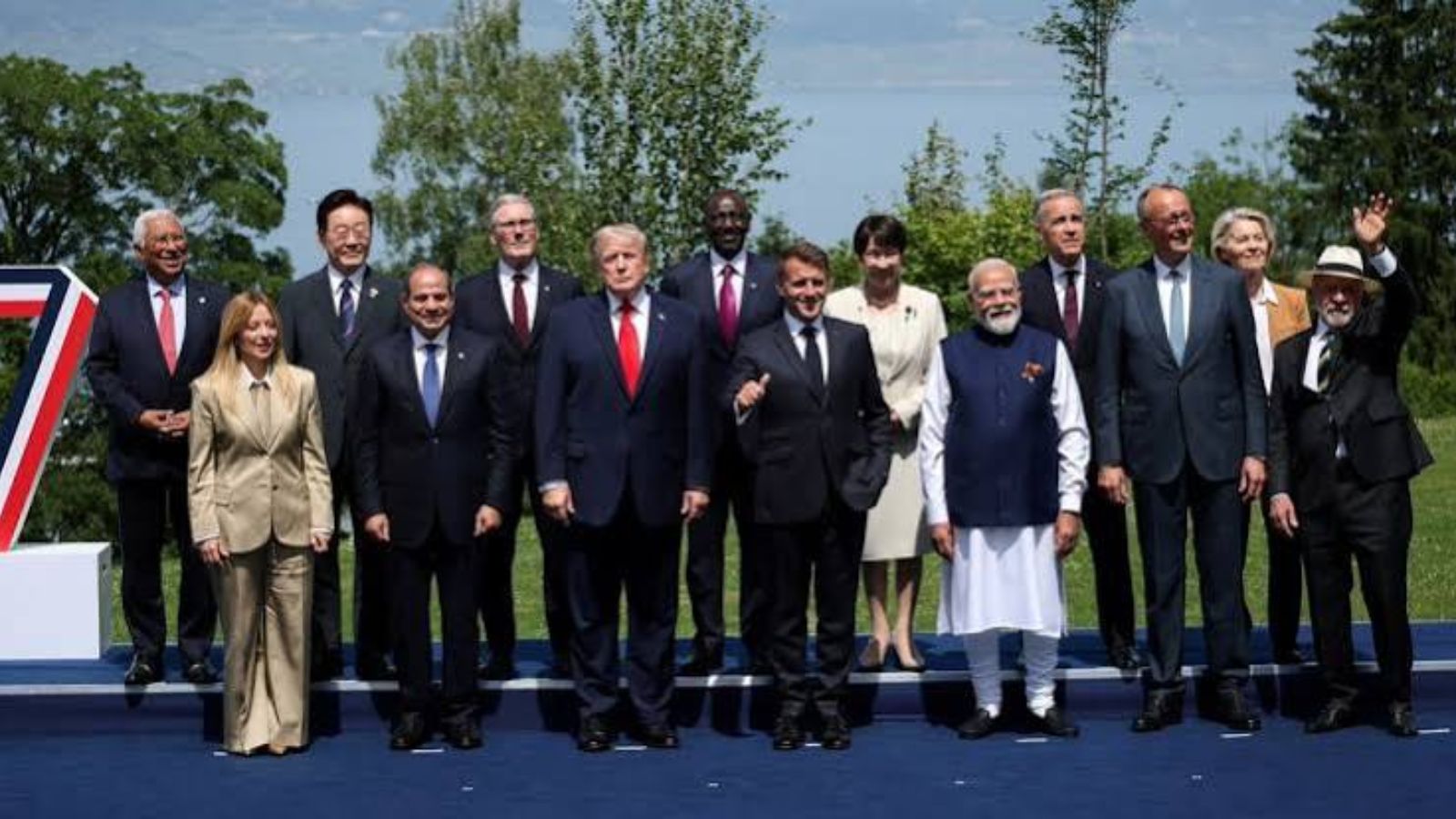
Inadvertent audio captures at multilateral summits are routinely dismissed by mass media as humanizing color pieces, yet they function as high-yield intelligence leaks that expose the real-time operational constraints of global statecraft. When the host broadcaster at the Evian G7 summit captured unscripted interactions between world leaders, the resulting data points did not merely reveal personal habits; they quantified the precise tension lines governing modern bilateral negotiations. Beneath the veneer of "hot mic moments" lies a predictable operational environment where the divergence between a state's public posture and its raw strategic priorities can be mapped with mathematical precision.
Understanding these leaks requires moving past theatrical interpretation to evaluate the structural mechanisms of international diplomacy. Leaders operate under intense domestic constraints while attempting to execute asymmetric multi-variable negotiations. When the official broadcast feed drops but the ambient inputs remain live, the resulting transcript provides an unweighted sample of how executive authority balances personal leverage, macroeconomic security, and sovereign defensive posturing.
The Bilateral Transaction Mechanics of Trade Asymmetry
The most structurally significant data point emerged from a brief exchange between Canadian Prime Minister Mark Carney and United States President Donald Trump regarding automotive trade policy. The underlying friction stems from Canada’s recent departure from the unified North American tariff regime, having lowered its 100% tariff on Chinese electric vehicles (EVs) to 6.1% in exchange for agricultural market concessions.
The mechanism of this interaction illustrates how middle-tier economies utilize specialized caps to mitigate the retaliatory behavior of a dominant trading partner.
[Canada's Concession to China]
       │
       ▼ Lower Tariffs on Canadian Agriculture
[Market Access Restructuring]
       │
       ▼ 6.1% Tariff + 49,000 Volume Cap (3% Market Share)
[Risk Mitigation Pitch to US]
       │
       ▼ "Hard Line" Volume Constraints
[Equilibrium Preserved]
Carney's specific phrasing—quantifying the policy as "less than three percent of our market" and a "hard line" cap of 49,000 vehicles—reveals a calculated defense strategy designed to pacify American protectionist policy. By shifting the metric of evaluation from the tariff rate (which plummeted from 100% to 6.1%) to absolute volume constraints, the Canadian executive attempted to alter the American president's economic cost function.
Trump’s recorded verification—"That's good, I like it"—indicates that the American administration's trade enforcement mechanism prioritizes market insulation over structural regulatory conformity. The exchange uncovers a critical operational reality: middle powers can successfully break ranks with broad geopolitical coalitions if they cap the absolute volume of leakages to a level that falls below the dominant power's threshold for punitive economic retaliation.
The Sovereign Micro-Leverage and Information Arbitrage Framework
A separate, highly cryptic audio fragment recorded Trump explicitly prompting European Council President António Costa with a single geographic signifier: "Greenland." To analyze this without relying on speculative narrative requires examining the structural intent behind asymmetrical conversational prompts in high-level diplomacy.
[Asymmetric Informational Prompt] -> "Greenland"
       │
       ▼
[Receiver Cognitive Load Disruption] -> Decoupled Context (Security vs. Resource Acquisition)
       │
       ▼
[Strategic Arbitrage Zone] -> Forced Decoupling of EU Integration Strategy
The placement of a historically volatile geopolitical flashpoint into a casual corridor conversation acts as an intent-testing mechanism. By isolating a single word without contextual qualifiers, the speaker forces the interlocutor to process multiple conflicting analytical matrices simultaneously:
- The macroeconomic resource potential of the Arctic shelf.
- The defensive perimeter of the North Atlantic Treaty Organization (NATO).
- The territorial sovereignty of a European Union partner state (Denmark).
This creates a cognitive load bottleneck for the receiving diplomat. Because the European Union's foreign policy relies on consensus-driven bureaucratic alignment, direct, unscripted prompts from a unilateral actor disrupt the standard processing pipeline. The "hot mic" did not reveal a policy shift; it demonstrated the deliberate execution of tactical ambiguity used to gauge emotional or defensive baselines before formal, structured sessions begin.
Peer Integration and the Maintenance of Group Cohesion
Media coverage focused heavily on German Chancellor Friedrich Merz questioning Italian Prime Minister Giorgia Meloni on her cessation of tobacco use since May first, alongside Emmanuel Macron leaving his watch behind at a working lunch. When stripped of its trivial framing, this transactional data maps the mechanics of intra-coalition stabilization.
Multilateral summits generate high cognitive and physical stress variables, which degrade executive decision-making capacities over multi-day periods. The public display of peer validation regarding personal behavioral adjustments serves an operational purpose: it builds informal horizontal alignment across ideologically divergent leaders.
Meloni's acknowledgment of self-regulation, followed by Carney's immediate query regarding nicotine replacement logistics ("Do you have a patch?"), establishes an underlying trust infrastructure. This informal infrastructure reduces the transaction costs of subsequent hard-power negotiations. When formal parameters become deadlocked—such as the active friction between Merz and Trump over Iranian trade policy—these minor social capital deposits prevent total systemic breakdown within the summit environment.
The incident with Macron's abandoned watch, which prompted Trump to joke, "Give me it if he left, gimme," illustrates the exploitation of minor executive oversights to lower conversational barriers. Humorous boundary-testing in the presence of peers serves as a proxy metric for assessing status dynamics within the group. Trump’s declarative entry to a session regarding Chinese market subsidization—stating "I'm the boss!" to a laughing room—reinforces this structural reality. Absolute authority within these spaces is continuously asserted through informal social dominance displays rather than formal procedural assignments.
Strategic Allocation of Secondary Diplomatic Variables
The final layer of captured data centers on the tactical deployment of cultural markers, specifically sports diplomacy, during active trade and security crises. The audio record captured multiple leaders shifting to safe-harbor topics, including the ongoing World Cup and local club football achievements, to fill dead spaces between structured panels.
This behavioral pattern indicates that when structural positions are entirely irreconcilable—such as the cross-border management of the Ebola outbreak or the recalibration of sanctions on Russian oil shipments—executives automatically default to low-risk shared domains to preserve the appearance of bilateral momentum.
The physical exchange of symbolic assets further highlights this dynamic. Chancellor Merz's presentation of a German national football jersey emblazoned with the number 47 to Trump directly mirrors the broader strategic playbook of European states trying to find alignment with an unpredictable American executive. Merz's subsequent public notation that "after all, we're on the same team" underscores the exact limitation of this approach. It attempts to use a low-cost, high-visibility cultural token to paper over deep structural rifts regarding defense spending allocations and Ukraine strategy.
The Structural Vulnerability of Unmonitored Acoustic Spaces
The persistent occurrence of these audio exposures reveals an ongoing operational vulnerability in international security protocols. Despite massive resource allocation toward technical counter-surveillance, the primary failure point remains the transitional spaces between active diplomatic sessions.
The limitation of current statecraft architecture is its inability to enforce cognitive containment on world leaders during informal transitions. A leader who is highly disciplined during a closed-door bilateral session will naturally lower their operational security posture when moving toward a lunch table or family photo setup.
The strategic takeaway for sovereign intelligence apparatuses is clear: the transitional zone is the most cost-effective collection window available. For corporate and state actors analyzing these summits from the outside, the insights gleaned from these unmonitored gaps yield a significantly higher accuracy rate regarding actual policy boundaries than any carefully managed joint communique issued at a summit's conclusion. Future executive planning must treat the immediate perimeter of any broadcast microphone not as a passive background element, but as an active, unencrypted data transmission node.