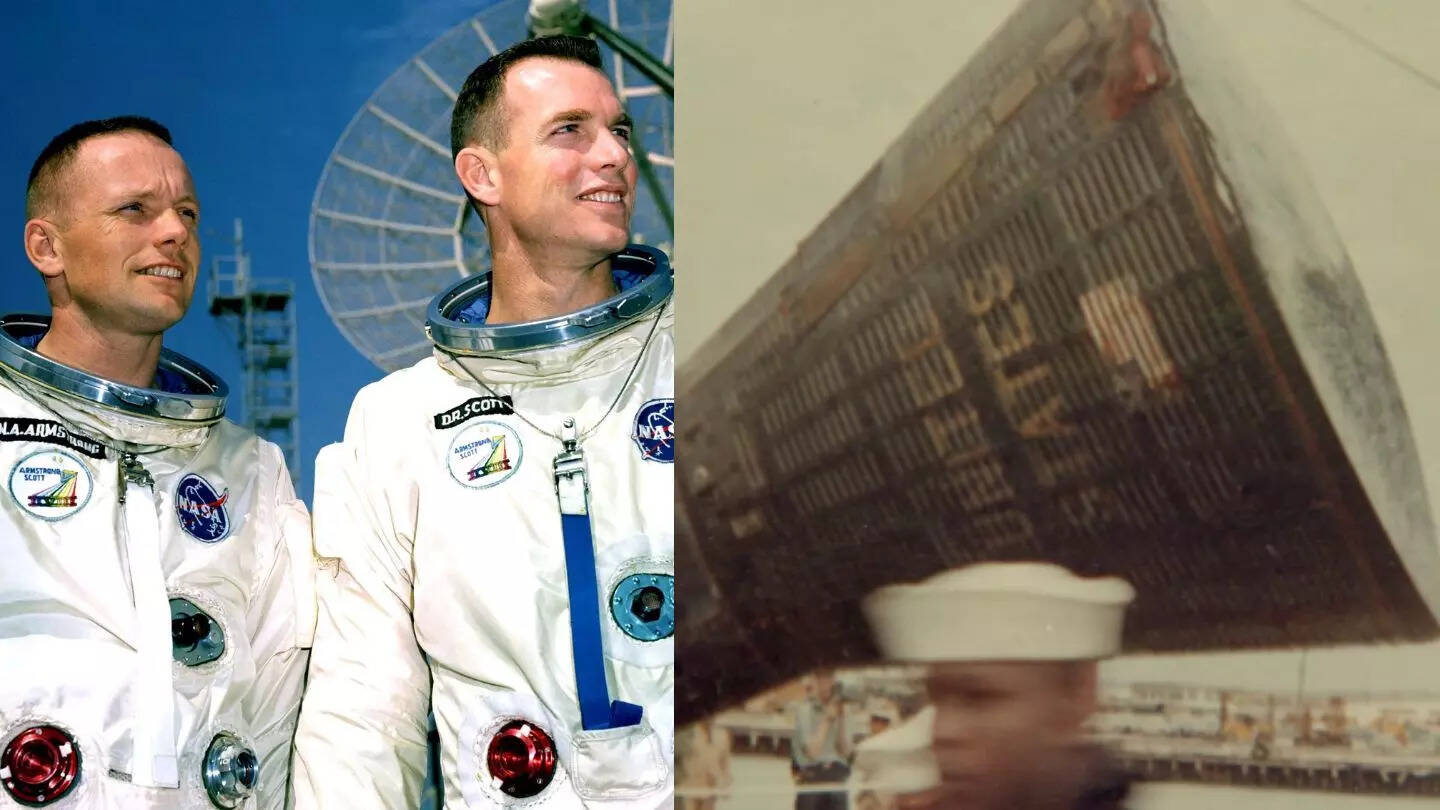
Most people remember Neil Armstrong as the calm, stoic figure stepping onto the lunar surface in 1969. They think of the "small step" and the grainy black-and-white footage of a triumph. But three years before Apollo 11, Armstrong and co-pilot David Scott were trapped in a metal coffin spinning at one revolution per second in the vacuum of space. New interest in the digitized 16mm footage from the 1966 Gemini 8 mission reminds us that the path to the moon wasn't a series of steady victories. It was a sequence of near-fatal errors narrowly corrected by nerves of steel.
If you haven't seen the footage of the Agena target vehicle pulling away as the Gemini capsule rolls uncontrollably, it’s haunting. It shows the moment the Space Race almost ended in a double funeral.
Why Gemini 8 was the Most Dangerous Test Flight in History
NASA's Gemini program was the awkward middle child between the "just get there" era of Mercury and the "conquer the moon" era of Apollo. Gemini was where the real work happened. Astronauts had to learn how to dock two spacecraft together. If you can’t dock, you can’t go to the moon. It’s that simple.
Armstrong and Scott achieved the world's first space docking on March 16, 1966. For about thirty minutes, they were heroes. Then, a stuck thruster on the Gemini capsule started firing continuously.
Imagine being strapped into a seat, unable to move, while your entire world begins to tilt. At first, they thought the problem was with the Agena—the vehicle they had just docked with. They used the Gemini’s own maneuver thrusters to try and steady the pair. It didn't work. The rotation only got faster.
The Decision That Saved Their Lives
Armstrong made a split-second call to undock. He thought the Agena was the dead weight causing the spin. He was wrong. Once the Gemini capsule was free, it became even lighter and the spin rate skyrocketed. They were pulling nearly 4Gs. At that speed, the human inner ear fails. Your vision blurs. Eventually, you black out as blood is forced away from your brain.
The newly stabilized and released footage from the onboard cameras captures the dizzying blur of the horizon. It isn't just a technical record. It's a document of two men staring at their own mortality.
Armstrong had to make a choice that would effectively end the mission. He had to activate the Reentry Control System (RCS). The rules were clear: if you use the RCS thrusters, you have to come home immediately. You don't get to finish the mission. You don't get to do your scheduled spacewalk.
He didn't hesitate. He shut down the main maneuver system and used the reentry thrusters to kill the spin. It worked. But it also meant they had to splash down in the Pacific, thousands of miles away from the primary recovery fleet.
Technical Failures and Human Resilience
We often talk about "NASA precision," but Gemini 8 was a masterclass in hardware failure. An electrical short caused the Number 8 thruster to stay open. There was no warning light. No computer voice telling them what was wrong. They had to figure it out while the centrifugal force was trying to knock them unconscious.
David Scott later recounted how the sun was flashing through the windows like a strobe light. Every second, the sun would whip past, blinding them, then darkness, then the sun again.
Critics at the time wondered if Armstrong had been too quick to use the RCS. Some armchair experts at NASA HQ questioned if he could have saved the mission. But the flight data later vindicated him completely. If he had waited another sixty seconds, the spin rate would have exceeded the structural limits of the spacecraft. It would have literally torn itself apart.
What the 16mm Footage Actually Tells Us
The film recovered from the capsule isn't just about the crisis. It shows the mundane reality of 1960s spaceflight. You see the cramped quarters—the Gemini capsule was about the size of the front seat of a Volkswagen Beetle.
The grainy images of the Agena drifting away are a reminder of how lonely space actually is. When they splashed down in the rough seas of the Western Pacific, they weren't met by a carrier. They were met by a small rescue plane that dropped divers to attach a flotation collar. They sat in that bobbing capsule for three hours, seasick and exhausted, waiting for the USS Leonard F. Mason to pick them up.
Why This Mission Changed Apollo
Without the near-disaster of Gemini 8, we likely don't land on the moon in 1969. This mission taught NASA about "contingency logic." It forced them to redesign thruster electronics to prevent shorts from bypassing the system.
It also cemented Neil Armstrong's reputation as the "coolest" pilot in the office. When Deke Slayton was looking for the man to lead Apollo 11, he remembered Gemini 8. He wanted the guy who didn't panic when the world started spinning at 60 RPM.
The footage we see now serves as a correction to the Hollywood version of space travel. It’s loud, it’s violent, and things break. The beauty of the Gemini 8 story isn't that they docked; it's that they survived the docking.
Take Action to Learn More
If you want to understand the sheer physics of what Armstrong and Scott faced, look up the raw flight telemetry logs available through the NASA National Space Science Data Center. You can track the exact degrees of rotation per second and realize just how close they came to "G-LOC" (G-force induced loss of consciousness). Don't just watch the edited clips; find the full 16mm transfer to see the unedited chaos of the spin. It changes your perspective on the moon landing forever.