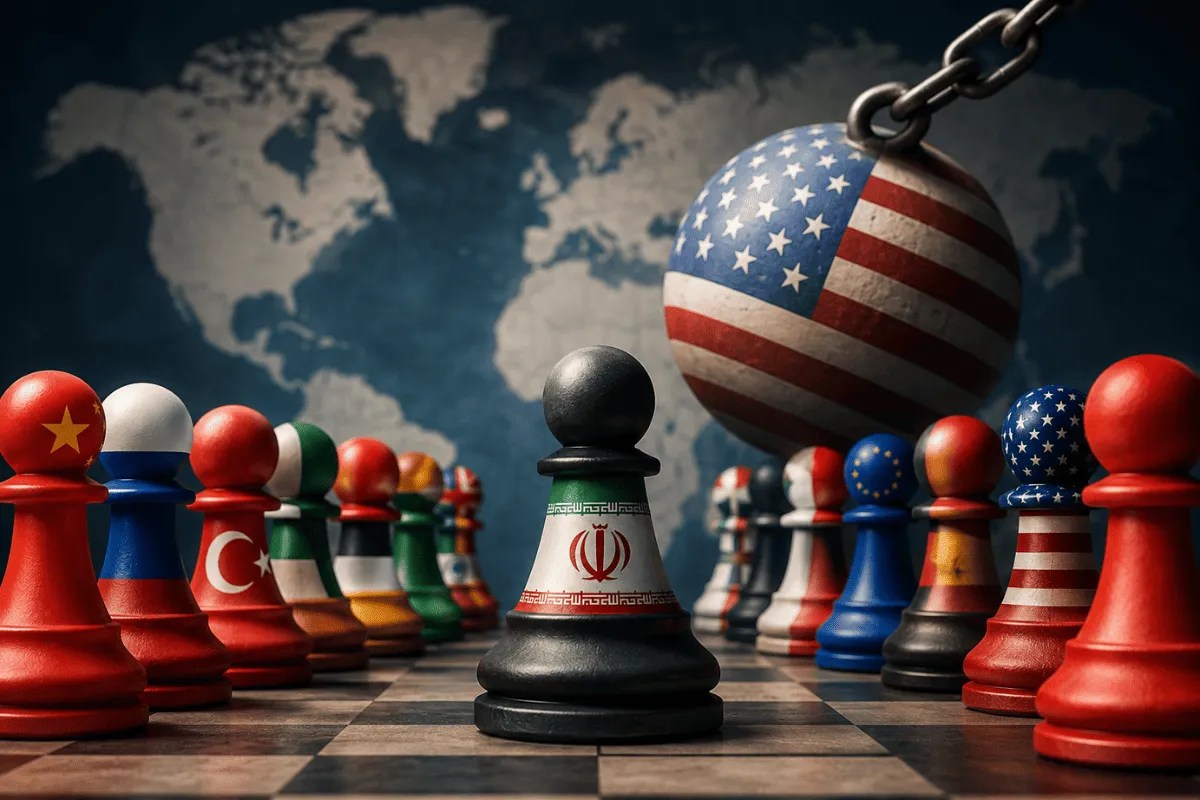
The headlines coming out of the latest G7 summit read like a victory lap for Western diplomacy. "Leaders agree to tighten the screws on Russian energy," the mainstream financial press chirps, repeating the official communique with the docile compliance of a stenographer. The narrative is comforting: by expanding sanctions, cutting off tech transfers, and tightening enforcement on the shadow fleet, the West is fundamentally draining the Kremlin's war chest.
It is a beautiful fiction. It is also entirely wrong.
If you analyze the hard mechanics of global commodity flows rather than the wishful thinking of bureaucratic press releases, a brutal reality emerges. Every time the G7 introduces a clumsy new restriction on Russian oil or liquefied natural gas (LNG), they do not choke the revenue stream. They merely redraw the global trade map, introducing friction that spikes logistics costs, enriches a predatory network of dark-market middlemen, and structurally guarantees structurally higher energy floors for Western economies.
I have spent nearly two decades analyzing energy arbitrage and supply-chain logistics. I have watched Western policy committees design economic restrictions that assume the rest of the world operates like a rules-bound corporate boardroom. It does not. Global commodities are fluid, agnostic, and driven entirely by price differentials. By treating energy sanctions as a moral tool rather than a cold engineering problem, the G7 has systematically built a high-margin, parallel energy economy where Moscow holds the levers.
The Flawed Premise of the "Price Cap" Illusion
The foundational error of current Western strategy lies in a total misunderstanding of inelastic demand. The G7 continues to operate under the assumption that a price cap or a localized ban reduces the global volume of Russian barrels entering the market. It does not. It simply alters the shipping coordinates and the currency of settlement.
When the G7 enforces stricter compliance on Western-insured tankers, they do not park Russian crude in Siberian storage tanks. They accelerate the growth of the shadow fleet—a decentralized, opaque network of aging vessels owned through shell entities in jurisdictions completely outside Western regulatory reach.
Consider the basic math of the Urals-to-Brent spread. When sanctions tighten, the discount on Russian Urals crude wide relative to the international benchmark, Brent. To a casual observer, a wide discount looks like economic punishment for Russia. To a commodity trader, that discount is a massive flashing neon sign screaming "Arbitrage Opportunity."
What happens next is entirely predictable:
- Refinement Laundering: Indian and Chinese refiners snap up the discounted Urals crude at a massive discount.
- Molecular Transformation: They process that crude into diesel, jet fuel, and gasoline in massive coastal refineries like Jamnagar.
- The Re-Export Loophole: Because the crude has been structurally transformed into refined products, it legally loses its Russian origin destination. These refined products are then shipped straight into European ports at full market price.
European consumers are still buying Russian energy molecules. They are just paying an inflated premium to intermediaries in Asia to paper over the moral hazard. The Kremlin still sells its volume; it simply adjusts its margins while Western industrial competitive capacity erodes under the weight of artificially inflated input costs.
Dismantling the Shadow Fleet Myth
The mainstream foreign policy establishment loves to publish elaborate white papers on how to sink the shadow fleet through targeted financial asset bans. This overlooks the structural reality of global maritime law and the sovereign self-interest of non-aligned nations.
The shadow fleet is not a temporary anomaly. It is a permanent, parallel logistics infrastructure. When the US Treasury or the European Commission blacklists a specific vessel, the operators do not scrap the ship. They register it under a new flag of convenience—moving from Gabon to the Cook Islands or Eswatini within forty-eight hours—rename the vessel, and transfer ownership to a new obscure corporate entity registered in Dubai or Mumbai.
[Russian Port] -> (Shadow Fleet Tanker) -> [Ship-to-Ship Transfer: Laconian Gulf] -> (Unregulated Vessel) -> [End Purchaser]
This ship-to-ship (STS) transfer network operates in international waters, frequently just outside the territorial limits of Greece or inside the exclusive economic zones of North African states. Trying to regulate this via Western insurance bans is fundamentally useless because these ships do not use Western maritime insurance. They rely on state-backed Russian reinsurance, domestic Chinese clubs, or are self-insured via sovereign indemnities.
The G7 is trying to play referee in a league that explicitly rejects their rulebook. The more friction the West introduces, the more the premium for transport increases. Who captures that premium? Not the Western consumer, and certainly not the Western taxpayer. It is captured by the very entities willing to operate in the gray zone, often with direct or indirect state backing from Moscow's strategic partners.
The Liquefied Natural Gas Delusion
The newest frontier in the G7's tactical misfires is the targeting of Russian Arctic LNG 2 projects and transshipment hubs. The consensus view argues that by blocking access to specialized ice-breaking LNG vessels, the West can freeze Russia out of the super-chilled gas market entirely.
This is an exceptionally dangerous miscalculation that severely underestimates technological adaptation and the vulnerability of European gas infrastructure.
Europe has structurally decoupled itself from Russian pipeline gas, replacing it primarily with US and Qatari LNG. But this transition is terrifyingly fragile. Global LNG supply capacity is incredibly tight, operating at near-maximum utilization rates. Any meaningful structural removal of Russian LNG molecules from the global balance sheet does not just hurt Russia—it triggers an immediate global bidding war.
If European buyers are barred from purchasing Russian LNG, those volumes will pivot toward energy-starved emerging economies in South Asia. In turn, the European utilities will be forced to outbid Asian buyers for Atlantic basin LNG, driving domestic power prices back to volatile, economically destructive peaks.
Furthermore, Russia has spent years mastering reverse-engineering and local manufacturing pipelines. While Western technology bans initially delayed the commissioning of Arctic liquefaction trains, they forced Novatek and domestic engineering firms to develop sovereign alternatives for turbine components and heat exchangers. By forcing this pivot early, the G7 has inadvertently accelerated Russian technological independence in a critical sector, ensuring that when these facilities hit full operational capacity, they will be entirely immune to Western supply-chain chokeholds.
The Harsh Economics of Self-Harm
Let us address the question that Western policymakers refuse to ask publicly: What is the real cost of this strategy to the West itself?
The enforcement of these energy sanctions relies on a fundamental contradiction. The G7 wants to lower Russian revenues while keeping global oil markets perfectly supplied to avoid domestic inflation. This is mathematically impossible. You cannot remove or heavily penalize one of the top three energy producers on earth without structurally driving up the global cost of capital, shipping, and insurance.
| Metric | Pre-Sanctions Western System | Current Fractured System |
|---|---|---|
| Average Tanker Transit Time | 5–7 Days (Direct Baltic to Europe) | 25–30 Days (Baltic to India/China) |
| Logistics Settlement Currency | US Dollar / Euro | Yuan / Dirham / Indian Rupee |
| Insurance Underwriting | London IG Clubs (Strict Compliance) | Sovereign Backed / Non-Western Captives |
| Supply Chain Transparency | High (Public Exchange Traded) | Low (Bilateral, Over-the-Counter) |
Look at the structural shift documented above. The dramatic expansion in transit times alone ties up massive amounts of global tanker capacity, effectively creating an artificial shortage of shipping tonnage. Higher shipping rates translate directly into higher landing costs for every single barrel of oil moved globally, regardless of where it was pumped.
The Western industrial engine—particularly in Western Europe—is effectively subsidizing its own geopolitical strategy through a permanent tax on its manufacturing sector. German chemical plants and French heavy industry are competing against US counterparts with cheap domestic shale gas, and Chinese competitors powered by discounted Russian raw inputs. The G7's sanctions are effectively a slow-motion deindustrialization mechanism for the European continent.
Stop Trying to Fix the Embargo
The current policy debate is stuck in a loop of incrementalism. Bureaucrats argue over whether the price cap should be lowered from sixty dollars to fifty dollars, or whether another dozen mid-sized shipping managers in Dubai should be added to the SDN list. This is rearranging deck chairs on a sinking economic ship.
The premise that Western financial engineering can control the physical distribution of global commodities is broken. If the ultimate goal is genuinely to limit the geopolitical leverage of state-backed energy giants, the solution is not to write more un-enforceable compliance memos. The solution requires a complete rejection of the current strategy.
First, the G7 must abandon the illusion of the price cap completely. It has failed to restrict volume and has failed to permanently depress revenue; it has only succeeded in creating a lawless, multi-billion-dollar gray market that answers to no one.
Second, instead of trying to block the flow of physical molecules—which the global market will always bypass—Western strategy must focus entirely on domestic supply dominance and regulatory demolition. The only mechanism that systematically defunds state-backed energy exporters is a sustained, structural collapse of the global commodity price floor. And the only way to achieve that is an aggressive, uncompromising expansion of Western energy production.
This means lifting ideological restrictions on domestic fossil fuel infrastructure, fast-tracking LNG export approvals within Western jurisdictions, and building out massive, redundant supply lines that outproduction-compete the opposition. You do not beat an energy adversary by telling the world what it cannot buy. You beat them by making your own energy so cheap, abundant, and logistically reliable that the gray-market arbitrage simply evaporates.
As long as the G7 relies on sanctions lawyers rather than drilling rigs and infrastructure engineers, the parallel energy economy will continue to thrive. The current system is not hurting the Kremlin; it is merely charging the Western consumer a premium to watch Russia sell its energy to the rest of the world.