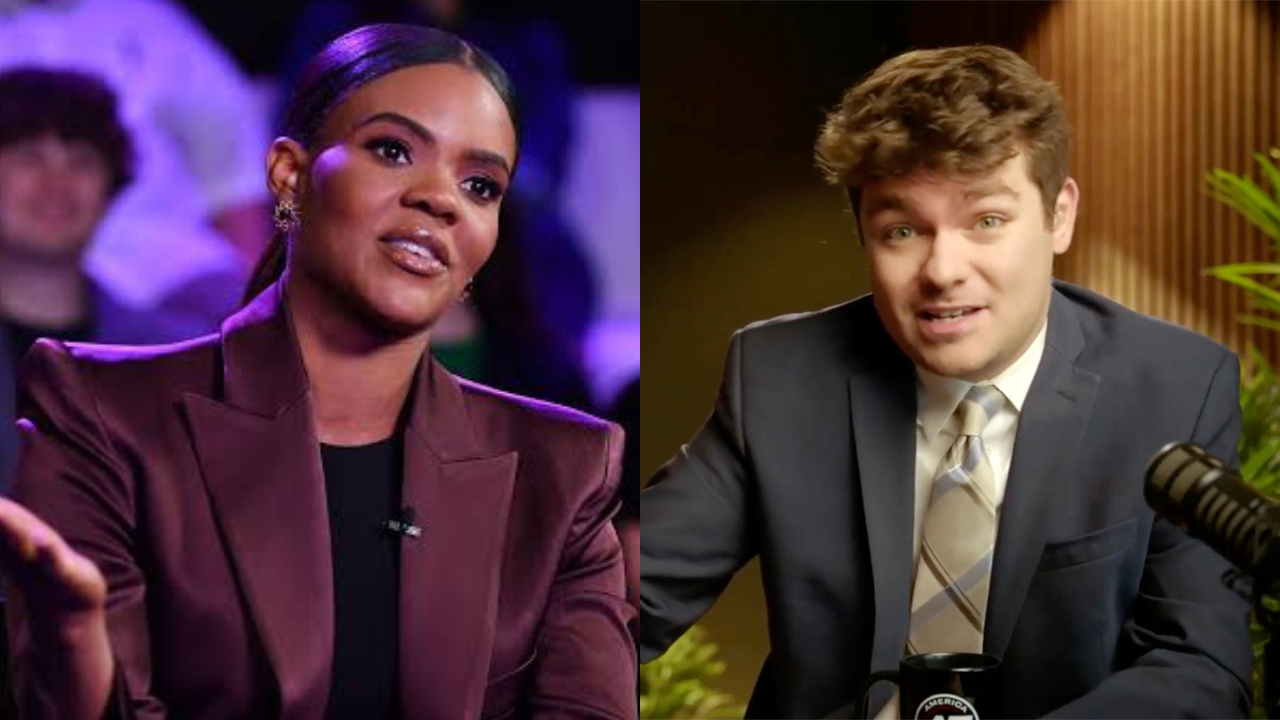
The political theater surrounding Nick Fuentes and the pepper spray incident involving Marla Rose has shifted from a street-level skirmish into a full-scale litmus test for the American far-right. While the legal maneuvers—Rose dropping criminal charges in favor of a civil lawsuit—suggest a tactical pivot, the real story lies in the immediate and aggressive defense of Fuentes by Candace Owens. This is not merely a dispute over a canister of irritant. It is a calculated moment of realignment where traditional conservative media figures are forced to choose between the guardrails of polite society and the raw, unfiltered energy of the "Groyper" movement.
The facts of the encounter remain a flashpoint. During a confrontation in Chicago, Fuentes was doused with pepper spray by Marla Rose, an activist who has long tracked and protested his presence. Initially, the narrative centered on the legality of the physical exchange. However, the dismissal of criminal charges against Rose does not signal her innocence or Fuentes’s defeat. Instead, it moves the battleground to civil court, where the burden of proof is lower and the potential for financial discovery is higher. For Fuentes, a man whose career depends on the perception of being an untouchable outsider, the civil suit represents a different kind of threat: a deep dive into his finances and the logistical support behind his operations. Learn more on a related subject: this related article.
The Candace Owens Intervention
Candace Owens did not just comment on the incident; she staked a claim. By backing Fuentes, Owens signaled a definitive break from the institutional GOP and the "Mainstream Right." Her support was framed as a defense of free speech and a rejection of "leftist violence," but the subtext was much louder. She is betting on the idea that the future of the conservative movement belongs to the dissidents who are unafraid of being associated with the fringe.
This move is high-risk. Fuentes is a pariah to most corporate sponsors and legacy media outlets. By aligning with him, Owens is burning bridges that she spent years building at outlets like The Daily Wire. This isn't a mistake. It is a deliberate strategy to capture an audience that feels abandoned by the "Con-Inc" establishment. Owens understands that in the current attention economy, loyalty to a specific, high-intensity subculture is more valuable than broad, lukewarm approval from the general public. Further reporting by The New York Times delves into comparable views on this issue.
The Civil Lawsuit Strategy
Marla Rose’s decision to drop criminal charges is a classic legal pivot. Criminal cases are handled by the state, and the complainant often loses control over the narrative and the outcome. By filing a civil lawsuit, Rose keeps the reins. She can demand depositions. She can subpoena records.
The strategy here is likely "lawfare"—using the legal system not just to seek damages, but to harass and deplatform an opponent. For Fuentes, whose income streams are already precarious due to various bans from payment processors, a protracted legal battle is a war of attrition. He may win the argument on the street, but losing in the courtroom via legal fees and discovery could be a killing blow to his organization.
A Movement Eating Itself
The reaction to the Owens-Fuentes alliance has exposed deep fissures within the right-wing ecosystem. You have the "Old Guard" who view Fuentes as a toxic liability that will prevent the movement from ever achieving mainstream electoral success. Then you have the "New Dissidents" who believe the Old Guard is comprised of nothing more than "controlled opposition."
This infighting is the natural result of a movement that lacks a centralizing figure or a coherent set of policy goals beyond "anti-wokeness." When the primary motivator is opposition to a common enemy, the moment that enemy is out of sight, the movement turns inward. The pepper spray incident acted as a chemical catalyst, speeding up a reaction that was already simmering.
The Logistics of the Confrontation
The Chicago incident wasn't an accident. It was the result of two opposing forces seeking a physical manifestation of their online rhetoric. Fuentes travels with a specific intent to provoke a reaction that he can then broadcast to his followers as proof of his persecution. Rose, conversely, represents the "direct action" wing of the left that believes silence is complicity.
When these two ideologies meet on a sidewalk, the outcome is predictable. What is less predictable is how the footage is edited and disseminated. In the hours following the spray, both sides released snippets of video designed to make the other look like the aggressor. This is the new reality of political engagement: the event itself matters less than the thirty-second clip that survives the encounter.
The Financial Stakes of Deplatforming
One cannot analyze the Fuentes-Rose-Owens triangle without looking at the money. Fuentes has been a test case for "financial deplatforming." He has been kicked off almost every major social media platform and payment gateway. His survival has depended on crypto-donations and obscure, fringe hosting services.
Candace Owens, while still vastly more mainstream, has also flirted with the edges of deplatforming. Her defense of Fuentes is a defense of the "right to exist" in the digital and financial square. If Fuentes can be sued out of existence for a sidewalk confrontation, who is next? That is the question Owens is posing to her audience. She is framing the civil suit against Fuentes as an attack on the entire dissident right.
The Role of Independent Media
The reason this story gained such traction isn't because of the legacy networks. It's because of the decentralized network of streamers, podcasters, and X (formerly Twitter) accounts that thrive on this specific brand of controversy. These creators don't follow the rules of traditional journalism. They don't need a "second source" or a "balanced perspective." They need a side to root for.
Owens has become the de facto queen of this independent media space. She provides the intellectual veneer for arguments that were previously confined to anonymous message boards. By bringing Fuentes into her orbit, she is validating his presence to millions of people who might have previously dismissed him as too radical.
Tactical Errors and Strategic Wins
If Rose’s goal was to stop Fuentes, the pepper spray was a tactical error. It gave him the "victim" status that is the lifeblood of his brand. It allowed him to claim that the left is so afraid of his ideas that they must resort to chemical weapons to silence him.
However, the lawsuit is a different story. If Rose’s legal team is competent, they will move the focus away from the politics and toward the specific actions and damages. They will try to bankrupt him. In the world of high-stakes political activism, a bankrupt enemy is just as good as a jailed one.
The Shift in Rhetorical Standards
We are witnessing a total collapse of the "middle ground" in political discourse. Ten years ago, a conservative figure like Owens would have issued a boilerplate statement condemning all violence while distancing themselves from a figure like Fuentes. Today, that distance is seen as weakness.
The "New Right" demands total solidarity. If you aren't willing to defend the most controversial figures in your camp, you are viewed as a traitor. This creates a feedback loop where figures are pushed into increasingly radical positions just to maintain their base of support. Owens isn't just following this trend; she is leading it.
The Chicago Legal Landscape
Chicago is a city with a complex relationship with political protests. The local authorities are often caught between a rock and a hard place when dealing with figures who go there specifically to stir the pot. The decision to drop criminal charges likely reflects a desire by the State’s Attorney to stay out of a political quagmire. A civil trial, however, will be held in a different atmosphere. It will be about "torts" and "liabilities," not "free speech" and "incitement."
Predictable Patterns of Escalation
The trajectory of this incident follows a weary, familiar pattern.
- The Event: A physical confrontation recorded on multiple phones.
- The Viral Peak: The footage is shared with polarized captions.
- The Celebrity Endorsement: A larger figure (Owens) uses the event to signal their tribal loyalty.
- The Legal Pivot: Criminal charges are traded for a civil war of attrition.
The end result is rarely a resolution. Instead, it is a hardening of the lines. Those who support Fuentes will see the lawsuit as a "witch hunt." Those who support Rose will see it as "accountability."
The Erosion of Traditional Gatekeeping
The most significant takeaway from the Owens-Fuentes-Rose saga is the total irrelevance of traditional media gatekeepers. In the past, a figure like Fuentes would have been successfully "canceled" by a loss of platform. But the infrastructure built by the dissident right—combined with the backing of major influencers like Owens—has created a parallel reality where "cancellation" is simply a branding opportunity.
This parallel infrastructure is what allows a street fight in Chicago to become a national news story. It provides the legal funds, the media coverage, and the emotional support necessary to turn a liability into an asset. Owens knows that by backing Fuentes, she is positioning herself as the leader of this parallel world. She is no longer looking for a seat at the table; she is building her own room.
The lawsuit filed by Marla Rose will drag on for months, perhaps years. It will be filled with motions, counter-motions, and fund-raising emails from both sides. But the damage is already done. The incident has successfully forced a realignment of the American Right, pushing the movement further away from the center and into a confrontational, uncompromising stance. The pepper spray has cleared, but the eyes of the political world are still stinging from the fallout.
The real question isn't whether Fuentes or Rose wins the lawsuit. The question is whether the institutional structures of American politics can survive a landscape where every minor confrontation is transformed into a battle for the soul of the nation, mediated by influencers who benefit more from the conflict than the resolution. If the current trend holds, the answer is a resounding no. The goal is no longer to convince the other side; it is to exhaust them until they have nothing left but their rage.
The move from criminal to civil court is simply a change of scenery for a play that has no final act. For the participants, the process is the point. The depositions will be clipped for social media. The court appearances will be live-streamed. The verdict, whatever it may be, will be rejected by one side as a sham and celebrated by the other as a divine mandate. This is the new standard of justice in an age where the court of public opinion is the only one that truly matters.
Expose the finances. Subpoena the emails. Record the depositions. The war of attrition has moved into the discovery phase, and in this arena, the truth is often less important than the ability to pay the legal bills. For Fuentes, Owens, and Rose, the struggle is the brand. They will ride this incident until the next one inevitably takes its place, leaving the public to sort through the wreckage of a discourse that no longer knows how to settle a grievance without a camera rolling and a lawyer on retainer.