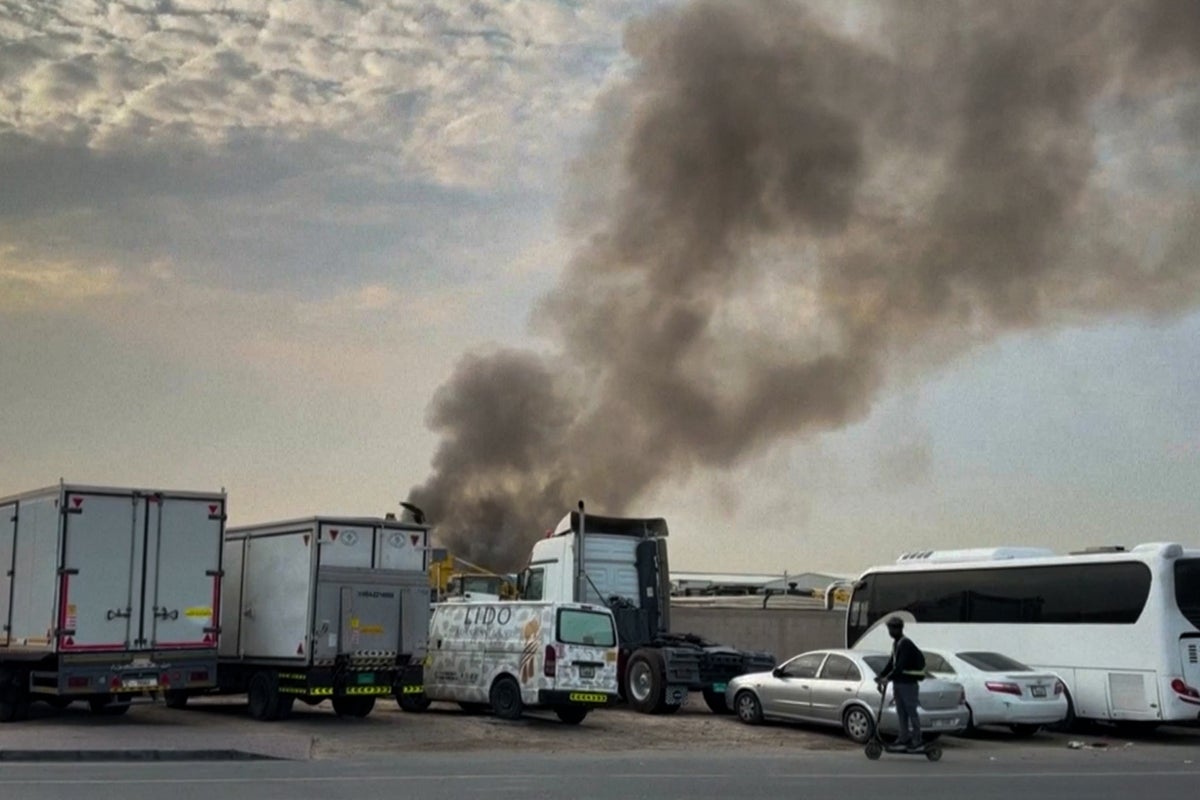
The smoke rising from the Dubai International Financial Centre (DIFC) marks more than a structural fire. When debris from an intercepted kamikaze drone struck one of the most expensive pieces of real estate on the planet, it shattered the illusion of total insulation that the United Arab Emirates has cultivated for decades. This was not a random malfunction. It was a targeted penetration of a specific airspace designed to protect billions in global capital. For an economy built on the promise of being a safe harbor in a volatile Middle East, the physical presence of shrapnel in the financial district is a direct challenge to the nation's primary export—stability.
The incident follows a pattern of escalating regional tension where low-cost, high-impact autonomous systems are used to bypass traditional defense hierarchies. While official reports often focus on the efficiency of interception, the reality on the ground is messier. Even a "successful" shoot-down results in kinetic energy that must go somewhere. In a city defined by vertical density and glass facades, gravity is an enemy. When a projectile is neutralized directly above a business hub, the fallout becomes a weapon of its own, capable of disrupting global markets and forcing a reassessment of sovereign risk.
The Calculus of Kinetic Failure
Modern air defense is an exercise in probability, not a guarantee of safety. The UAE operates some of the most sophisticated hardware in the world, including the Terminal High Altitude Area Defense (THAAD) and Patriot systems. These are designed to hit fast-moving ballistic missiles. They are, quite literally, trying to hit a bullet with another bullet at hypersonic speeds. However, the kamikaze drone operates in a different lane. These "suicide" drones, often referred to as loitering munitions, are slow, small, and made of materials that offer a minimal radar cross-section.
The problem is the altitude. Most defense systems are optimized for threats coming from the stratosphere. A drone hugging the coastline or weaving between the desert dunes stays below the effective floor of many long-range sensors. By the time a short-range defense system engages, the target is already over a populated area. If you blow up a drone five hundred feet above a skyscraper, the engine block and the remaining fuel load do not vanish. They accelerate toward the pavement.
Why the Financial District was the Target
The choice of the DIFC is not accidental. It is the geographic center of the UAE's pivot toward a post-oil economy. A drone hitting an empty stretch of the Rub' al Khali desert is a footnote. A drone hitting the financial heart of the Middle East is a global headline that moves the needle on insurance premiums for every ship and building in the region.
Foreign direct investment is a skittish creature. It seeks stability above all else. When a physical strike occurs in a regulated financial zone, it signals that the "security tax" for doing business in Dubai is about to increase. Lloyds of London and other global underwriters do not look at these events as isolated accidents. They view them as a change in the risk profile of a region that was supposed to be the "Switzerland of the Sands." If the most protected square mile in the country can be showered with burning metal, the entire premise of the region's safe-haven status is under fire.
The Low Cost of Asymmetric Warfare
The cost to launch a swarm of kamikaze drones is negligible compared to the billions of dollars in real estate and infrastructure they threaten. A single drone can be assembled for the price of a used sedan. The missiles used to intercept them cost millions of dollars each. This is an economic war of attrition where the defender is forced to overspend to protect a static target, while the attacker can fail nine times out of ten and still win if the tenth drone causes a fire in a high-profile tower.
This math is unsustainable. The UAE and its neighbors are now forced to rethink the very nature of urban defense. It is no longer about big radars on the horizon. It is about "point defense"—small-scale, rapid-fire systems that can neutralize a target at a very short range. But even this has a downside. Using a Gatling-style cannon to shred a drone in a city means thousands of rounds of heavy caliber ammunition are being fired into the air over a crowded street. What goes up must come down.
The Problem with Glass
Architecture in Dubai is a celebration of glass. It is a material that symbolizes modernity and wealth. It is also remarkably fragile in the face of a pressure wave or falling shrapnel. When the debris from the DIFC interception hit, the damage wasn't just structural; it was a sensory nightmare. Shards of reinforced glass falling from a fifty-story building are as lethal as the drone itself.
This creates a secondary crisis for building owners and insurers. The cost to replace specialized glass panels on a skyscraper is immense. The labor required to secure a "wounded" building in a high-wind environment like the Gulf is even higher. If these incidents become more frequent, the "vertical city" model starts to look like a liability.
Behind the Interception
The official narrative usually emphasizes the "successful interception" of the threat. This is technically true but practically misleading. An interception that results in fire and damage on the ground is a partial failure of the mission. The goal of air defense is to keep the debris away from high-value targets.
In the DIFC case, the timing was critical. The drone was likely detected late, forcing a short-range engagement. This suggests that the attackers are refining their flight paths to exploit "blind spots" in the urban sensor grid. These spots are created by the very buildings the defense systems are trying to protect. Every skyscraper creates a radar shadow. A drone flying through those shadows is nearly invisible until it is right on top of its objective.
The Regional Rivalry Factor
The source of these drones is rarely a mystery to those who follow regional dynamics. The technology is almost always traced back to Iranian-backed groups or the Houthi rebels in Yemen. These actors have mastered the art of "cheap and effective" warfare. By targeting Dubai, they are sending a message to the entire GCC (Gulf Cooperation Council) alliance. The message is simple: Your wealth is not a shield.
For the UAE, this is a delicate diplomatic tightrope. They must project strength to reassure investors, but they must also avoid an escalatory spiral that could lead to a full-scale regional conflict. A military response could trigger more attacks, while a lack of response could be seen as weakness. The middle ground—investing in even more expensive defense technology—is the current path.
The Drone Swarm Threat
The most concerning development is the move toward swarm technology. A single drone is easy to track and shoot down. A swarm of fifty drones, all attacking from different directions and altitudes, is a nightmare for even the most advanced systems. These swarms are designed to overwhelm the radar's processing capability and "saturate" the defense.
Imagine twenty drones approaching the Burj Khalifa simultaneously. If the defense system stops nineteen, but the twentieth hits the top third of the building, the mission is a success for the attacker. The psychological impact of seeing a landmark on fire is more valuable than any military objective. This is what the DIFC incident foreshadows: a future where the sheer volume of low-cost threats makes total protection impossible.
The Economic Aftermath
The real damage from the DIFC strike is not the broken glass or the smoke. It is the subtle shift in the risk-reward ratio for international firms. Many companies have their regional headquarters in Dubai precisely because it is seen as a bubble of safety in a rough neighborhood. If that bubble is pierced, the logic for staying there begins to erode.
Saudi Arabia is currently building "The Line" and other massive "Giga-projects" that will face the same threats. The DIFC incident is a warning for the entire Arabian Peninsula. The era of the "safe harbor" is being replaced by the era of the "hardened target." This requires a fundamental shift in how cities are built and managed. It means more visible security, more drills, and a more militarized urban environment.
The Role of Counter-Drone Technology
The next phase of this conflict will be fought in the electromagnetic spectrum. Electronic warfare (EW) and directed-energy weapons (lasers) are the only way to combat the drone threat without the risk of falling debris. By "jamming" the drone's signal or "frying" its electronics with a high-powered microwave, the threat can be neutralized more cleanly.
However, these technologies are still in their infancy for urban deployment. Jamming a drone in the middle of a financial district also means jamming the cell phones and Wi-Fi networks of every business in the area. High-powered lasers require massive amounts of electricity and can be dangerous to civilian aircraft or anyone in the line of sight. There is no silver bullet.
A New Reality for Global Hubs
The DIFC strike is a reminder that in the 21st century, the front line is anywhere a drone can fly. For Dubai, the challenge is to maintain its image as a luxury destination and financial powerhouse while simultaneously turning its skyline into a fortress. It is a contradiction that will be difficult to manage.
Security is no longer a background process; it is a front-and-center concern for every tenant and investor. The smoke over the financial district might have cleared, but the questions it raised are only beginning to be answered. The city's resilience will be measured by its ability to adapt to a world where the most significant threats are small, slow, and increasingly difficult to stop. The sky is no longer a neutral space; it is a vector.
Insurance companies are already revising their "act of war" and "terrorism" clauses for the region. A few years ago, these were boilerplate additions that most people ignored. Now, they are the subject of intense negotiation. The cost of doing business in a high-rise in the Gulf just went up, and it’s not coming back down anytime soon.
The UAE must decide if it will continue to rely on external defense contractors or if it will take the difficult step of developing its own end-to-end security architecture that is purpose-built for its unique urban geography. Until then, every drone spotted on a radar screen is a potential threat to the nation's economic heart.
The smoke is a signal. The debris is a warning. The next move belongs to the architects of the city’s defense, who are now racing against an enemy that gets cheaper and smarter with every passing month. If you are a business leader with an office in the DIFC, the risk is no longer theoretical. It is as real as the shrapnel on the sidewalk.