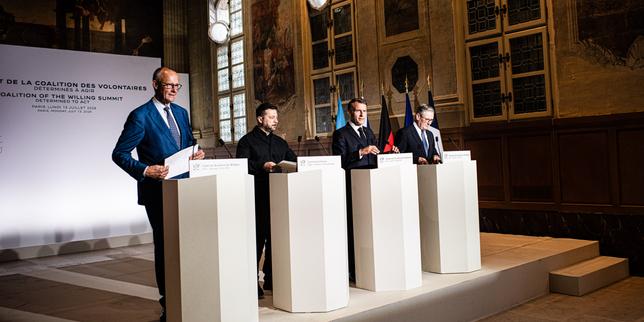
The traditional military flyover above the Champs-Élysées always aims to project unshakeable state power. For this July 14 Bastille Day parade, Western leaders have orchestrated an even grander spectacle—a highly publicized "coalition of volunteers" marching shoulder-to-shoulder to telegraph absolute solidarity with Ukraine and a defiant message to Vladimir Putin. Yet beneath the synchronized marching boots and the roaring fighter jets lies a much grimmer reality. This public display of a unified European front is a thin veneer masking severe industrial shortfalls, deep-seated political fractures, and a growing panic over the sustainability of long-term military aid.
The primary objective of this year's parade is psychological warfare. It attempts to convince Moscow that Europe's pockets are deep and its political will is ironclad. But a forensic look at the actual defense outputs, shifting electoral dynamics across the continent, and the logistical bottlenecks of European militaries reveals that the coalition is hitting its structural limits.
The Empty Arsenals Behind the Pomp
Military parades excel at showcasing pristine equipment. What they cannot show are the depleted stockpiles sitting in the warehouses behind those lines. For over two years, European nations have dipped into their active reserves to supply Kyiv, operating under the assumption that industrial manufacturing could rapidly scale up to replace the gaps. That assumption has proven dangerously naive.
Consider artillery ammunition, the brutal metric defining the attrition warfare in eastern Ukraine. European defense contractors face severe structural constraints. They struggle with shortages of basic raw materials like nitrocellulose, which is essential for gunpowder, alongside a critical deficit of skilled labor. A defense ministry official, speaking on the condition of anonymity, admitted that while the political rhetoric remains highly ambitious, the actual lead times for placing and receiving orders for heavy munitions have doubled since early 2022.
The defense industrial base in Europe was designed for peacetime efficiency, not high-intensity industrial warfare. It relies on fragile, highly specialized supply chains. If a single supplier of specialized steel or microelectronics in the chain experiences a delay, the entire assembly line halts. The result is a glaring discrepancy. Politicians stand on stages promising millions of shells, while factories on the ground struggle to ship a fraction of those figures.
The Sovereignty Trap in European Defense
The grand narrative of European defense cooperation always sounds promising in speeches, but the reality is bogged down by national self-interest. True integration would require nations to standardize their equipment and pool their purchasing power. Instead, Europe remains a patchwork of competing defense contractors, each fiercely protected by their respective home governments.
- Project Duplication: France, Germany, and other regional powers continue to fund competing programs for next-generation tanks and fighter jets. This divide-and-conquer approach to procurement dilutes overall research budgets and prevents the cost savings that come with mass production.
- Interoperability Failures: Troops from different European nations often cannot share basic spare parts or ammunition in the field because their proprietary systems are designed to different national specifications.
- Economic Protectionism: Governments hesitate to award lucrative defense contracts to foreign European suppliers, preferring to keep the jobs and capital within their own borders even if it means slower delivery times and higher costs.
This protectionism means that the "coalition of volunteers" is not a unified military machine. It is a loose collection of independent actors. They are trying to fight an industrial war of attrition using boutique, low-volume production methods.
The Looming Political Cliff
While the industrial crisis is structural, the political crisis is immediate. The coalition marching down the Champs-Élysées is politically fragile, with several key governments facing intense domestic opposition that could soon sever the flow of aid.
In Paris, the very host of the Bastille Day celebrations, the political ground is shifting. The government's ability to push through massive defense spending hikes is severely constrained by a highly polarized parliament and a staggering national debt. Public fatigue with inflation and the rising cost of living has given substantial ammunition to political factions who argue that domestic social spending is being sacrificed to fund a foreign war.
Across the Rhine, Germany’s coalition government remains perpetually divided over the scope of its military commitments. Berlin has repeatedly hesitated to send longer-range weapon systems, paralyzed by the fear of direct escalation with Moscow and deeply rooted historical anxieties. This hesitation has created friction with Eastern European allies, particularly Poland and the Baltic states, who view any sign of caution as weakness.
Further complicating the picture is the changing political landscape in Washington. European strategists are privately terrified of a potential shift in U.S. foreign policy that could leave Europe solely responsible for funding and arming Ukraine. Without the massive intelligence, logistical, and financial backbone provided by the United States, Europe's current contributions would be entirely insufficient to prevent a collapse of the front lines.
The Mirage of Fast-Track NATO Integration
A major talking point of this year's diplomatic offensive is the closer alignment of Ukrainian forces with NATO standards. We see joint training initiatives, shared intelligence feeds, and promises of future membership. But integrating a military mid-conflict is an incredibly chaotic process.
The Ukrainian military is currently forced to operate an absurdly diverse logistical nightmare. They must maintain British Challenger tanks, German Leopards, American Abrams, and Soviet-era armor simultaneously. Each of these platforms requires entirely different spare parts, maintenance protocols, and ammunition types.
This logistical chaos is not easily resolved by training programs in Western Europe. It requires a massive, secure supply chain stretching from deep within NATO territory directly to the front lines. Russia has consistently targeted these supply corridors, forcing Ukraine to execute highly complex, dangerous transport operations just to keep their foreign-supplied gear running.
Moving Beyond Symbolic Displays
The Bastille Day parade serves its purpose as a piece of political theater, but theater does not win wars of attrition. If the coalition of volunteers wants to transition from a symbolic alliance to a functional military deterrent, it must make difficult, politically painful choices.
First, European leaders must stop treating defense spending as a domestic jobs program. They need to aggressively standardize weapons platforms across the continent, even if it means shutting down redundant national industries.
Second, governments must provide defense contractors with long-term, guaranteed procurement contracts spanning a decade or more. Private manufacturers will not invest the hundreds of millions of dollars required to build new factories and train new workers if they fear that state funding will dry up the moment the current conflict reaches a temporary ceasefire.
Finally, Western leaders need to be honest with their electorates. They must explain that supporting a long-term conflict requires sustained economic sacrifices, rather than pretending that victory can be achieved through clever diplomacy and existing military surpluses alone.
The jets screaming over Paris will soon land, the flags will be packed away, and the politicians will return to their offices. When the smoke clears, the cold, hard mathematics of industrial production and political will remain. Europe is running out of time to turn its symbolic unity into actual physical power.