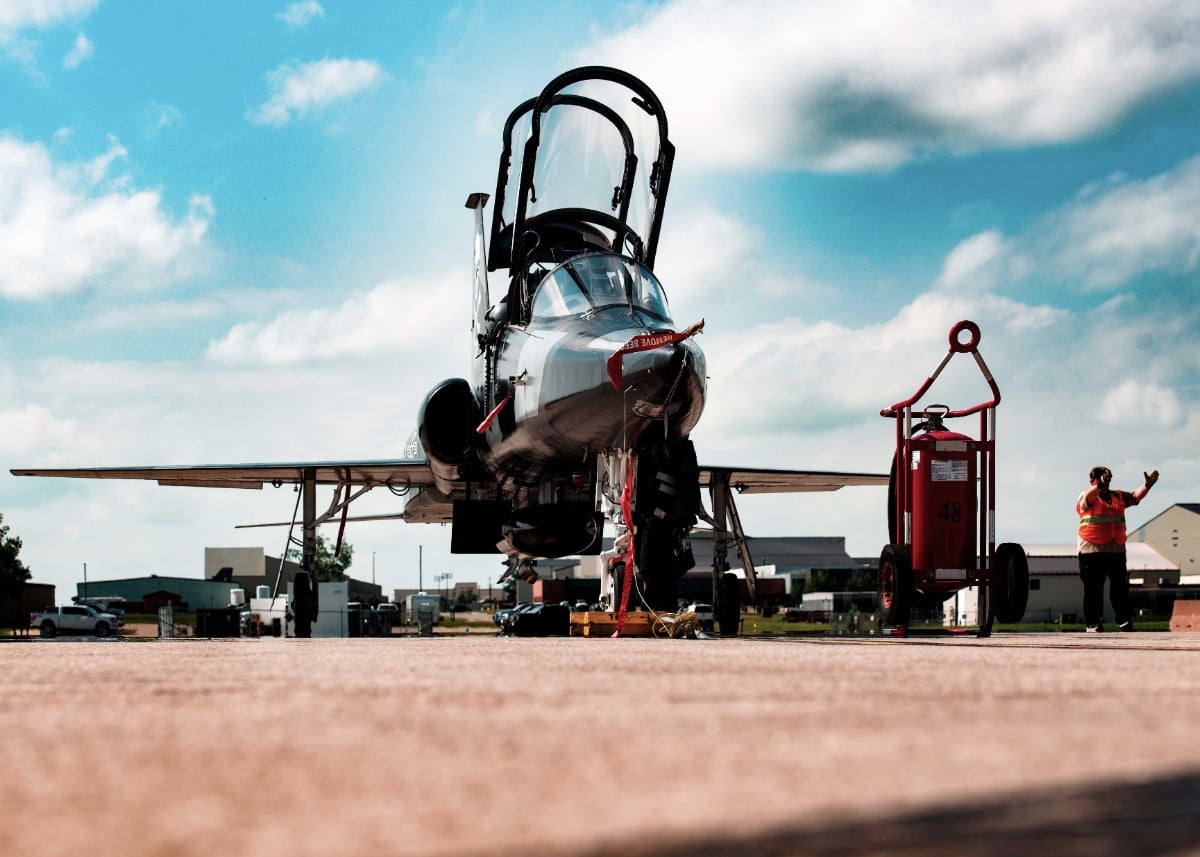
The Pentagon just approved a $4 billion contract to overhaul and support its pilot training hubs. The defense tech establishment is cheering. Mainstream defense trade publications are dutifully copy-pasting the press release, hailing this massive capital allocation as a vital upgrade to readiness and a major win for pilot proficiency.
They are dead wrong.
This massive expenditure is not a forward-looking strategy. It is an expensive insurance policy for a legacy platform that is rapidly losing relevance. We are burning billions to perfect human reflexes for a theater of war that will be entirely dominated by silicon, algorithms, and autonomous systems.
I spent over a decade inside defense procurement pipelines, watching committee after committee vote to throw good money after bad, simply because acknowledging reality would mean admitting that entire weapon programs are obsolete before they leave the hangar. This $4 billion contract is the pinnacle of that denial.
The Flawed Premise of the "Ready Pilot"
The lazy consensus in defense circles assumes that the bottleneck in modern air superiority is the human pilot's training environment. The argument goes like this: if we build better simulators, synthesize more complex threat environments, and link training hubs across the country, our pilots will be sharper than the adversary.
This logic collapses under the weight of modern anti-access/area-denial (A2/AD) reality.
Imagine a scenario where a human pilot in an F-35 encounters a swarm of autonomous, low-cost loitering munitions controlled by a decentralized mesh network. The human brain, even when augmented by a $400,000 helmet, operates on a biological delay. Neural processing takes time. Biological g-force limitations cap structural maneuvers at roughly 9Gs before the human blacks out.
An autonomous vehicle cares nothing about g-forces. It does not experience cognitive overload. It does not need a $4 billion simulated training hub to learn how to fly in formation or execute a tactical turn. It needs code, iterative machine learning loops, and cheap, scalable hardware.
By spending $4 billion to optimize human training, we are optimizing for the wrong variable. We are spending Ferrari money to tune a horse and buggy.
The Hidden Cost of the Simulation Industrial Complex
The defense primes love training contracts. Why? Because they are low-risk, high-margin, and perpetually renewable. Unlike building a new airframe, which carries immense engineering risk and public scrutiny, managing "training pipelines" is a bureaucratic goldmine.
Here is how the game is actually played:
- The Baseline Trap: A contractor builds a simulation environment using proprietary architecture.
- The Vendor Lock-in: The hardware requires specific software updates that only the original contractor can provide.
- The Sustenance Loop: Every time the actual aircraft gets a software patch, the training simulator requires a multi-million dollar "alignment update."
This $4 billion does not go directly to making a lieutenant a better dogfighter. A massive percentage of it is swallowed by software maintenance backlogs, proprietary interface fees, and the sheer overhead of maintaining physical infrastructure across sprawling military bases.
If you want to know where the money should actually go, look at what groups like the Defense Advanced Research Projects Agency (DARPA) proved with the AlphaDogfight Trials. An AI algorithm, developed on a fraction of a fraction of this contract's budget, consistently defeated an experienced Air Force F-16 instructor pilot in simulated visual-range dogfights. The AI did not need a multi-billion dollar hub. It needed a server rack.
Dismantling the Frequently Asked Questions
When you point out the absurdity of these massive training allocations, the defense establishment relies on a handful of canned talking points to defend their budgets. Let us dismantle them one by one.
Don't we still need human pilots for ethical decision-making and command?
This is the standard shield used to justify every legacy aviation budget. The argument assumes that an autonomous system must be entirely unmonitored to be effective. It ignores the reality of human-machine teaming.
The human belongs at the command level, acting as a mission manager from a safe distance, not sitting in a multi-million dollar cockpit trying to manually dodge hypersonic missiles. We should be training officers to manage autonomous swarms, not spending billions to teach 22-year-olds how to stick-and-rudder an aircraft through a simulated SAM site.
If our adversaries are investing in advanced fighter pilots, shouldn't we?
This is peer-adversary mimicry, and it is a trap. If an adversary spends billions building a traditional fifth-generation fighter fleet and training pilots to fly them, the correct asymmetrical response is not to copy them. The correct response is to build a counter-system that renders their massive investment useless.
An adversarial pilot who trained for 5,000 hours in an advanced simulator is still entirely constrained by the physical limits of their aircraft and the biological limits of their meatware. A swarm of fifty autonomous drones, costing less than a single fighter jet, will overwhelm that pilot regardless of how pristine their training hub was.
The Hard Truth of Digital Engineering
The true pivot the Air Force needs to make is away from physical-centric training hubs and toward pure digital engineering environments where software can be iterated daily.
The downside to this contrarian view is obvious: it requires a radical cultural shift. It means telling thousands of personnel that their primary skill set is becoming secondary. It means forcing traditional defense primes to abandon their lucrative, decades-long maintenance contracts in favor of open-architecture, software-first development. That causes immense political friction. Senators fight to keep training bases open in their districts because bases mean jobs, not because they win modern wars.
But the alternative is worse. The alternative is entering a high-end conflict with beautifully trained pilots who are completely outpaced by superior numbers of autonomous algorithmic systems.
Stop funding the simulation of the past. Stop measure-measuring readiness by hours spent in a legacy cockpit simulator. The next conflict will not be won by the branch with the best-trained pilots; it will be won by the branch that successfully removed the human bottleneck from the kinetic loop entirely.
Turn off the simulators. Fire up the compilers.