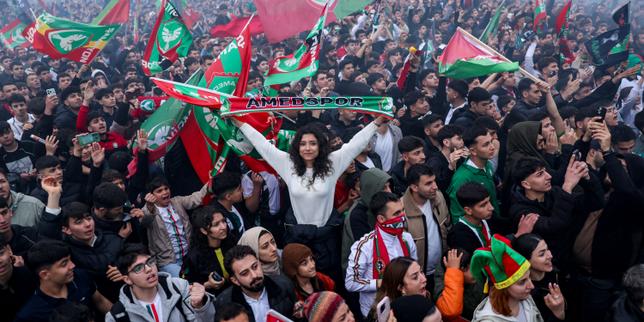
Amedspor is not merely a football club competing in Turkey s Süper Lig. Based in the southeastern city of Diyarbakır, the team functions as a public manifestation of Kurdish identity, cultural survival, and political tension that institutional diplomacy can neither suppress nor fully accommodate. When supporters chant in Kurdish or display historical symbols banned or discouraged across official civic spaces, they convert ninety minutes of athletic competition into an unvarnished referendum on national belonging. Ankara watches closely. Every home match at the Diyarbakır Stadium acts as a barometer of the state of minority rights, security crackdowns, and the fragile limits of public expression in contemporary Turkey.
The Administrative Battleground of Nomenclature
The roots of this friction stretch back decades. Founded as Melikahmet Turanspor in 1972, the club eventually adopted the name Amed in 2014, embracing the historic Kurdish designation for Diyarbakır. That renaming was never a simple administrative update. It was a calculated assertion of identity during a brief historical window when peace negotiations between the Turkish state and Kurdish political movements flickered before collapsing entirely. When the Turkish Football Federation approved the name change under strict conditions—such as forcing the club to alter its emblem colors to strip away combinations resembling the Kurdish national flag—it set a precedent. The state tolerated the entity on the pitch only under constant administrative surveillance, bureaucratic fines, and disciplinary penalties designed to keep local expression within narrow boundaries.
As the team climbed through the lower tiers of the Turkish football pyramid, every promotion brought heightened scrutiny. Away matches frequently transformed into hostile environments. Rival supporters hurled nationalist slogans, security forces maintained aggressive radiuses around team buses, and disciplinary committees imposed stadium bans for minor infractions. Yet the pushback failed to extinguish the momentum. By the mid-2020s, Amedspor crossed an invisible threshold by securing promotion to the Süper Lig, entering the elite tier of Turkish domestic football for the first time in its history. This achievement shifted the geopolitical optics completely. The club was no longer a regional curiosity tucked away in the lower divisions; it occupied prime television slots, broadcast into millions of living rooms nationwide every single weekend.
Tactical Shifts and Squad Construction
On the pitch, the sporting reality reflects modern recruitment strategies rather than pure romanticism. Management constructed a competitive squad featuring international names like striker Gift Orban, midfielder Dia Saba, and defender Lumbardh Dellova. These acquisitions transformed Amedspor from a symbolic underdog into a genuine tactical threat. Early autumn fixtures proved the point. Shock victories against traditional Turkish powerhouses like Beşiktaş and Trabzonspor stunned sports analysts, momentarily placing the club near the summit of the Süper Lig standings. When a team representing a historically marginalized region sits above Istanbul giants in the league table, the cultural resonance bypasses normal sporting metrics. It forces a nationwide audience to confront a presence they cannot easily sanitize or ignore.
The state apparatus responds to this visibility through an intricate system of friction. While top-tier political figures occasionally offer cautious congratulations following major promotional milestones to project an image of tolerance, municipal trustees appointed by the central government routinely target Kurdish institutions, pressuring local civil society. The football club occupies a unique, unprotected middle ground. It is officially registered within the Turkish sports federation, bound by its rules, yet treated by nationalist factions as a permanent security threat. Stadium restrictions, targeted refereeing decisions, and spontaneous bans on away fans highlight the precarious nature of their participation. The club cannot be outright banned without triggering severe civil unrest, nor can it be normalized without granting structural legitimacy to the identity it embodies.
The Economics of Isolation and Resistance
Opposing fans frequently weaponize historical grievances during matches. Chants celebrating paramilitary conflicts or Ottoman nationalism echo across stands whenever Amedspor visits western cities like Istanbul, Izmir, or Bursa. These incidents are rarely isolated outbursts of hooliganism; they reflect deep-seated societal fractures regarding who belongs inside the modern Turkish republic. In response, Amedspor supporters have cultivated an ethos of solidarity that extends beyond ethnic lines. The club positions itself as a sanctuary for the overlooked, drawing support not just from Kurdish nationalists, but from progressive activists, marginalized urban youth, and anti-establishment figures who view the team as a vehicle for broader social dissent.
Financial pressures add another layer of vulnerability. Corporate sponsors based in western Turkey hesitate to associate their brands with a club carrying such intense political baggage. Major multinational partnerships bypass Diyarbakır entirely, fearing backlash from state-aligned regulatory bodies or consumer boycotts in nationalist provinces. Consequently, the club relies heavily on diaspora contributions, local merchant networks, and gate receipts from packed home fixtures. This financial autonomy, while granting them independence from Istanbul-based conglomerates, leaves them exposed to sudden economic shocks and currency fluctuations that plague Turkish football finances as a whole.
The Psychological Toll on the Dressing Room
The players themselves carry an invisible burden that professional athletes in standard clubs never face. Foreign imports sign contracts knowing they will step into high-tension environments where every refereeing decision is scrutinized for bias. Domestic players understand that an emotional reaction to a racist chant from the stands can invite career-ruining disciplinary suspensions. Despite these burdens, the dressing room remains cohesive. On-field success depends on tactical discipline rather than political messaging. When Gift Orban converts a counterattack or Dia Saba threads a decisive pass through an opponent's defense, the stadium roars for reasons entirely rooted in athletic excellence. The paradox defines Amedspor's existence: they must be twice as good as their opponents just to be judged by the scoreline rather than their geography.
International observers often mischaracterize the phenomenon through the lens of traditional sports diplomacy, comparing it to other minority sporting symbols across Europe. That comparison misses the structural hostility unique to the Turkish context. Unlike regional clubs in stable democracies that enjoy constitutional protections for linguistic minorities, Amedspor operates within a legal framework where expressing Kurdish cultural identity remains heavily regulated. The pitch becomes the only viable forum where visibility is protected by the global rules of association football. FIFA and UEFA regulations prevent the Turkish state from dissolving the club overnight without inviting international sanctions, creating a fragile protective shield around the team.
As the season grinds forward into winter, the physical and psychological toll on the squad becomes visible. Injuries mount, travel logistics between Diyarbakır and western away fixtures test player recovery rates, and the constant media spotlight drains emotional reserves. Yet every matchday remains an unscripted event where the establishment's narrative meets raw, populist reality. Whether Amedspor maintains its position near the upper tier of the table or slips back into the mid-table battle, the psychological barrier has already been breached. A name once erased from official maps is now read aloud by national television anchors every Sunday night.