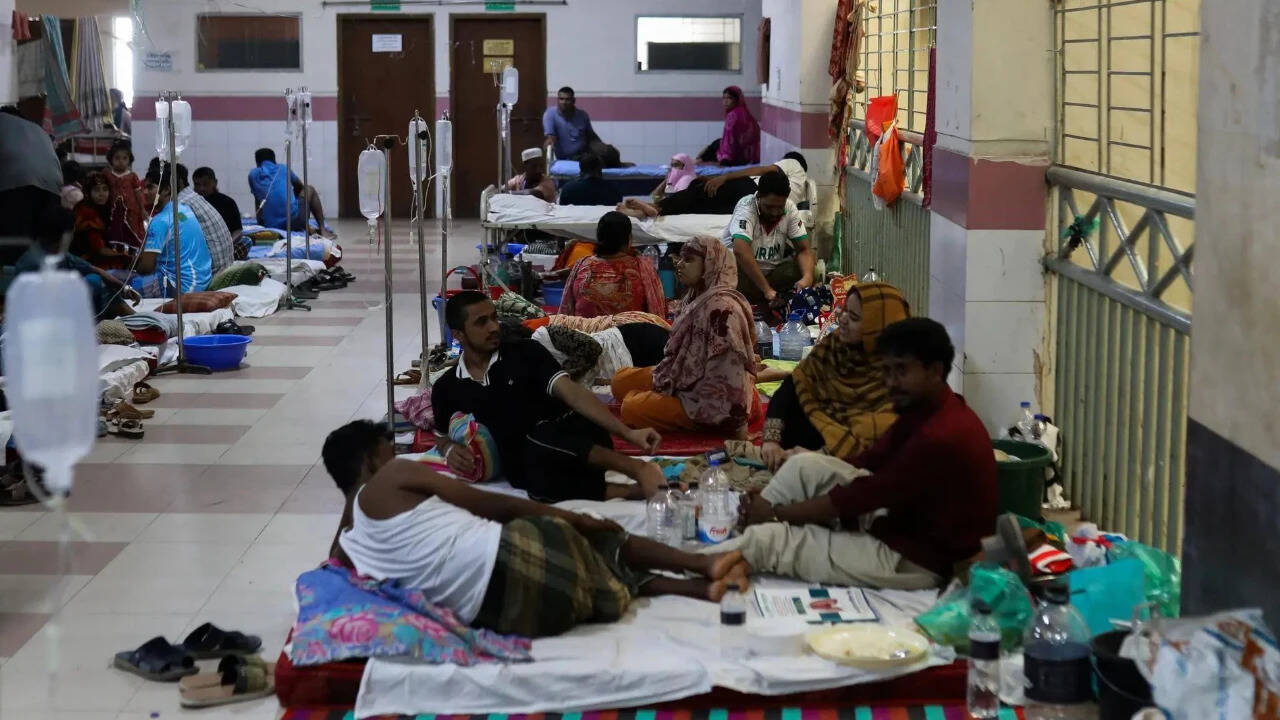
The floor of the public ward smells of bleach and unwashed linen, a sharp scent that fails to mask the underlying metallic tang of fever and sweat. A middle-aged man lies on a thin reed mat right beside the nurse station because every metal cot in the hospital was claimed forty-eight hours ago. His skin is flushed, his platelets are crashing, and an IV bag hangs precariously from a rusted window latch. This is not a field triage station set up in the wake of an earthquake. This is a tertiary medical facility in the heart of Dhaka during peak monsoon season, and the scene repeats across every public health institution in the city.
Dengue has evolved from an intermittent seasonal nuisance into an entrenched epidemiological crisis that overmatches municipal infrastructure. Every year, public health officials express shock at the surge. Every year, temporary wards are thrown together in corridors, verandahs, and outdoor tents. The response is consistently reactive, treating the symptom of an overwhelmed healthcare system while ignoring the structural decay that allows the Aedes mosquito to dictate public policy. If you enjoyed this piece, you might want to look at: this related article.
To understand why urban hospitals transform into makeshift field camps every monsoon, we must examine the intersection of climate shifts, unbridled construction, and systemic municipal failure.
The Vector And The Concrete Jungle
The life cycle of the Aedes aegypti mosquito is a masterclass in urban adaptation. Unlike malaria vectors that require stagnant rural ponds, the dengue mosquito thrives in the discarded plastic containers, construction site water traps, and rooftop gardens of a dense metropolis. Dhaka is expanding upward and outward at a frantic pace, driven by rapid urbanization and lax zoning enforcement. For another angle on this event, check out the recent coverage from National Institutes of Health.
Every new high-rise foundation dug into the damp soil creates an artificial subterranean lake when rains hit. Uncapped PVC pipes left on building sites fill with rainwater and incubate thousands of larvae within a week. The city's drainage network, choked with non-biodegradable polythene bags and construction debris, backs up during heavy downpours. Water stagnates in streets and alleys for days.
Urban planners have warned for decades that the city's physical growth outpaced its sanitation infrastructure. When concrete replaces permeable soil, runoff increases exponentially. Municipal authorities rely on periodic fogging campaigns, spraying insecticide from pickup trucks as a performative gesture that clears adult mosquitoes from the immediate air for a few hours while leaving the breeding grounds in underground reservoirs untouched.
Fogging is cheap, visible, and politically useful. Larvicidal treatment, rigorous site inspections, and infrastructural overhaul are expensive, tedious, and politically unrewarding. As a result, the mosquito population expands unchecked, feeding on a dense human population that lacks basic vector protection at home.
The Breaking Point Inside The Wards
Inside facilities like Dhaka Medical College Hospital or Mugda Medical College Hospital, the clinical reality is brutal. Nurses work double shifts without adequate protective gear, moving from bed to cot to floor mat, administering saline drips and monitoring blood pressure with exhausted precision.
The shortage is not just physical space. It is human capital and diagnostic supply.
When thousands of patients flood emergency departments simultaneously, the primary bottleneck shifts from beds to blood component separation units. Dengue hemorrhagic fever causes rapid plasma leakage and severe thrombocytopenia. Patients need platelet transfusions urgently. Blood banks run dry within hours of a surge. Families are forced to scour private laboratories and commercial blood banks, paying exorbitant black-market prices for platelets while their relatives deteriorate on the floor of a public hallway.
Physicians are forced to practice triage rationing. Patients with stable vital signs, even those suffering from debilitating joint pain and high fever, are turned away with prescriptions for paracetamol and instructions to monitor their own hydration at home. Only those actively hemorrhaging or showing signs of shock secure a physical spot inside the building.
This creates a perverse incentive. Patients wait until they are dangerously critical before seeking care, knowing that minor cases will be sent back out into the mosquito-ridden streets. By the time they arrive at the hospital, their multi-organ systems are already under severe stress, converting a manageable viral infection into a high-mortality emergency.
The Policy Vacuum
Public health messaging in the media often falls back on individual responsibility. Citizens are told to clear stagnant water from flowerpots, sleep under mosquito nets, and wear long sleeves. While sound advice, it shifts the burden of structural failure onto the individual.
A day laborer living in a tin-shed slum with open sewage running past the doorstep cannot mosquito-proof their home. A family renting a single room in an apartment building has no control over the construction site next door or the stagnant water in the building's underground parking garage. Vector control is inherently a collective, municipal responsibility. When local government bodies fail to enforce building codes, clear drainage canals, and maintain rigorous sanitation standards, individual precautions act as mere bandaids on a gaping wound.
Furthermore, coordination between municipal corporations and the central health ministry remains fractured. The city corporations handle mosquito eradication, while the health directorate manages hospitals. These two entities operate in separate silos with minimal operational synergy. When an outbreak flares, the health directorate scrambles to find floor space for patients while the city corporations continue routine, ineffective spraying schedules, each blaming the other for the rising death toll.
Breaking The Cycle
Mitigating this annual catastrophe requires abandoning the emergency mindset and adopting a permanent, year-round preventive strategy.
First, vector control must be decentralized and weaponized against larval sites rather than adult insects. Biological control methods, such as introducing larvivorous fish into permanent water bodies and utilizing bacterial larvicides like Bacillus thuringiensis israelensis (Bti), offer sustainable suppression without chemical resistance buildup.
Second, real-time data integration must replace sluggish bureaucratic reporting. Private clinics and public hospitals must feed admission numbers into a centralized digital registry that tracks infection hotspots down to the neighborhood level. This allows municipal authorities to deploy targeted sanitation crews to specific blocks weeks before an outbreak peaks, rather than reacting after the wards are overflowing.
Third, primary healthcare clinics in every ward must be upgraded to handle fluid management and basic testing. Currently, minor dengue cases bypass local clinics entirely and head straight for tertiary hospitals because peripheral facilities lack diagnostic tools and trained staff. Strengthening primary care prevents the centralization bottleneck that leaves patients sleeping on verandahs.
The floor of the public hospital ward is a mirror reflecting the state of urban governance. Until urban development is tied directly to public health infrastructure, and until vector control is treated as a year-round war rather than a monsoon-season public relations campaign, the mats will remain on the concrete, and the mosquito will continue to win.