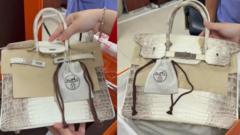
The mainstream media loves a predictable script when a billionaire falls from grace. A corrupt tycoon gets arrested, the state seizes their assets, and a flashy public auction hammers down millions for a collection of rare handbags.
The recent auction of a jailed Vietnamese tycoon’s Hermès Birkin bag collection, which fetched over $550,000, triggered the usual wave of breathless commentary. Financial pundits and luxury bloggers jumped on the data point to chant the same tired mantra: luxury handbags are an unbeatable alternative asset class, a recession-proof hedge, and a smarter investment than equities.
They are completely misreading the room.
Treating a forced asset liquidation in a highly manipulated market as proof of macroeconomic stability is financial malpractice. The $550,000 headline is not evidence of a booming, resilient secondary market. It is a textbook example of artificial scarcity, survivor bias, and the unique pathology of panic-buying at state-sponsored auctions.
The Flawed Premise of the Handbag Hedge
When people see a collection of crocodile and ostrich skin bags sell for half a million dollars under a judge's order, they assume the value is inherent to the leather and the brand.
It isn't. The valuation is entirely propped up by a structural anomaly that luxury houses spend millions to maintain: the artificial barrier to entry.
To buy a Birkin at retail, you cannot just walk into a boutique with a stack of cash. You must participate in a grueling, opaque system of "prespending." You buy the blankets, the pillows, the jewelry, and the asymmetric porcelain plates to build a relationship with a sales associate. Only then might you get offered the privilege of buying a bag.
The True Cost Equation: > A $12,000 retail Birkin actually costs $30,000 to $40,000 in forced ancillary purchases.
When a state auction occurs, buyers are not paying a premium because the asset appreciates like a stock. They are paying a premium to bypass the gatekeeper. The secondary market premium is simply the cost of avoiding the brand's forced retail hazing ritual.
Why Asset Forfeiture Auctions Distort Real Value
I have watched high-net-worth individuals navigate these liquidations for over a decade. The psychology of a government-run criminal auction is fundamentally different from a standard Sotheby's or Christie's fine art sale.
When the state sells off a criminal enterprise’s assets, three distinct forces artificially inflate the final hammer price, rendering the data useless for normal market analysis.
1. The Proximity to Power Premium
In emerging markets, owning the specific physical asset of a fallen titan carries a perverse prestige. It is a twisted form of trophy hunting. The buyers at these auctions are rarely pure investors looking for a 7% annualized return. They are rival oligarchs, speculators, and high-tier collectors buying a piece of contemporary history. The provenance isn't just "Hermès"; the provenance is "corrupt political drama." You cannot model that variable on an Excel sheet.
2. The Illusion of Clean Liquidity
State auctions provide a rare, legally sanitized environment where massive amounts of cash can be deployed quickly with absolute title clarity. The government is guaranteeing the authenticity and the clean transfer of the asset. For buyers operating in grey-market economies, that state guarantee eliminates transaction risk entirely. They will gladly pay a 30% premium above market value just for the peace of mind that the transaction is fully blessed by the judiciary.
3. Target Group Mania
Standard economic theory assumes rational actors. But auction rooms operate on adrenaline and proximity. Put five ultra-high-net-worth individuals in a room competing for a finite set of assets from a high-profile criminal case, and ego takes over. The final bid ceases to reflect the global market value of the object; it reflects the size of the winner's ego in that specific sixty-second window.
Dismantling the Knight Frank Luxury Investment Index Myth
Proponents of the "handbag asset class" love to cite the Knight Frank Luxury Investment Index, which frequently places bags near the top of passion investments, sometimes outperforming wine, watches, and art over a ten-year horizon.
But these indices suffer from massive survivor bias. They track the performance of the top 0.1% of bags—the pristine, untouched, rare colorways kept in climate-controlled vaults.
Standard Luxury Asset Depreciation Trajectory:
[Retail Purchase] -> [Immediate 30% Drop if Common Style/Color]
                  -> [Gradual Decay if Worn or Exposed to Sunlight]
                  -> [0% Liquidity in Average Suburban Market]
Imagine a scenario where an investor buys five standard Hermès Kelly or Birkin bags in common black or gold leather, uses them occasionally, and stores them in a normal closet. If they try to liquidate that collection quickly during a personal liquidity crunch, they will face a brutal reality check.
- The Consignment Tax: Luxury consignment platforms take anywhere from 15% to 35% of the final sale price.
- The Liquidity Trap: Unlike a share of Apple or a government bond, you cannot click a button and liquidate a luxury bag at market price in seconds. It can sit on a shelf for months waiting for a hyper-specific buyer who wants that exact size, hardware combination, and leather type.
- Authentication Costs: The market is flooded with "super-fakes"—counterfeits so precise they require microscopic analysis to detect. Proving your asset is real costs time and money.
When you factor in the friction costs, the maintenance, and the immediate hit of the consignment fee, the real return on investment for the average buyer drops into negative territory.
The Hidden Risk: The Brand Can Destroy Your Portfolio Overnight
The ultimate flaw in treating luxury goods as a stable investment portfolio is that you are entirely dependent on the whims of a single corporate board.
If you own an index fund tracking the S&P 500, your risk is diversified across hundreds of companies. If you own a fleet of luxury bags, your net worth is entirely leveraged against the marketing strategy of executives in Paris.
What happens if the brand decides to increase production to satisfy quarterly earnings expectations? Look at what happened to the sneaker resale market. For years, Nike Jordan 1s were treated like gold. Resellers made fortunes. Then, Nike increased production runs, saturated the market, and the bottom fell out of the resale economy.
Hermès is smarter than Nike, but they are not immune to market pressures. They have been steadily increasing their production capacity, opening new leatherworking facilities across France. The second the supply curve shifts even slightly to the right, the premium on the secondary market evaporates. You are not investing in an asset; you are gambling on a corporation's willingness to keep its own customers starving.
Stop Asking if Luxury is an Investment
The mainstream financial press asks the wrong question. They look at a $550,000 auction result and ask, "Should you add luxury goods to your portfolio?"
The real question is: "Why are you looking for validation for your consumption habits?"
If you want to buy a half-million dollars worth of French leather because you love the craftsmanship, the status, or the thrill of the hunt, do it. It is your money. But do not dress up your expensive hobby in the language of Wall Street to justify it to your accountant.
A asset that yields no dividends, costs money to store and insure, loses value the moment you spill coffee on it, and requires a volatile public auction of a disgraced tycoon to hit a record price is not a financial strategy. It is a luxury circus.
Keep your capital in assets that produce actual economic value. Leave the criminal liquidation auctions to the people who need to burn cash for sport.