Silence.
In a football stadium, silence is never natural; it is a heavy, suffocating thing that settles over concrete terraces only when something has gone terribly wrong—a player motionless on the turf, a sudden medical emergency in the stands, or the breathless fraction of a second before a penalty kick decides a season. Normally, the game is defined by noise: the rhythmic thud of leather against stitched boot, the sharp intake of collective breath when a winger breaks past a fullback, the roar that rises from the throat of a crowd when the ball ripples the back of the net. If you found value in this piece, you should check out: this related article.
Now subtract all of it. Subtract the smell of damp grass under floodlights, the scratch of a pen against a spiral notebook, the casual camaraderie of a press box at halftime. Replace those sensations with four concrete walls, the metallic scrape of a heavy door sliding shut, and the slow, grinding erosion of time measured not in ninety-minute halves, but in five hundred consecutive dawns.
That is the reality facing Christophe Gleizes. For another angle on this story, see the latest update from USA Today.
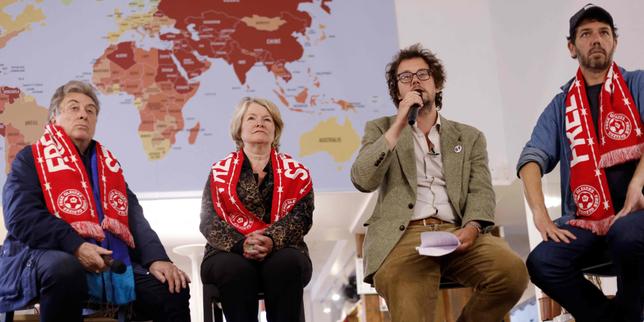
For five hundred days, the French sports journalist has been detained in Algeria, stripped of his press credentials, his freedom, and his ability to do the one thing that defines his professional existence: observe, ask questions, and tell the truth about the world through the lens of sport. To mark that grim milestone, Reporters Without Borders—known globally as RSF—has organized a solidarity football match, gathering journalists, athletes, and advocates on a pitch not to chase a trophy, but to break the quiet surrounding a man who has been locked away for doing his job.
The Architecture of a Disappearance
Most people assume that when a journalist is arrested abroad, it happens in a flash of cinematic chaos—camera lenses shattering on cobblestone streets during a riot, or armored vehicles blocking a convoy on a war-torn border. We picture war correspondents in flak jackets. We rarely picture a sports writer.
That assumption is precisely why cases like Christophe Gleizes’s are so insidious.
Sport is supposed to be the universal neutral ground, the place where politics pauses for ninety minutes and human triumph takes center stage. Yet anyone who has spent real time around international football knows that the pitch is never truly separate from the power structures surrounding it. Stadiums are monuments to national pride; clubs are vessels of regional identity; federations are often extensions of state influence. When a journalist looks past the scoreboard to examine how a league is run, how money flows through a club, or how fans express dissent from the terraces, the whistle blows—not from a referee, but from the state.
Consider a hypothetical afternoon in any major footballing city, an illustration of how easily reporting crosses an invisible line. A reporter arrives with a legitimate press pass, a voice recorder, and a list of standard questions about club management and local football culture. He speaks to players, chats with supporters outside the gates, and takes notes on the atmosphere. Nothing about the afternoon resembles espionage. Nothing resembles subversion. Yet in an environment where narrative control is absolute, curiosity itself becomes an offense. Asking why a stadium is half-empty, or interviewing a figure the authorities would rather ignore, transforms a notebook into evidence.
Once the cell door closes, the machinery of detention operates on a clock designed to exhaust the outside world.
Days turn into weeks. Weeks dissolve into months. For the public, a headline flashes briefly across a morning feed and is buried by afternoon beneath celebrity gossip, transfer rumors, and the relentless churn of daily news. Five hundred days is a number easily skimmed in a headline—just three digits, clean and abstract. To understand what five hundred days actually feels like, you have to stretch it out across your own life. Think back to where you were five hundred days ago. Think of the birthdays you have celebrated since then, the seasons that have shifted from summer heat to winter frost and back again, the hundreds of casual conversations over coffee, the freedom to walk out your front door without asking permission.
Christophe Gleizes has spent every single one of those days waiting.
Why a Football Match Matters When Words Fail
When diplomacy stalls behind closed doors and formal press releases vanish into bureaucratic drawers, advocates face a brutal strategic dilemma: how do you keep a detained human being alive in the public imagination without putting them in greater danger?
You cannot simply issue the five-hundredth identical statement demanding release. People stop reading. Outrage has a shelf life, and authoritarian systems count on that fatigue. They bet that if they hold a journalist long enough, the noise will die down, the hashtags will fade, and the prisoner will become a forgotten footnote in an annual human rights report.
RSF’s decision to organize a solidarity match is an answer to that fatigue, built on a simple, visceral truth: people understand football in their bones.
If you have ever stood on the touchline on a cold Sunday morning, watching amateur players chase a ball across muddy turf just for the love of the game, you know that football is an act of collective presence. You cannot play it alone. You cannot fake effort when your lungs are burning in the seventieth minute. By taking the campaign for Christophe Gleizes off the page and onto the pitch, RSF is translating an abstract legal crisis into something physical, visible, and impossible to ignore.
Let us be clear about what a charity or solidarity match can and cannot accomplish. It will not magically unlock a prison gate in Algiers before the final whistle blows. No referee can issue a red card to arbitrary detention, and no goal scored on a French pitch will overturn a judicial order thousands of miles away. Anyone pretending otherwise would be selling sentimentality instead of strategy.
What the match does accomplish is far more practical—and far more threatening to those who rely on silence.
First, it creates an undeniable visual record. Photographs of colleagues, public figures, and citizens standing shoulder to shoulder in jerseys bearing Christophe’s name circulate across sports desks and social media feeds that rarely cover press freedom. Suddenly, a story trapped in the "international news" ghetto spills over into sports culture, reaching millions of fans who might never read an editorial about media law.
Second, it sends an unmistakable signal to the cell itself. In prolonged detention, isolation is the primary weapon. Interrogators and prison systems thrive on convincing a detainee that they have been abandoned—that their newsroom has moved on, their country has forgotten them, and their sacrifice means nothing. News of a stadium full of people gathering in your name, kicking a ball so that your name stays spoken aloud, pierces that psychological armor. It tells a prisoner: You are still on the pitch. We are still playing for you.
The Invisible Stakes for Every Reader
It is tempting, sitting safely far away, to view the detention of a French journalist in Algeria as a niche diplomatic dispute—a tragic complication for one man, one family, and one profession, but distant from our own daily lives.
That comfort is an illusion.
Every time a reporter is locked up for five hundred days without transparent accountability, the boundaries of what we are allowed to know shrink by a fraction. We do not notice the loss immediately, just as you do not notice the air thinning as you climb a mountain until your chest begins to ache. First, fewer foreign correspondents travel to sensitive regions because the personal risk outweighs the assignment fee. Next, local sources stop picking up the phone because they see what happens to the people who write down their words. Gradually, entire swaths of the world go dark, replaced by official press releases, sanitized state broadcasts, and curated social media feeds.
Sport is often the canary in that coal mine.
When governments host major tournaments, buy European clubs, or pour billions into athletic sponsorships, they are purchasing legitimacy. They want the cameras pointed at the bicycle kicks, the trophy lifts, and the fireworks—never at the labor conditions behind the stadiums, the suppression of fan movements, or the journalists detained for asking uncomfortable questions. If sports journalism is reduced to box scores and transfer gossip because investigative reporting carries a five-hundred-day prison sentence, then the game itself becomes a stage set for propaganda.
As someone who has spent years watching how narratives are constructed and controlled, I have seen how quickly self-censorship takes root. You do not need a censor standing over a writer’s shoulder if the writer knows that crossing an invisible line means disappearing for a year and a half. Fear does the editing in advance. Sentences get softer. Tough questions get swallowed. Stories die in draft folders before a single reader ever knows they existed.
The Rhythm of Solidarity
Walk onto the pitch where RSF has gathered players for Christophe Gleizes, and look closely at what is happening between the lines.
There are no multimillion-euro transfer fees at stake here. Nobody is checking league tables or calculating goal differentials. Instead, you see journalists trading their notebooks for shin guards, lacing up boots alongside athletes and supporters who understand that freedom of expression is not a luxury reserved for editorial boards—it is the oxygen of any open society.
Every pass is a reminder. Every sprint down the flank is a refusal to let five hundred days become six hundred, or seven hundred, or a thousand.
The authorities holding Christophe Gleizes have spent five hundred days betting on quiet. They have bet that procedural delays, closed courtrooms, and the sheer passage of time would wear down the resolve of his family, his colleagues, and his advocates. They have bet that the world would eventually look away, distracted by the next kickoff, the next tournament, the next glittering spectacle.
They miscalculated the stubbornness of people who love both the truth and the game.
Somewhere tonight, in a cell stripped of the noise and color of the sport he dedicated his career to chronicling, Christophe Gleizes will mark another night behind bars. Five hundred days have already been stolen from his life—days that no court ruling, no diplomatic apology, and no celebration can ever give back. Yet out on the grass, under bright lights and open skies, dozens of players are stepping across the white touchline, kicking off a match that refuses to end until he walks free.