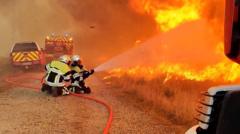
Southern France is burning again. When temperatures cross forty degrees Celsius, the pine forests of the Gironde turn into tinderboxes. Journalists like to frame these events as freak weather anomalies. They are not. They are the predictable outcome of decades of poor land management, subterranean drying, and a climate system that has shifted past its historical bounds. The flames racing through the south-west are symptoms of a systemic failure in how Europe guards its rural geography.
To understand why these fires are different, you have to look beneath the surface. Surface heat gets the headlines. The real crisis happens below ground. Winter rainfall failed to recharge the deep aquifers across the Nouvelle-Aquitaine region. Without that sub-surface moisture buffer, soil humidity plummeted months ahead of schedule. When a heatwave hits an already desiccated landscape, vegetation does not just dry out; it cures like timber in a kiln. A spark from a catalytic converter on a highway or a discarded glass bottle becomes an unstoppable front within minutes.
The Fire Trap of Monoculture Forestry
Forest management in the Landes department has prioritized economic yield over ecological resilience for over a century. Vast swathes of the region are dominated by single-generation maritime pine plantations. This setup creates a continuous, highly flammable fuel bed.
- Maritime pine resin is exceptionally volatile under thermal stress.
- Planting trees in dense, uniform grids eliminates natural firebreaks.
- Root systems compete fiercely for dwindling groundwater during droughts.
When a crown fire enters a dense pine monoculture, firefighting tactics fail. Water drops from Canadair planes evaporate before hitting the flames. Firebreaks cleared by local authorities are frequently too narrow to stop embers driven by sixty-kilometer-per-hour winds.
The Subterranean Crisis Nobody Reports
Water scarcity dictates the tactical reality on the ground. Fire departments in the south-west are rationing water supplies during active deployments. Local reservoirs, meant to feed agricultural irrigation and emergency tankers, sit at historic lows.
Municipalities face impossible choices. Do you pump the remaining local water to save residential zones, or do you divert it to agricultural buffers that might slow an advancing front?
"We are fighting high-intensity crown fires with tools designed for twentieth-century brush clearing."
— Regional Forestry Operations Director
The reliance on aerial firefighting is a dangerous crutch. Planes can slow a flank, but they cannot extinguish a fire burning deep in root systems and peat layers. Ground crews are forced to work in hazardous conditions, choking on toxic smoke laced with agricultural chemicals and burning resin.
Economic Fallout and Insurance Realities
The economic model of rural France is fracturing under the smoke. Tourism along the Atlantic coast faces massive cancellations every time a red alert is issued. Winegrowers in Bordeaux watch their grapes bake on the vine while smoke taint ruins entire vintages.
Insurance companies are quietly rewriting risk models. Policies for rural properties in high-risk zones are either spiking in cost or disappearing altogether. The state-backed catastrophe insurance system is buckling under the weight of recurring, multi-billion-euro disaster payouts.
- Premiums for commercial forestry have doubled in three years.
- Insurers now mandate mandatory brush clearance zones around private structures.
- Uninsurable properties are seeing immediate drops in real estate value.
Rethinking Defense Strategies
Continuing to rely on reactive suppression is a losing game. Change requires shifting capital from emergency response to radical landscape redesign. That means breaking up continuous pine tracts with deciduous hardwood species that retain moisture and resist fire spread. It means restoring wetlands that were drained decades ago for agriculture.
The political will to mandate these changes remains weak. Forest owners resist planting lower-yield hardwoods because timber markets reward fast-growing pine. Local politicians fear angering rural landowners by enforcing strict land-clearing laws.
The heatwaves will return next summer, and the summers after that. Until policy catches up with the physics of a warming planet, the south-west will remain trapped in a repeating loop of smoke, evacuation, and ash.