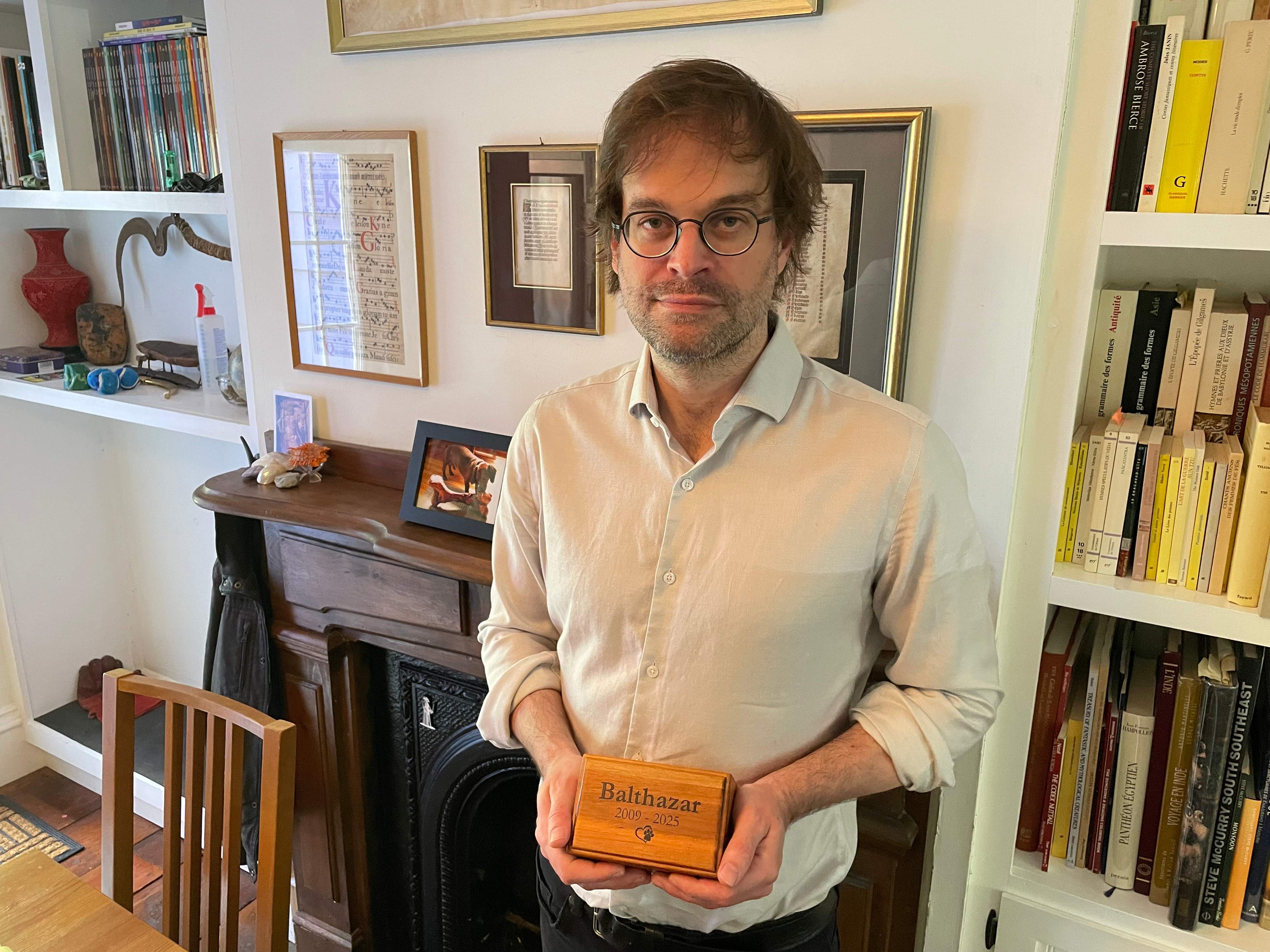
The box was small, wooden, and dense. It held sixteen years of a shared life, reduced to a grey powder that felt impossibly heavy in Vincent Masse’s hands.
Balthazar had been a dachshund. Anyone who has ever loved a dachshund knows they do not merely occupy space in a house; they command it. They are stubborn, fiercely loyal creatures that wrap themselves around the rhythm of your days until you cannot remember what waking up looked like before they were there. For over a decade and a half, Balthazar and Masse traveled the world together. When the little dog’s heart finally stopped, the silence left behind was deafening.
Masse wanted something permanent. He did not want a photo that could fade or a keepsake that could be misplaced in a future move. He wanted Balthazar with him, literally, under his skin.
He found Kerri Parnell, a tattoo artist in Winnipeg who specializes in the delicate, deeply emotional art of cremation tattoos. It is a process where a minute amount of ashes is sterilized and infused directly into the ink. It transforms grief into a physical, indelible marker. For Masse, living in Halifax, the journey required a flight across the country. He packed his bags, placed the wooden box containing Balthazar’s remains into his carry-on luggage, and headed to the Halifax Stanfield International Airport.
Then he met the machine.
Modern air travel is governed by a quiet, invisible friction between efficiency and humanity. We line up, remove our shoes, empty our pockets, and surrender our belongings to the conveyor belt. At the Halifax airport, Masse placed the wooden box onto the belt. It moved forward, sliding into the belly of the high-tech CT X-ray scanner.
The machine looked inside the box. And the machine said no.
Cremated remains are incredibly dense. To an advanced, automated security scanner calibrated to look for threats, a concentrated mass of bone fragments and ash presents as an unreadable block. The computer flagged it. It rejected the box.
When Masse asked for a human intervention, he ran headfirst into the rigid architecture of modern bureaucracy. The highest-ranked security officer on the floor stood beside him, looking at the box, looking at Masse, and looking at the screen. But the security officer was powerless. The computer had made its decree, and the protocol was absolute. No human on the floor possessed the authority to manually bypass the automated decision of the scanner.
Consider what happens in that moment. To the security apparatus, the box contained an unidentified, dense inorganic mass that failed a diagnostic algorithm. To Masse, the box contained his best friend.
The officers offered a standard procedural solution: put the box in a checked bag.
But anyone who flies frequently understands the unspoken gamble of checked luggage. Bags are thrown. Bags are misrouted. Bags vanish into the bellies of connecting airports, sometimes never to be seen again. To risk losing a suitcase containing regular clothes is an inconvenience; to risk losing the final, irreplaceable remains of a loved one is an unthinkable horror. Masse refused. His boarding pass was invalidated. The flight left without him.
He stood in the terminal, isolated by a system designed to process bodies and cargo, but entirely unequipped to process grief.
He called Parnell from the airport, his voice thick with the frustration of a man who felt utterly stranded by technology. Parnell, who guides people through the raw terrain of loss every day, understood immediately. Her solution was simple, practical, and heartbreaking: go home, open the box, and take out just enough for the ink.
Masse went back to his empty house. He paid an extra $900 to book a second flight for later that afternoon. Then, with Parnell watching over a live video call to offer steady reassurance, he opened the wooden box. He carefully transferred a tiny fraction of Balthazar’s ashes into a plastic Ziplock bag.
It felt wrong. It felt clinical. But it was the only way forward.
When he returned to the airport later that day, the plastic bag went onto the conveyor belt. This time, the density was low enough. The scanner did not flash red. The Ziplock bag passed. Everyone in the screening line, including the staff who had witnessed the ordeal earlier, breathed a collective sigh of relief.
But the real problem lies elsewhere, rooted in a broader systemic disconnect. The Canadian Air Transport Security Authority notes that while ashes are technically permitted in cabin baggage if they are under 350 milliliters and housed in non-metallic containers, their density makes them notoriously difficult to scan. The agency openly recommends that passengers use air cargo services instead.
To suggest that a grieving person should ship the ashes of their companion via a commercial cargo hull, alongside crates of freight and mail, reveals a profound blind spot in how we design public systems. It asks humans to compartmentalize their trauma to make things easier for the hardware.
Masse eventually made it to Winnipeg. In Parnell’s studio, the environment was a world away from the sterile, fluorescent glare of the airport security line. Parnell operates with a meticulous, patent-pending process to ensure the ashes are fully re-sterilized before they ever touch a needle. But the physical safety is only half the equation. The emotional safety matters just as much.
Before the needle touched Masse’s skin, they stood together in the room. They called out Balthazar’s name, welcoming the memory of the little dachshund into the space, grounding the entire procedure in an act of deliberate remembrance. Parnell refuses to do this work via the mail; she believes the wraparound process of grief requires human presence.
Today, a small image rests on Masse's chest. It is a quiet, permanent tribute, forged from ink and ash, a piece of Balthazar that can never be lost, delayed, or rejected by a machine.
Technology will continue to advance. Scanners will become sharper, algorithms more unyielding, and automated boundaries more absolute. Yet the human heart remains exactly as it has always been—fragile, stubborn, and desperately searching for ways to hold onto what it loves. We must begin to ask ourselves what happens when our systems lose the capacity to let a human look another human in the eye and say, "I understand."