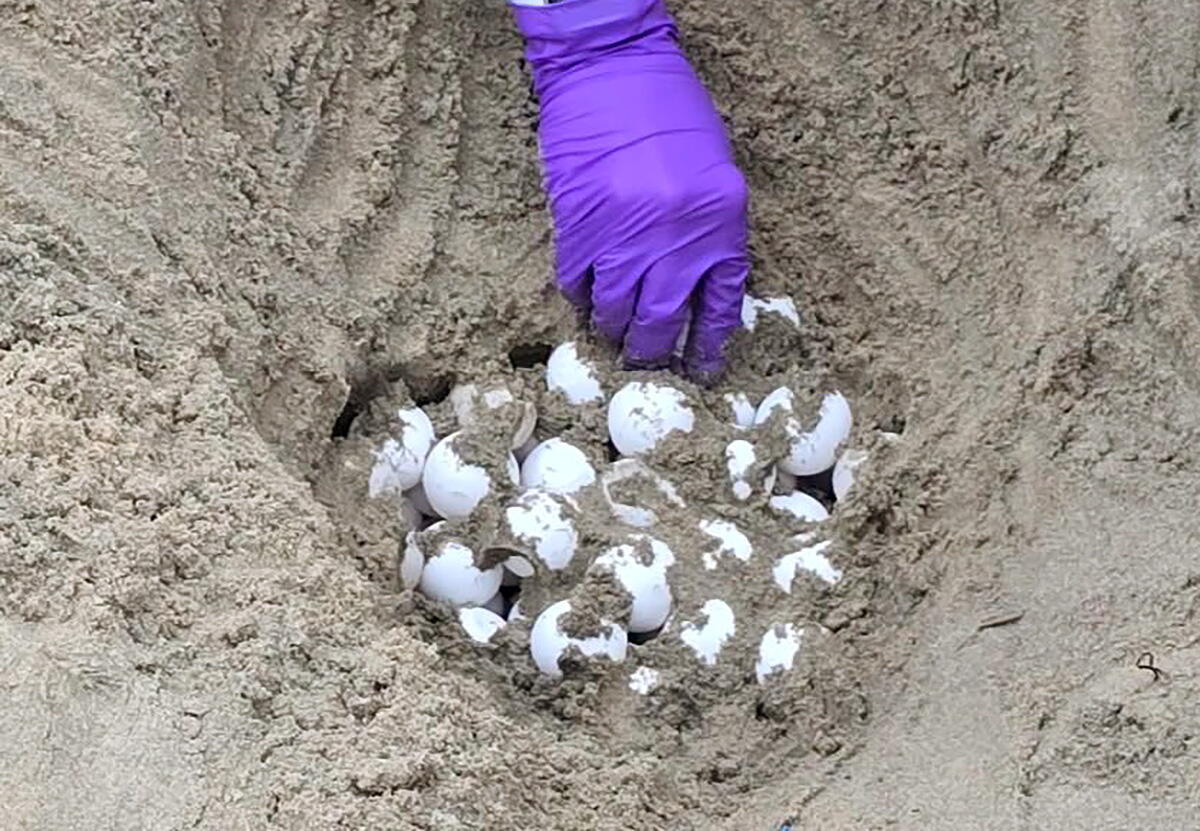
Two inches beneath a nondescript patch of California sand, sixty small hearts are beating in the dark.
They have been waiting through roughly fifty-five days of Pacific fog, high tides, and the rhythmic thrum of coastal foot traffic. Above them, behind a modest perimeter of wooden stakes and orange mesh netting, a rotating cast of marine biologists and sleep-deprived volunteers sits in folding chairs, nursing lukewarm coffee and staring at flat sand as if willing it to crack. They are waiting for what coastal researchers call the frenzy—that sudden, chaotic eruption when hatchlings break through their leathery shells simultaneously, claw upward through compacted quartz, and sprint blindly toward the surf before gulls, raccoons, or stray dogs notice the buffet has opened.
For California, this is not merely a wildlife curiosity. It is an unprecedented biological border crossing. Historically, eastern Pacific green sea turtles (Chelonia mydas) have treated Southern California’s estuaries—places like San Diego Bay and the San Gabriel River—as high-end diners, not maternity wards. They migrate north from Mexican waters to gorge on eelgrass and warm themselves in coastal power plant outflows, then swim back south to sandy beaches in Michoacán or the Revillagigedo Islands to lay their eggs. Until now, verified sea turtle nesting in the Golden State was practically nonexistent.
Yet here is the nest. Real. Monitored. Ticking like a biological clock.
The Invisible Shift Beneath the Swell
To understand why a handful of reptiles choosing a California beach matters, you have to picture the ocean not as a static blue expanse, but as an invisible highway system whose lanes are constantly shifting with temperature.
Consider a hypothetical scenario to make the scale concrete: imagine living in a house where the thermostat creeps up half a degree every few years. At first, you simply kick off the heavy duvet. Then you start sleeping with the window cracked. Eventually, you realize the entire floor plan of your life has migrated to the cooler basement. Sea turtles are cold-blooded navigators governed by thermal boundaries. As marine heatwaves and long-term ocean warming push subtropical isotherms northward along the Pacific coast, ancient migratory instincts begin to glitch—or, depending on your perspective, adapt.
When I first started walking coastal transects with field researchers years ago, the work felt largely forensic. You looked for what was missing. You logged stranded carcasses, untangled monofilament line from flipper joints, and explained to beachgoers why a plastic bag floating in the surf looks indistinguishable from a moon jellyfish to a hungry reptile. Back then, the idea of guarding a live clutch on a temperate California beach felt like science fiction. You spent your nights cataloging loss, never expecting to chaperone an arrival.
That history makes the current vigil feel electric, fragile, and slightly terrifying.
Anatomy of the Frenzy
What biologists call the "frenzy" is actually a masterpiece of evolutionary synchronization, best understood through a simple analogy: think of a crowded subway car where the doors won't open unless everyone pushes at once.
A single hatchling trapped two feet underground does not have the caloric budget or muscular leverage to dig itself out. If one turtle hatches early and tries to ascend alone, it suffocates in the sand. Instead, the siblings wait until nearly the entire clutch has pipped—sliced open their shells using a temporary, razor-sharp egg tooth called a caruncle. Once cramped together in the dark chamber, the movement of one triggers the movement of all. Together, they thrash. Sand collapses from the ceiling of the egg chamber and gets packed beneath their flippers, turning the entire writhing mass into a slow-motion biological elevator.
Days pass in this upward crawl. Just below the surface, the group pauses.
They are taking the temperature of the ceiling. If the sand above them is scorching hot, it means the sun is high, and emerging would mean instant dehydration or immediate capture by coastal predators. When the sand finally cools—usually after sunset, though overcast coastal mornings can trick them—the brake releases.
Burst.
They erupt from the crater in a frantic scramble, each weighing roughly fifty grams, no larger than a child's palm. For the next twenty-four to forty-eight hours, these hatchlings enter a metabolic sprint fueled entirely by the internal yolk sac absorbed just before hatching. They do not eat. They do not rest. They orient toward the brightest, lowest horizon—historically, the reflection of moon and starlight off breaking waves—and swim straight past the surf zone into deeper pelagic waters where coastal predators thin out.
The Trap of Artificial Horizons
Here is where human infrastructure collides with three hundred million years of instinct.
California’s coastline is not an unlit wilderness. It is a glittering ribbon of boardwalks, pier floodlights, beachfront condos, and highway lamps. To a hatchling calibrated to follow light toward open water, a sodium-vapor streetlight behind the dunes looks identical to a full moon over the Pacific. Biologists call this disorientation, though "fatal misdirection" is closer to the truth. Instead of crawling seaward, hatchlings turn inland, exhausting their finite yolk reserves in parking lots, storm drains, and dune grass.
This is why the biologists stationed around California's first monitored nest are prepared to intervene—a delicate ethical tightrope in conservation science. Normally, hands-off observation is the rule; hatchlings need the physical struggle down the beach to imprint on the Earth’s magnetic field, a biological GPS that will guide females back to this exact stretch of coast twenty or thirty years from now if they survive to adulthood. Interfere too early, and you risk scrambling their internal compass. Wait too long, and city lights or hungry gulls wipe out the cohort before it touches saltwater.
So the team waits with red-filtered flashlights—wavelengths invisible to marine turtles—and dark fabric barriers ready to shield the crawl path from urban glare. They have measured sand temperatures with buried data loggers, knowing that incubation heat determines sex in sea turtles: warmer sand produces females, cooler sand produces males. Given California's milder coastal climate compared to tropical nesting beaches in Mexico, this single clutch could carry disproportionate genetic value if it yields rare male hatchlings into a warming eastern Pacific population increasingly skewed female.
Uncertainty at the Waterline
Will they make it? Nobody on that beach can promise a happy ending.
Even under pristine conditions, sea turtle survival math is brutal. Roughly one in a thousand hatchlings survives to sexual maturity. Between the nest and adulthood lies a gauntlet of ghost fishing gear, boat strikes, toxic runoff, tiger sharks, and shifting prey fields. Moreover, biologists freely admit they are operating in uncharted territory here. One nest does not make a trend. It could be the vanguard of a permanent northward range expansion driven by climate change, or it could be a biological anomaly—a single gravid female caught in a warm current who decided she couldn't hold her eggs another thousand miles south.
Watch the volunteers on the night shift, though, and statistical probabilities vanish.
They sit quietly as the marine layer rolls in, turning coastal streetlights into blurry halos. Every few minutes, someone sweeps a dim red beam across the staked perimeter, checking for a subtle dimple in the sand—the first sign that the subterranean elevator has reached the top floor. Around them, joggers pass with earbuds in, oblivious to the drama unfolding six feet off the path.
Then, perhaps tonight, perhaps tomorrow, the sand will shiver. A tiny, sand-crusted snout will poke into the cool California air, followed by another, and another, until sixty ancient mariners tumble out into a modern world that barely knows they exist—racing toward a dark ocean that belongs to them, if only we let them reach it.