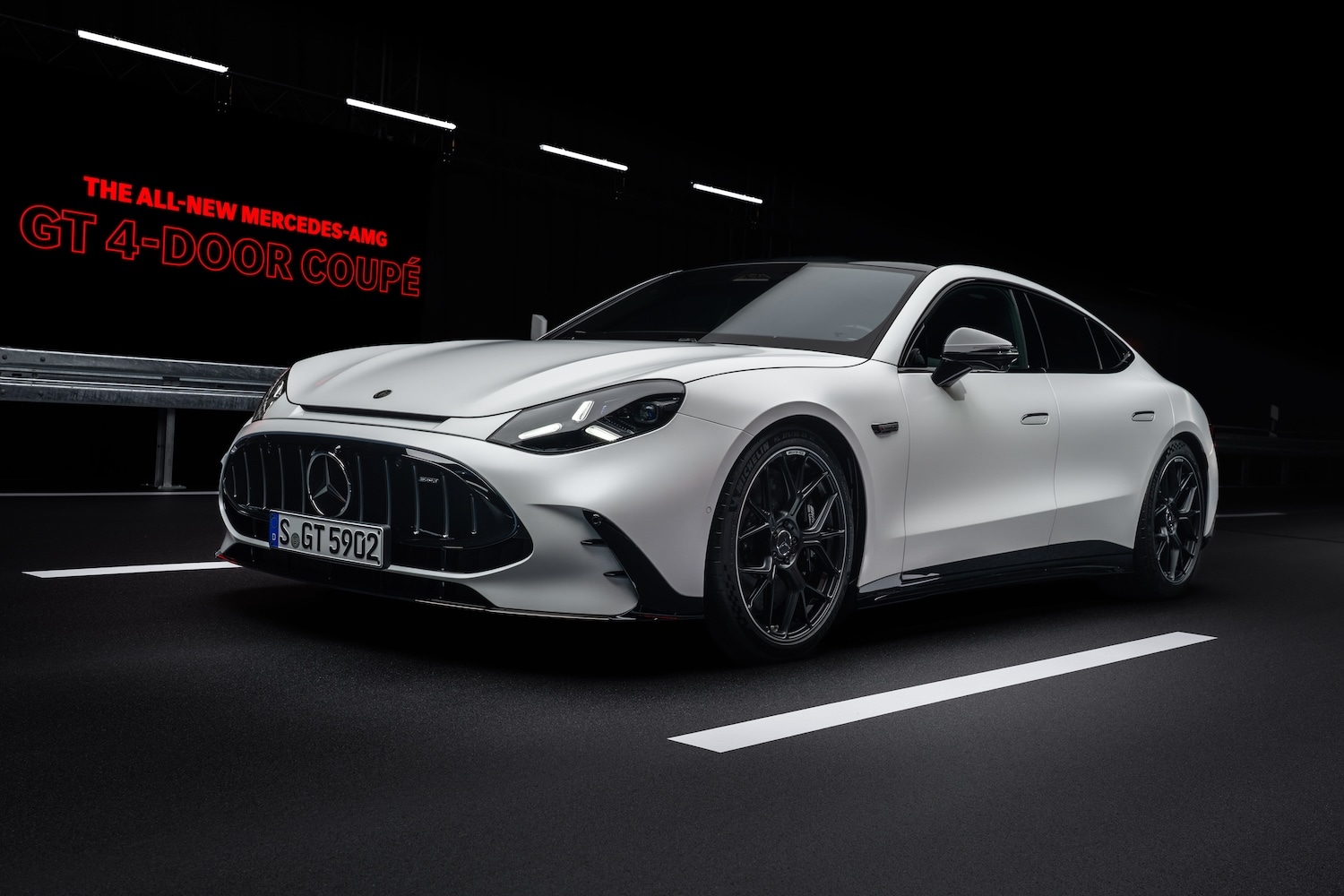
Mercedes-AMG just unveiled its first ground-up electric super sedan, the GT 4-Door Coupé, and the raw engineering data reads like science fiction. Built on the brand's new 800-volt AMG.EA architecture, the top-tier GT 63 variant belts out 1,169 horsepower and a bruising 2,000 Nm of torque. It plugs into a DC fast charger and draws a massive 600 kilowatts of power, enough to juice its 106 kWh battery from 10 to 80 percent in a brief 11 minutes. It is a stunning display of pure German technical dominance.
Yet, beneath the carbon fiber and active aerodynamics lies a glaring corporate identity crisis. To keep traditional buyers from panicking, Mercedes-AMG went through the trouble of synthesizing a fake V8 exhaust note that pumps through the cabin speakers, synced with haptic vibrators in the seats to mimic an old-school gas engine. It even features a simulated gearbox to interrupt the smooth power delivery of the electric motors, explicitly replicating the gear shifts of a transmission that does not exist.
This juxtaposition reveals a deeper industry truth. Even when legacy automakers build a superior electric powertrain, they remain absolutely terrified that consumers will hate it unless it pretends to be an internal combustion engine.
The YASA Revolution and Why Axial Flux Changes Everything
To understand how Mercedes achieved these numbers, you have to look past the marketing fluff and focus on the magnets. For over a decade, almost every mainstream electric vehicle has relied on radial flux motors. In a radial motor, the rotor spins inside a cylindrical stator, and the magnetic flux flows perpendicularly out from the rotation shaft. They are reliable, relatively cheap to build, and inherently bulky.
Mercedes-AMG threw that blueprint out. The GT EV is the first series-production vehicle to utilize axial flux motors, developed by YASA, an Oxford-based electric motor specialist that Mercedes quietly acquired back in 2021.
In an axial flux design, the magnetic flux runs parallel to the axis of rotation. The rotor and stator are arranged as thin, flat discs stacked tightly against each other like a high-tech pancake. The packaging advantages are absurd.
- Width: The rear motors on the AMG GT measure a mere eight centimeters wide.
- Placement: Two of these wafer-thin motors sit side-by-side on the rear axle within a single High-Performance Electric Drive Unit.
- Boost: A third, slightly wider motor sits on the front axle, acting as a high-speed booster that completely decouples via a clutch during highway cruising to eliminate drag.
Because axial flux motors pull the magnetic field at a larger radius, they produce vastly more torque per kilogram than a standard EV motor. This design allowed engineers to pack a tri-motor, all-wheel-drive system into a car without compromising passenger space or adding unnecessary overhangs. The rear axle features fully variable torque vectoring that can shift power between the left and right wheels faster than a mechanical differential could even process the command.
Formula 1 Batteries and the Myth of Lasting Speed
Any engineer can program an inverter to dump a massive amount of current into an electric motor for a single, headline-grabbing drag strip run. The real engineering challenge is repeatable performance. In most high-end EVs, after two or three hard launches, the battery pack begins to overheat. The internal software kicks in, limiting power output to save the cells from degrading. This thermal throttling is the dirty secret of the luxury EV segment.
To solve this, the AMG team turned to their Formula 1 powertrain division in Brixworth, England. The GT EV uses a custom NCMA (Nickel-Cobalt-Manganese-Aluminum) cylindrical cell chemistry arranged in 18 laser-welded modules.
The breakthrough here is a direct, liquid-cooled architecture that pumps a non-conductive, oil-based coolant directly around every single one of the 2,660 cells.
Instead of cooling the battery pack from a bottom plate, each cell is completely submerged in moving fluid. If a driver decides to run laps at a track, the intelligent thermal management system keeps the individual cell temperatures tightly regulated. This prevents thermal runaway and ensures that all 1,169 horsepower remain available lap after lap.
[Traditional Cooling Plate] -> Cools only the bottom of the battery cell
[AMG Direct Oil Submersion] -> Surrounds 100% of the cell surface for instant thermal regulation
This thermal control is also the secret behind the car's 600 kW charging rate. Charging a battery at that speed generates an immense amount of heat. By utilizing the direct-cooling oil loops, the AMG GT can absorb an 800-amp current without melting its internal components, recovering roughly 286 miles of WLTP range in 10 minutes.
The Fragile Psychology of the Performance Buyer
If the mechanical platform is a masterpiece of thermal dynamics and advanced metallurgy, the software tuning is a study in corporate anxiety. The inclusion of a synthesized V8 soundtrack and simulated gear shifts proves that Mercedes is fighting an uphill battle against its own customer base.
For half a century, the AMG brand was defined by the brutal, unrefined throb of a hand-built V8 engine. It was an auditory signature. When an EV removes that noise, it strips away the theater of the driving experience.
By adding haptic feedback to shake the driver’s seat during simulated upshifts, Mercedes is attempting to fabricate soul out of code. It is an acknowledgment that speed alone is no longer a differentiator in the electric era. When a family crossover can hit 60 mph in three seconds, a six-figure super sedan needs to offer something more than sheer G-force.
"The irony is palpable: Mercedes spent hundreds of millions of dollars engineering a continuous, single-stage planetary gearbox that delivers perfectly linear, uninterrupted acceleration, only to write software that intentionally introduces shift hesitation to mimic a 2010 transmission."
This psychological crutch isn't unique to Mercedes. Hyundai did it with the Ioniq 5 N, and Dodge is doing it with its electric muscle cars. But seeing it implemented on an ultra-luxury flagship platform built on genuine Formula 1 technology feels like a step backward. It implies that the engineers don't trust the car's actual mechanical merits to satisfy the driver.
The Infrastructure Reality Check
No matter how fast the AMG GT can technically charge, it remains completely tethered to the reality of public charging infrastructure. The car’s 11-minute charging claim relies entirely on the availability of a 600 kW DC fast charger.
Right now, finding a functional, well-maintained charger capable of delivering even 350 kW in North America or Europe is a roll of the dice. Most public high-power stations are plagued by broken screens, derated power outputs due to cooling failures, or software handshake errors between the station and the vehicle.
The AMG GT does feature a clever voltage-switching system that allows its 800-volt pack to split into two virtual 400-volt halves when plugged into older infrastructure, maximizing the speed of legacy chargers. But until the physical stations on the side of the highway catch up to the capabilities of the AMG.EA platform, owners will rarely experience that theoretical 11-minute stop. They will be stuck sitting at a broken 150 kW dispenser, listening to a synthesized idle sound through the infotainment system while they wait.
The engineering team in Affalterbach has successfully built an electric powertrain that outclasses its internal combustion predecessors in every measurable performance metric. The axial flux motors are lighter, the packaging is smarter, and the thermal management is unmatched. Now, the marketing department just needs to find the courage to let the V8 die.