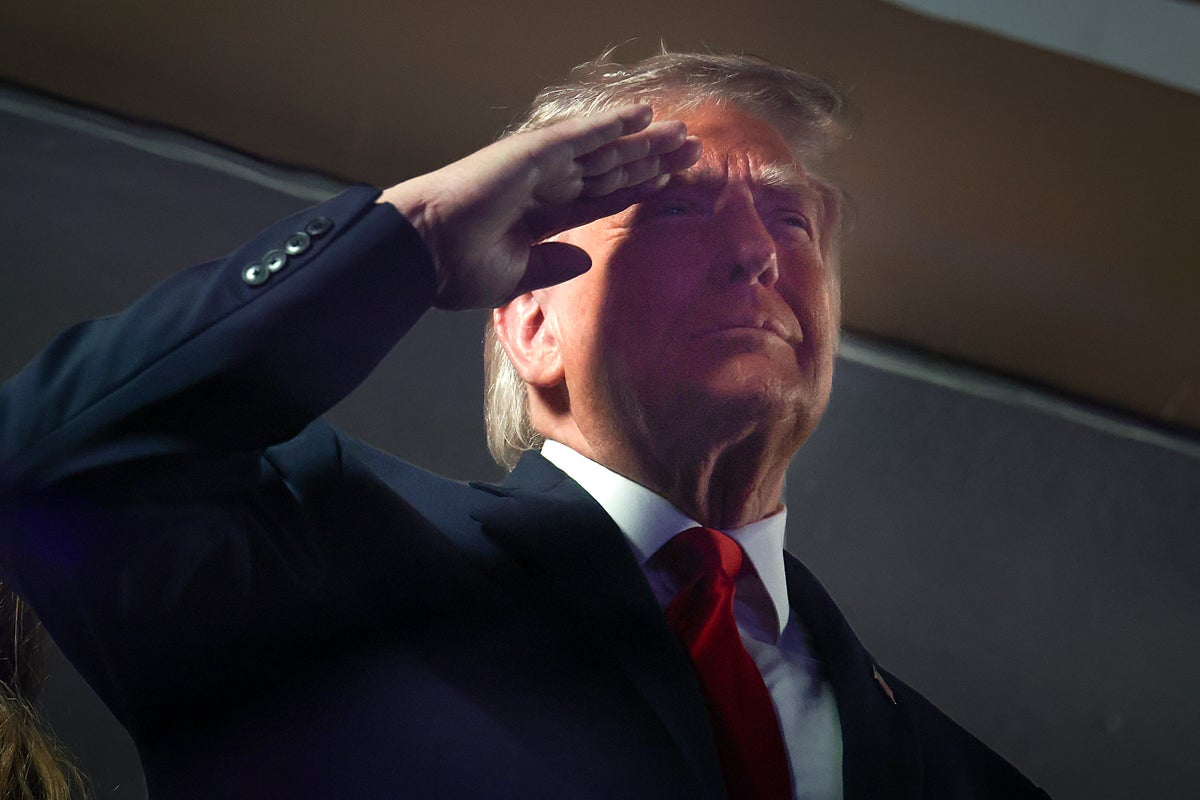
Media pundits love a cheap gotcha moment. For years, editorial boards and political commentators have breathlessly tracked Donald Trump’s posture during the national anthem. When he raises his right hand to his brow in a crisp military salute at an NBA game or a political rally, the standard script immediately runs online. Journalists instantly rush to cite 36 U.S. Code § 301, smugly pointing out that civilians are supposed to put their right hand over their heart, not salute. They call it an egregious violation. They frame it as a sign of ignorance or disrespect.
They are missing the entire point.
This obsession with the literal text of the federal Flag Code is a classic example of looking at the finger pointing to the moon instead of looking at the moon itself. The media's selective outrage over anthem etiquette relies on a fundamentally flawed understanding of what the Flag Code actually is, who it applies to, and how the presidency interacts with the military. By treating an advisory custom as a binding criminal statute, critics expose their own misunderstanding of American civic tradition.
The civilian salute isn't a constitutional crisis. It is a calculated piece of political theater that makes perfect sense once you look past the superficial text of the code.
The Flawed Premise of Enforceable Etiquette
Let's clear up the legal reality immediately. The U.S. Flag Code is an advisory set of guidelines. It has absolutely no teeth. It carries zero criminal penalties, zero civil fines, and zero enforcement mechanisms.
The Supreme Court settled the issue of forced flag veneration decades ago. In landmark cases like West Virginia State Board of Education v. Barnette (1943) and Texas v. Johnson (1989), the Court made it undeniably clear that the government cannot compel specific physical behavior regarding national symbols. If a citizen wants to stand at attention, sit down, kneel, or salute with their left hand, their right to do so is fiercely protected by the First Amendment.
"If there is any fixed star in our constitutional constellation, it is that no official, high or petty, can prescribe what shall be orthodox in politics, nationalism, religion, or other matters of opinion." — Justice Robert H. Jackson, Barnette (1943)
When an analyst screams that a politician is "violating federal law" by saluting, they are misleading their audience. They are treating a voluntary etiquette manual like the penal code.
I have spent years analyzing political branding and communication strategies. I have watched campaigns waste millions trying to script the perfect, sterile image of patriotism, only to get outmaneuvered by raw, gut-level symbolism. In the arena of mass media, a hand over the heart is standard corporate civic duty. A military salute is a deliberate assertion of authority.
The Commander in Chief Blind Spot
The argument gets even weaker when applied to the sitting President of the United States. Critics love to remind everyone that Trump never served in the active-duty military, pointing to his Vietnam-era medical deferments. They argue that because he is a civilian, the military salute is barred to him under 36 U.S. Code § 301, which explicitly reserves the gesture for uniformed service members, veterans, and active personnel.
This ignores the structural reality of the executive branch. Under Article II, Section 2 of the U.S. Constitution, the President is the Commander in Chief of the Army and Navy of the United States, and of the Militia of the several States when called into actual service.
While the presidency is fundamentally a civilian office designed to ensure civilian control of the military, the occupant of that office sits at the absolute apex of the military chain of command. The President signs the deployment orders. The President authorizes the strikes. The military salutes the President every single day, a tradition formalized by Ronald Reagan in 1981 and maintained by every executive since, regardless of their personal veteran status.
To claim the ultimate commander of the armed forces cannot return or initiate a salute because of a 1942 advisory civilian code is a bureaucratic technicality that collapses under the weight of constitutional reality.
The Mechanics of Political Symbolism
Let's dissect why this gesture works so well for Trump and why his critics fall into his trap every single time.
Political communication is not about adhering to footnotes in a code book. It is about emotional resonance. For Trump's core base, the military salute sends a clear, visceral message that bypasses intellectual debate.
- Law and Order Alignment: The salute visually links the politician directly to the military and law enforcement communities, reinforcing a hardline stance on national security.
- Anti-Establishment Defiance: By intentionally choosing a gesture that drives traditional media elites crazy, the politician signals to voters that they do not care about elite rules or beltway consensus.
- Maximalist Patriotism: To the average observer who doesn't memorize Title 36 of the U.S. Code, a salute looks more respectful and more patriotic than simply putting a hand over the heart. It raises the stakes of the ritual.
Imagine a scenario where a politician strictly follows every line of the Flag Code. They stand perfectly still, hand positioned exactly over the left breast, eyes locked at a precise angle. It is textbook. It is also completely forgettable. It generates zero headlines, fires up zero voters, and commands zero attention.
By breaking the advisory rule, Trump forces the media to cover his patriotism. The resulting articles—filled with pedantic explanations of federal code—only serve to make his critics look like scolding schoolteachers to a massive portion of the electorate. The controversy itself is the victory.
The Hypocrisy of Selective Outrage
The most frustrating aspect of this ongoing debate is the sheer selectivity of the outrage. The U.S. Flag Code is routinely ignored by corporations, sports leagues, and politicians across the entire political spectrum, usually with zero pushback from the media.
If we are going to be purists about the text, let's look at what else the Flag Code prohibits:
| Section of Code | What It Prohibits | Common Reality |
|---|---|---|
| 4 U.S. Code § 8(d) | Using the flag as athletic apparel, bedding, or drapery. | Millions of patriotic t-shirts, board shorts, and sports uniforms. |
| 4 U.S. Code § 8(i) | Using the flag for advertising purposes in any manner. | Every car dealership commercial during the Fourth of July. |
| 4 U.S. Code § 8(g) | Placing any word, figure, mark, picture, or drawing on the flag. | Thin Blue Line flags, political campaign logos superimposed on stripes. |
| 4 U.S. Code § 8(c) | Carrying the flag flat or horizontally. | The massive, stadium-sized flags carried out before every NFL game. |
Where are the scathing op-eds demanding that sports teams stop laying the flag flat across football fields? Where is the panic over athletic brands turning the stars and stripes into compression gear? It doesn't exist, because those violations are culturally accepted as expressions of pride.
To suddenly turn into a strict originalist regarding Section 301 while ignoring the blatant commercialization of the flag outlined in Section 8 is intellectual dishonesty. It proves that the criticism isn't about protecting the sanctity of the Flag Code. It is about finding a weapon to swing at a political opponent.
Stop Reading the Manual and Watch the Game
The downside to this contrarian view is obvious: it encourages a slippery slope where civic traditions are replaced by pure optics. If every public official starts inventing their own protocols to maximize social media engagement, the shared language of American ritual degrades. There is real value in uniform, collective tradition. It binds a fractured public square together.
But we do not live in a world of shared, sterile civic consensus anymore. We live in an era of hyper-mediated political warfare.
Judging a populist politician by the standards of a 20th-century etiquette guide is like bringing a knife to a laser fight. The salute isn't an accident. It isn't a mistake made by an uneducated team. It is a deliberate choice to project power, command the frame, and trigger an immediate, predictable reaction from an opposition that prefers rulebooks to reality.
If you want to understand modern political theater, close the legal textbooks. Stop analyzing the posture and start analyzing the power dynamics. The media thinks they are exposing a rule-breaker; the politician knows he is executing a masterclass in brand dominance.