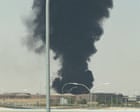
Panic sells. Precision reporting does not. When smoke billows near a major international aviation hub, the default media reflex is immediate, breathless escalation. You read the breaking alerts about air raid warnings over the Saudi capital, and the cognitive machinery instantly grinds toward worst-case scenarios. Supply chain collapse. Capital flight. Total geopolitical destabilization.
Strip away the flashing banner graphics, and a starkly different reality emerges.
I have spent the better part of two decades advising sovereign risk funds and logistics operators navigating Middle Eastern infrastructure corridors. When a kinetic interception occurs over a modern urban center equipped with multi-layered missile defense architecture, the resulting plume of white smoke or falling debris is not a sign of systemic failure. It is proof of a multi-billion dollar interception system doing precisely what it was engineered to do.
Yet, mainstream wire services treat every intercept as a near-apocalyptic near-miss. They focus entirely on the momentary shockwave and ignore the financial and operational mechanics keeping the engine running.
Let us dismantle the lazy consensus.
The Cost Curve of Modern Air Defense
The central economic misunderstanding in every conflict report involving the Arabian Gulf centers on cost asymmetry. Commentators love to point out that a defensive interceptor costs millions of dollars while the incoming threat costs a fraction of that amount. They call it an unsustainable economic drain.
This argument is mathematically correct and strategically illiterate.
Air defense is not a profit and loss statement measured per round. It is an infrastructure insurance policy measured in operational continuity. If an interceptor battery neutralizes a projectile that would have otherwise clipped a cargo terminal at King Khalid International Airport, the cost of the defense battery is instantly offset a thousandfold. The alternative is not saving money; the alternative is the immediate suspension of air traffic, a multi-day grounding of cargo carriers, and an instantaneous spike in regional freight insurance premiums.
When smoke appears on the horizon near Riyadh, the market reaction should not be immediate divestment from Gulf equities. It should be a sober analysis of intercept efficiency ratios.
The Logistics Resilience Nobody Reports
Standard crisis reporting treats infrastructure like glass. One strike, and the whole system shatters.
Reality operates on redundancy. Major aviation hubs in the Kingdom are not single points of failure. They are engineered nodes within diversified transport networks designed to absorb localized disruptions without breaking stride. When an alert sounds, air traffic control protocols execute automated routing shifts within seconds. Cargo diverted from one runway lands at a regional alternative three hundred miles away, coordinated through digitized airspace management systems that run twenty-four hours a day, uninterrupted by external noise.
I watched analysts panic during previous regional flare-ups, predicting the immediate halt of non-oil trade into Riyadh. Within forty-eight hours, cargo volumes actually increased as operators rerouted shipments to bypass maritime chokepoints in favor of secure air corridors. The crisis created the very operational habituation it was supposed to destroy.
Dismantling the Risk Premium Fallacy
Why do international media outlets continue to frame these events as existential threats to the Saudi economy? Because fear generates engagement, and old biases die hard. Western financial desks still view Middle Eastern infrastructure through a colonial lens of fragility—the idea that advanced technological systems cannot operate reliably in non-Western latitudes.
That narrative is decades out of date.
The defense architecture protecting Riyadh is integrated, tested, and operated by personnel who treat airspace security with the cold calculus of corporate risk management. They do not react to the emotional cadence of cable news. They measure threat vectors, calculate intercept trajectories, and execute.
When you see smoke near an airport, stop asking if the region is sliding into chaos. Start asking how quickly the airspace reopens. In every recent instance, the answer is measured in minutes, not days.
The real risk is not the smoke on the horizon. The real risk is letting lazy journalism dictate your capital allocation strategy.
Ignore the noise. Look at the balance sheets. The capital is staying because the math works.