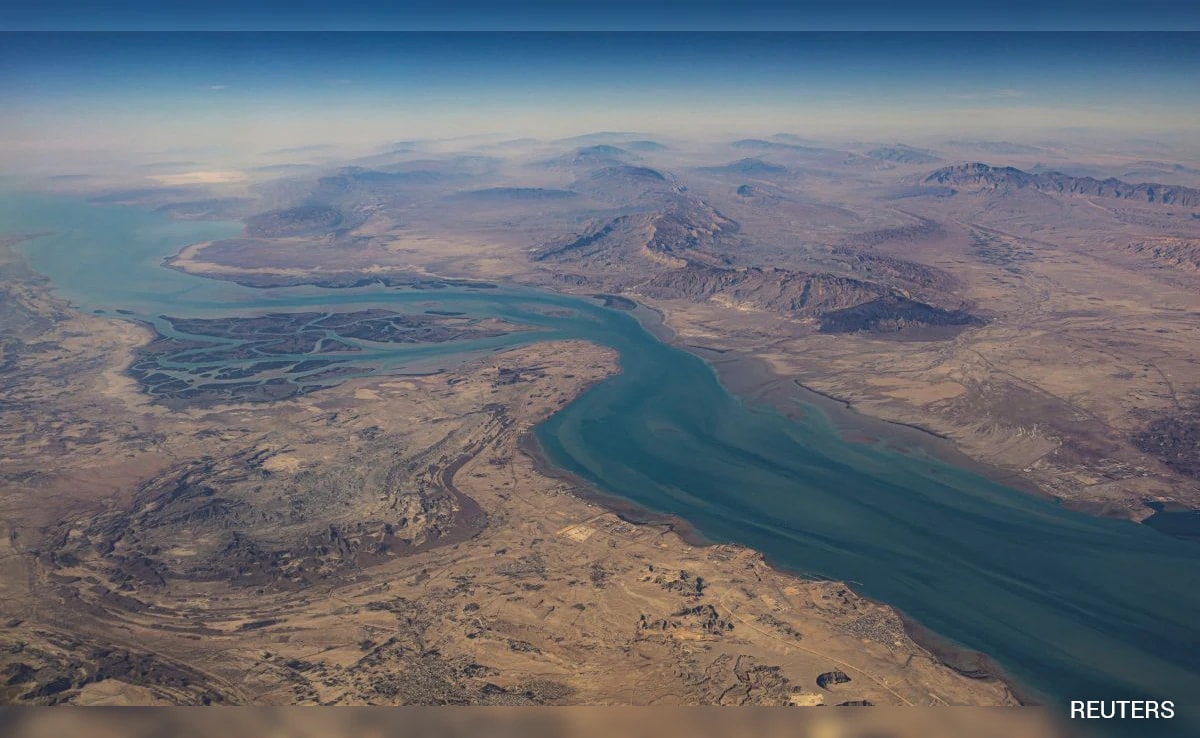
The Iranian Navy’s threat to destroy vessels transiting the Strait of Hormuz without a local permit represents a shift from historical gray-zone harassment to a formalized blockade doctrine. This maneuver targets the core of global energy security by attempting to assert sovereignty over an international waterway that facilitates 21% of the world’s petroleum liquids consumption. The strategic objective is not necessarily the destruction of shipping, but the extraction of a geopolitical "security rent" and the forced recognition of Iranian regional primacy through the weaponization of maritime bottlenecks.
The Triple Constraint of Maritime Interdiction
The viability of Iran’s threat rests on three distinct operational pillars. If any of these pillars fail, the strategy collapses into a localized skirmish rather than a global economic lever.
- Detection and Attribution Latency: For Iran to execute a "destruction" order, they must identify, verify, and target vessels within the 21-mile-wide narrowest point of the Strait. This requires a 24/7 Integrated Air Defense System (IADS) and surface-search radar network capable of distinguishing between neutral, hostile, and "unpermitted" commercial traffic amidst one of the highest vessel-density zones on Earth.
- Kinetic Proportionality: The threat of total destruction implies the use of Anti-Ship Cruise Missiles (ASCMs) or fast attack craft (FAC) swarms. The Iranian inventory, including the Noor and Ghadir missile families, operates on a high-probability-of-kill ($P_k$) ratio against unescorted tankers. However, the use of such force triggers immediate escalatory responses from the U.S. 5th Fleet and the International Maritime Security Construct (IMSC).
- Legal Contradiction of Transit Passage: Under the United Nations Convention on the Law of the Sea (UNCLOS), the Strait of Hormuz is governed by the regime of "transit passage." Iran, while not a signatory to UNCLOS, is bound by customary international law. By demanding permits, Tehran is attempting to redefine "transit passage" as "innocent passage," which would allow them to suspend transit if it is deemed "prejudicial to peace and security."
The Cost Function of Maritime Risk
The primary weapon in this scenario is not the missile, but the insurance premium. The moment a credible threat of destruction is issued, the "War Risk" surcharges for hull and machinery (H&M) insurance spike.
The economic fallout follows a predictable sequence:
- Initial Risk Premium: Insurance underwriters move the Strait of Hormuz into "Listed Areas," requiring shipowners to pay additional premiums for each transit.
- Diversion Costs: Large Crude Carriers (VLCCs) may attempt to divert to pipelines, such as the Habshan–Fujairah line in the UAE or the East-West Pipeline in Saudi Arabia. However, these pipelines have a combined capacity of approximately 6.5 million barrels per day, leaving a deficit of over 14 million barrels per day that must pass through the Strait.
- Spot Market Volatility: The Brent Crude "risk premium" typically adds $5 to $10 per barrel upon the issuance of such threats, regardless of whether a shot is fired.
Tactical Realities of the Permit Demand
Requiring a permit is a bureaucratic assertion of ownership over a global common. By creating a permit system, Iran forces commercial entities and their flag states into a binary choice: comply and acknowledge Iranian jurisdiction, or defy and risk kinetic engagement.
The Iranian Islamic Revolutionary Guard Corps Navy (IRGCN) utilizes a "Swarm and Saturated" attack doctrine. This involves deploying dozens of high-speed, missile-armed boats to overwhelm the Aegis Combat Systems of escorting destroyers. While a single U.S. Arleigh Burke-class destroyer can track and engage multiple targets, the sheer volume of "unpermitted" targets in the Strait creates a target-saturated environment where defensive depletion ($D_d$) becomes a legitimate risk.
$$D_d = \frac{T_a}{I_m \times P_k}$$
In this formula, $T_a$ represents the number of incoming threats, $I_m$ is the interceptor inventory, and $P_k$ is the kill probability. If Iran launches more low-cost drones and missiles than a convoy has interceptors, the "unpermitted" ship is effectively defenseless.
Counter-Intervention Mechanics
The global response to a formalized permit requirement involves two primary vectors: the "Operation Prosperity Guardian" model and the "Escort Doctrine."
Military escorts provide a physical shield, but they do not solve the legal-economic friction. If Iran monitors the Strait and selects a single vessel for "destruction" to make an example, the defender's reaction time is limited by the geography. The distance from Iranian coastal missile batteries to the shipping lanes is often less than 15 miles, providing a flight time for a subsonic cruise missile of roughly 60 to 90 seconds.
This compressed OODA (Observe-Orient-Decide-Act) loop favors the aggressor. To counter this, Western powers rely on "Over-the-Horizon" (OTH) targeting and pre-emptive strikes on mobile launchers. This creates a hair-trigger environment where a perceived "permit violation" could escalate into a full-scale regional conflict within minutes.
The Role of Asymmetric Assets
Iran’s strategy leverages three specific asymmetric assets that complicate traditional naval defense:
- Limpet Mines: Used in previous escalations (2019), these allow for "plausible deniability" while still enforcing the threat of destruction.
- Subsurface Threats: The Ghadir-class midget submarines are designed for the shallow, noisy waters of the Persian Gulf, making them difficult to detect via passive sonar. They serve as submerged sentries for "unpermitted" traffic.
- Loitering Munitions: Shahed-type drones provide a low-cost method for harassing bridge crews, forcing ships to slow down or change course into Iranian-controlled waters.
Data-Driven Vulnerability Assessment
The vulnerability of the global energy market is not uniform. The impact of a Strait of Hormuz blockade is felt most acutely in East Asian economies.
- China: Receives approximately 40% of its crude oil imports through the Strait.
- India: Depends on the Strait for nearly 60% of its energy needs.
- Japan and South Korea: Maintain nearly 80-90% dependency on this specific maritime artery.
The "destruction" threat is therefore a diplomatic lever used against China as much as it is a military threat against the West. By threatening the Strait, Iran pressures Beijing to intervene and provide sanctions relief or diplomatic cover in the UN Security Council.
Strategic Realignment and Hard-Power Realities
The issuance of a "permit or be destroyed" mandate represents a transition from a tactical nuisance to a strategic blockade. The international community's inability to secure the Red Sea against Houthi rebels has likely emboldened Tehran, suggesting that modern naval power struggles to protect slow-moving commercial hulls against persistent, low-cost asymmetric threats.
Naval planners must now move beyond traditional "Freedom of Navigation" (FON) operations and toward a "Persistent Escort" model. This requires a massive reallocation of hull-days from other theaters (such as the Indo-Pacific) to the Persian Gulf.
The ultimate strategic play for energy-importing nations is the rapid expansion of Strategic Petroleum Reserves (SPR) and the hardening of alternative pipeline infrastructure. Until the capacity of the Fujairah and East-West pipelines exceeds the daily throughput of the Strait, the "security rent" demanded by Iran remains a permanent tax on global trade. The focus must shift from reactive patrolling to the deployment of automated, high-energy laser (HEL) defense systems on commercial tankers themselves to neutralize the low-cost drone and missile threat that underpins the Iranian ultimatum.