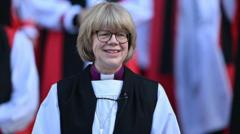
The stained glass is cracking, but the media is too busy polishing the new brass plate on the door to notice the foundation is gone.
The enthronement of the first female Archbishop of Canterbury is being hailed as a "historic breakthrough" and a "new dawn" for a thousand-year-old institution. It isn't. It is a desperate, late-stage pivot by a legacy brand that has lost its market fit. While the cameras capture the pomp and the progressive headlines celebrate a glass ceiling shattered, the actual pews are empty.
Breaking a ceiling only matters if the building isn't on fire.
The celebratory narrative surrounding this appointment rests on a fundamental misunderstanding of why people leave religion. The secular press treats the Church of England like a FTSE 100 company appointing its first female CEO. They assume that "representation" is the primary friction point preventing Gen Z and Millennials from engaging with the divine. It’s a category error. People aren't staying away from the Church because the leadership is too male; they are staying away because the product—theology—has been diluted into a lukewarm social club that offers nothing they can’t get from a well-curated Instagram feed or a local NGO.
The Diversity Trap in a Dying Market
The Church is currently obsessed with "relevance." In any other industry, when a product’s user base drops by 50% in twenty years, you don't just change the face of the spokesperson; you interrogate the value proposition.
The Church of England’s value proposition used to be the monopoly on eternal salvation. Now, it’s a vaguely spiritual consensus on mid-tier political issues. By prioritizing identity politics over metaphysical conviction, the Church has entered a race it cannot win. If you want progressive social activism, you go to a protest or join a non-profit. You don’t spend your Sunday morning in a drafty building listening to a watered-down version of the same thing.
I have spent years watching institutions attempt this "re-branding" through personnel changes. It’s a classic management consultant move: when the strategy is failing, change the optics. But the data from the Church’s own Research and Statistics department shows that "liberalizing" the clergy does not correlate with growth. In fact, the most "progressive" dioceses often see the sharpest declines in attendance, while the stubborn, traditionalist outposts—whether high-church Anglo-Catholic or hardline Evangelical—are the only ones holding onto their youth demographics.
Why? Because human beings crave certainty, not a mirror of their own secular opinions.
The False Promise of Modernization
The logic of the "historic breakthrough" suggests that by mirroring modern social values, the Church will finally be acceptable to the modern world. This is a tactical failure. Religion thrives on being other. It survives by offering a counter-cultural alternative to the prevailing winds of the era.
When the Church of England mimics the social architecture of the 21st century, it becomes redundant. If the Archbishop of Canterbury sounds exactly like a BBC Radio 4 presenter, why bother with the Archbishop?
Imagine a scenario where a high-end luxury brand decided to start selling plastic bags because "that’s what people use every day." They might see a temporary spike in "relevance" or "accessibility" mentions in the press, but they’ve effectively nuked their brand equity. The Church is doing the same. It is trading its ancient, mysterious, and demanding heritage for a seat at a table that doesn't actually want it there.
Dismantling the "Progressive Growth" Myth
The "People Also Ask" section of the internet is currently flooded with variations of: "Will a female Archbishop save the Church of England?"
The answer is a brutal no.
Let's look at the numbers. The Episcopal Church in the United States—the CoE’s American cousin—ordained its first female Presiding Bishop, Katharine Jefferts Schori, back in 2006. If the "representation equals growth" theory held water, we would have seen a renaissance of American Episcopalianism. Instead, the denomination has been in a freefall, losing nearly a quarter of its baptized members in the decade following her appointment.
The issue isn't the gender of the leader. The issue is the ideology that usually accompanies these "historic" appointments. These leaders tend to be institutionalists who view the Church as a vehicle for social cohesion rather than a supernatural reality. They prioritize "inclusion" over "doctrine," forgetting that a club that includes everyone for every reason eventually stands for nothing.
- Fact: Traditionalist churches in the UK are growing precisely because they offer high-stakes, high-demand faith.
- Logic Check: If you can get the same moral guidance from a TED talk, the Church is an expensive hobby, not a life-altering conviction.
The Burden of the First
We also need to talk about the unfair weight placed on this new Archbishop. By framing her appointment as a "fix" for the Church’s PR problems, the establishment has set her up to fail. She is expected to be a bridge-builder in a house that is currently divided between African bishops who hold to strict orthodoxy and Western liberals who want to rewrite the prayer book.
The Global South—where the Anglican Communion is actually growing—is not celebrating this enthronement. They see it as another example of Western theological imperialism. While the UK media celebrates, the majority of the world’s practicing Anglicans are looking for the exit. The new Archbishop isn't just taking over a shrinking domestic church; she is presiding over the messy divorce of a global family.
I’ve seen this play out in corporate mergers where the "face" of the new entity is chosen to appease a specific demographic, while the actual shareholders are busy liquidating their assets. The "shareholders" of the Anglican Communion are the millions of believers in Nigeria, Uganda, and Kenya. To them, this isn't progress; it’s a departure.
The Aesthetic of Authority
There is a specific, punchy irony in the fact that the Church uses medieval pageantry to celebrate a very modern, secular-aligned milestone. The robes, the miter, the staff—these are symbols of an authority that the modern Church is increasingly terrified to actually use.
True authority doesn't come from being "first." It doesn't come from being "relatable." It comes from a claim to truth that is independent of the current cultural mood. The moment the Church admits its leadership structure is subject to the same HR trends as a mid-sized tech firm, it surrenders its claim to being a divine institution.
If the new Archbishop wants to be more than a footnote in a Wikipedia entry about the decline of the West, she has to do the one thing the media will hate: she has to be unpopular. She has to stop trying to make the Church "make sense" to people who have no intention of ever stepping inside.
The High Cost of the Middle Ground
The Church of England’s biggest mistake has been its desperate attempt to occupy the "sensible middle." It wants the tradition of the past without the "offensive" bits, and the social approval of the present without losing its tax-exempt status.
This middle ground is a graveyard.
The enthronement is being treated as a destination, a "we finally made it" moment. In reality, it is a pivot point. The Church can either lean into its new role as a ceremonial wing of the state’s progressive apparatus—a sort of "Department of Heritage and Vibes"—or it can return to the radical, uncomfortable, and deeply unfashionable roots of its faith.
One path leads to more glowing profiles in The Guardian and a total disappearance of the congregation by 2050. The other leads to mockery, social exile, and a chance at actual survival.
The spectacle at Canterbury Cathedral isn't the start of a revolution. It’s the final coat of paint on a ship that has forgotten how to sail and is content to sit in the harbor and look "representative" while the wood rots below the waterline.
Stop looking at the person holding the staff and start looking at the empty pews behind her. The gender of the pilot doesn't matter when the engines have been sold for scrap.
Pick up the Bible or close the doors. There is no third option.