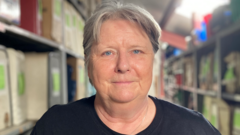
Arthur’s van smells like old upholstery and the ghost of a thousand tuna sandwiches. For twelve years, that smell was the scent of progress. It meant the wheels were turning, the heater was humming, and Mrs. Gable on Willow Creek Road was about to get the only conversation she’d have all week. But these days, the van sits in the gravel driveway of the community center longer than it should. Arthur checks the fuel gauge with the same anxiety a doctor might check a failing pulse.
The needle is a cruel master.
When fuel prices climb, we talk about global supply chains. We analyze Brent Crude. We debate the geopolitical ripples of distant wars. But for the small-scale charities that keep the gears of local society from grinding to a halt, the price of diesel isn't a statistic. It is a thief. It steals the miles. It steals the warmth. It steals the capacity to show up for people who have no one else.
The Invisible Infrastructure of Care
Charities operate on the thinnest of margins. Unlike a tech giant or a logistics firm, they cannot simply pass the cost onto a customer. Their "customers" are the housebound elderly, the hungry, and the displaced. You cannot ask a person in a food bank queue to pay a fuel surcharge for the van that delivered the bread.
Consider a hypothetical—but very real—scenario: a rural hospice service. They have four nurses who travel across three counties. Last year, their monthly fuel bill was $1,200. This year, for the same mileage, it is $1,900. That $700 gap has to come from somewhere. It comes from the training budget. It comes from the "extra" hour a nurse might spend holding a patient's hand. Eventually, it comes from the schedule itself.
The math of compassion is becoming impossible to balance.
Small non-profits are facing a pincer movement. While their operational costs are skyrocketing, the people they serve are simultaneously being squeezed by the same economic forces. When the cost of living spikes, donations typically dry up just as the demand for services explodes. People who used to give $20 a month are now using that $20 to keep their own lights on.
The Volunteer's Dilemma
The backbone of local charity isn't the paid staff; it’s the person who uses their own car to drive a neighbor to a dialysis appointment. These are the "grey-fleet" volunteers. They are often retirees on fixed incomes. For a long time, the standard mileage reimbursement was enough to cover their petrol and a bit of wear and tear.
Now, it’s a subsidy.
Arthur used to drive sixty miles a day. Now, he carefully maps his route to ensure there isn't a single wasted turn. He has started saying "no" to the calls that come from the outskirts of the county. Every time he says it, he feels a small piece of his soul chip away. He knows that when he says no, a man like Mr. Henderson stays in his dark apartment, eating cold soup because he can't get to the grocery store.
This is how a community begins to fray. It starts at the edges, where the roads are long and the houses are far apart.
The Ripple Effect of a High-Octane Crisis
When we look at the data, the picture is stark. Research from various sector analysts shows that one in five charities has been forced to reduce their service reach due to transportation costs. This isn't just about vans. It’s about the cost of heating the community hall. It’s about the price of the plastic containers used for meal deliveries.
Petroleum is baked into everything. It is the blood of our modern world, and when that blood becomes too expensive, the body begins to shut down non-essential functions. The problem is that "non-essential" to an economist is "survival" to a vulnerable family.
There is a cold irony in the fact that many of these organizations are now spending more time fundraising for their own survival than they are executing their missions. The mission is being eaten by the overhead. Managers are becoming forensic accountants, scouring spreadsheets for pennies while the needs of their community grow into mountains.
Why Logic Fails the Heart
We like to think that efficiency can save us. We talk about "optimizing" delivery routes or "leveraging" digital check-ins. But you cannot optimize a hug. You cannot digitize the act of checking if an old woman has enough blankets.
Some charities are trying to pivot to electric vehicles. It’s a noble goal, but the upfront cost is a barrier that might as well be a brick wall. A small food pantry doesn't have $40,000 for a new electric transit van. They are stuck with the old diesel guzzler that was donated back in 2014. They are tethered to the pump.
If the government doesn't adjust mileage rates or provide targeted fuel relief for the third sector, we are going to see a mass extinction of small, local charities. The big national brands might weather the storm with their massive donor databases and endowment funds. But the local groups—the ones who know your name and your dog's name—will simply vanish.
The Cost of Silence
What happens when the van stops for good?
The silence is the most terrifying part. It’s the phone that doesn't ring because people know there’s no help coming. It’s the darkened windows of the youth center that can no longer afford to run the bus for the after-school program.
We are witnessing a slow-motion hollowing out of the social safety net. We often assume that someone, somewhere, will step in. We assume the "system" is a rigid structure built of stone. It isn't. It is a fragile web of people like Arthur, people who are currently wondering if they can afford the three gallons of gas it takes to be a hero today.
The crisis at the pump is a crisis of connection. Every cent added to the price of a gallon is a mile removed from a person in need.
Arthur stands by his van, the cold wind whipping across the gravel lot. He looks at his clipboard. There are six names on the list. He looks at his wallet. He looks at the blinking red light on the dashboard. He sighs, opens the driver's side door, and climbs in. He’ll make it work today. He’ll skip his own lunch. He’ll drive a little slower. He’ll find a way because he can’t bear the thought of the silence on the other end of the door.
But tomorrow is coming. And the needle is already moving toward empty.