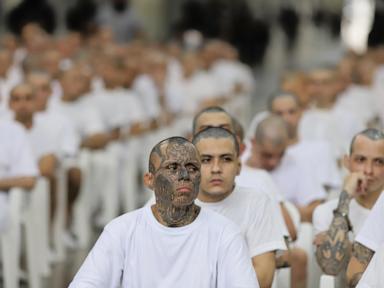
The image is stark and haunting. Hundreds of men, heads shaved and torsos bare, sit shoulder-to-shoulder on the cold floor of a high-security prison. This isn't just a routine transfer; it’s the beginning of a judicial experiment that has no precedent. In El Salvador, the government has launched a mass trial for 486 alleged members of the MS-13 gang. It’s a logistical mountain and a human rights minefield.
While the world watches these rows of shackled men, it's easy to miss the broader pulse of the region. From the Holy Week processions in Mexico to the political shifts in Venezuela, Latin America is a place of intense contrast. But El Salvador’s "Iron Fist" is the story everyone is talking about. It’s a story about the price of safety and the slow erosion of due process.
The Reality of 47000 Crimes in One Courtroom
Imagine trying to prosecute nearly 500 people at once for crimes spanning a decade. We’re talking about murder, extortion, and arms trafficking on a scale that defies logic. Prosecutors claim these individuals are responsible for over 47,000 criminal acts between 2012 and 2022.
The logistical nightmare is handled at the Center for the Confinement of Terrorism (CECOT), a "mega-prison" that has become the symbol of President Nayib Bukele’s administration. By holding these trials en masse, the government is essentially saying that individual defense is a luxury the state can no longer afford.
Critics aren't just whispering; they’re shouting. The Inter-American Commission on Human Rights has raised the alarm, noting that these collective prosecutions make it nearly impossible for a defendant to have a fair shake. When you're one of 500, how do you prove you were just in the wrong place at the wrong time?
The Discrepancy in the Numbers
There’s a growing gap between the "official" gang member count and the number of people actually behind bars. Before the state of exception began in 2022, intelligence reports estimated about 58,000 gang members were active. Fast forward to early 2026, and over 91,000 people have been arrested.
That means more than 33,000 people—roughly 36% of those detained—were never on a police radar as gang affiliates before their arrest. It's a staggering figure that points toward arbitrary detentions. Families are left in a lurch, often not knowing where their loved ones are or what they’re specifically charged with.
Beyond the Prison Walls Scenes from the Caribbean and South America
While El Salvador dominates the headlines with its judicial spectacles, the rest of the region is grappling with its own identity. Photography from this month captures a continent in flux.
- Mexico's Holy Week: In Atlixco, the "Engrillados" (the chained ones) walk the streets with thorns pressed into their skin and heavy chains dragging behind them. It’s a centuries-old display of faith and penance that feels worlds away from the sterile, high-tech surveillance of Bukele's El Salvador.
- The Venezuelan Transition: Following the seismic shifts in Venezuelan leadership earlier this year, the streets of Caracas are a mix of cautious hope and military presence. The images show a nation trying to find its footing after years of economic freefall.
- Haitian Resilience: Despite the ongoing instability, local markets in Port-au-Prince continue to buzz. The photos show women carrying massive loads on their heads, navigating streets that the state has largely abandoned.
The Bukele Model is Spreading
You can’t talk about these trials without talking about the "Bukele Effect." Other leaders in the region are taking notes. From Ecuador to Honduras, the appeal of a "hardline" approach is growing. People are tired of living in fear, and if the price of walking to the store without being robbed is a few thousand innocent people in jail, many seem willing to pay it.
But this is a dangerous trade. When you suspend the right to a lawyer or allow the government to intercept your texts without a warrant, you don't just "turn those rights back on" once the gangs are gone. You’ve fundamentally changed the DNA of the country’s legal system.
What Happens Next
If you're following this, don't just look at the conviction rates. Watch the prison conditions and the length of the "state of exception," which has been renewed nearly 50 times. The mass trials in San Salvador aren't just about MS-13; they’re a test case for whether democracy can survive a "war" on crime.
If you have family in the region or are planning to travel, stay informed through local outlets like El Faro, which continues to report despite intense government pressure. The visual narrative of Latin America right now is one of struggle and survival, but the legal precedent being set in El Salvador might be the most lasting image of all.
Keep an eye on the upcoming Inter-American Court rulings. They’ll likely be the only real check on this power, though whether Bukele chooses to listen is a different story entirely.