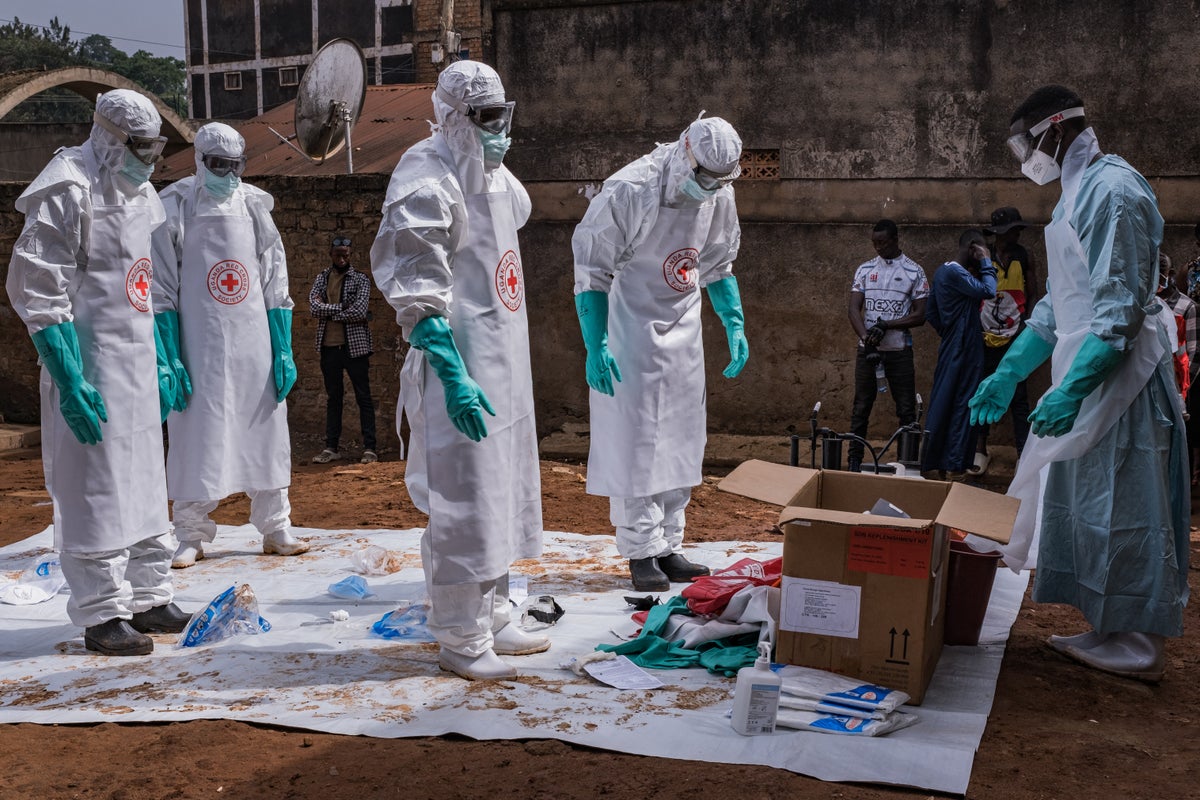
Linear comparisons between historical global health allocations and active pathogen outbreaks present a fundamental flaw in economic logic. Media assertions that the UK government's current commitment of £21 million to contain the burgeoning Ebola outbreak in the Democratic Republic of the Congo (DRC) and Uganda represents a dangerous retraction—measuring a mere fraction of the £427 million deployed during the 2014–2016 West African epidemic—fail to account for the operational mechanics of international crisis financing. Evaluating public health capital expenditure solely through an aggregate monetary lens ignores structural variances in viral epidemiology, regional baseline healthcare capacity, and the marginal utility of early-stage intervention capital.
To evaluate whether the current fiscal commitment is an empirically sound epidemiological strategy or a critical funding shortfall, the deployment of capital must be mapped against specific logistical frameworks. The efficacy of an international health response is determined not by gross expenditure, but by how capital functions to suppress the reproductive rate ($R_0$) of a pathogen before transmission dynamics shift from localized clusters to exponential regional growth.
The Three Pillars of Outbreak Cost Dynamics
The total financial commitment required to suppress a viral outbreak is governed by a distinct cost function. This function dictates that backend expenditures scale exponentially when frontend container variables are neglected. Rather than viewing international aid as a static charity pool, analytical precision requires breaking down containment costs into three distinct pillars.
Pathogen-Specific Transmission Profiles
The current outbreak in Central Africa involves the Bundibugyo ebolavirus strain, a variant distinct from the Zaire ebolavirus strain responsible for the 2014–2016 West African disaster. The epidemiological profile of the Bundibugyo strain presents unique diagnostic hurdles. The virus frequently presents with lower initial case-fatality rates and slower initial symptom onset, leading to delayed clinical detection.
During the initial weeks of the current outbreak, local diagnostics routinely yielded false negatives due to testing protocols calibrated exclusively for the Zaire strain. Consequently, transmission chains expanded silently across regional transport hubs including Goma and Kampala, elevating the latent case load far beyond the officially recorded metrics. Genomic tracking and immediate laboratory calibration represent highly leveraged entry points for targeted funding, yielding far higher suppression returns per pound spent than broad-based humanitarian relief.
Baseline Regional Resiliency
A critical error in comparing the 2014 West African crisis to the current Central African outbreak is ignoring the baseline public health infrastructure. Prior to 2014, Guinea, Liberia, and Sierra Leone had virtually zero systemic experience with filoviruses. The resulting intervention required building basic infrastructure from the ground up: erecting entire field hospitals, deploying international military logistical corps, and establishing standard operating procedures for contact tracing in urban environments.
Conversely, the DRC is managing its 17th documented Ebola event. The country possesses a highly specialized institutional architecture, localized laboratory networks, and an experienced cadre of native epidemiologists. Because the foundational infrastructure already exists, international capital acts as an operational multiplier rather than a primary construction fund. Capital efficiency is structurally higher because funds are directed into active supply chains rather than systemic construction.
The Conflict-Logistics Bottleneck
The presence of armed conflict in the eastern DRC introduces an operational friction coefficient that severely degrades the purchasing power of international aid. Financial allocations are bound by physical access constraints. When militant groups disrupt transit corridors, the cost of distributing personal protective equipment (PPE) and clinical resources escalates due to the requirement for private security escorts, armored logistics, or emergency airlifts.
Furthermore, geopolitical shifts—such as the contraction of large-scale international development frameworks over the past decade—have left rural clinics vulnerable. When external operational funding vanishes, localized healthcare delivery systems experience immediate equipment depletion. A £21 million allocation deployed in a high-friction conflict zone faces entirely different logistical constraints than a similar sum deployed in a stable geopolitical environment.
The Diminishing Marginal Utility of Delayed Capital
Epidemiological funding operates on a non-linear decay curve. Capital injected at $t_0$ (the index case or localized cluster phase) behaves as a preventive shield, whereas capital injected at $t_n$ (the established epidemic phase) functions as reactive damage control.
[Phase 1: Proactive Containment] -> High Leverage (Low Capital, High Suppression)
                |
                v
[Phase 2: Systemic Saturation]  -> Low Leverage (High Capital, Reactive Control)
During the 2014 West African outbreak, the international community delayed major financial deployments for months until the disease breached major urban centers. By that point, the transmission dynamics had achieved systemic saturation. The subsequent £427 million UK allocation was not a calculated choice for optimal outcomes; it was a premium paid to suppress an unchecked global health threat.
The current £21 million allocation targets the proactive containment phase. The objective is to fund immediate contact tracing, supply regional centers with diagnostic assays capable of differentiating the Bundibugyo variant, and establish localized quarantine protocols. When deployed effectively at the inception of regional transmission, a highly targeted £21 million intervention can theoretically achieve the same net reduction in $R_0$ as a multi-hundred-million-pound reactive deployment months later.
However, this strategy carries a severe structural vulnerability: if the initial allocation undercalculates the latent case volume—which independent groups like the London-based MRC Centre for Global Infectious Disease Analysis suggest already exceeds official figures due to diagnostic delays—the funding will prove insufficient, forcing a transition into the highly inefficient reactive spending paradigm.
Structural Bottlenecks in Current Allocations
The operational utility of the UK's current fiscal deployment is constrained by three clear systemic vulnerabilities that limit its overall effectiveness.
- The Vaccine Deficiency Gap: Unlike the Zaire ebolavirus, which can be mitigated using established countermeasures like the Ervebo vaccine, the Bundibugyo strain lacks an approved, mass-manufactured vaccine. Funding cannot simply purchase an existing pharmaceutical solution. It must instead be directed toward intensive infection prevention, resource-heavy contact tracing, and supporting experimental clinical trials. This structural reality shifts the containment burden entirely onto human infrastructure and physical logistics, which are inherently more expensive and logistically difficult to scale rapidly.
- The Inflationary Burden on Local Supply Chains: The influx of international aid capital into active conflict zones often triggers local market distortions. In major transport and logistics hubs like Bunia, the sudden demand for basic clinical necessities has caused rapid local price increases. When basic disinfectants and protective barriers experience immediate fourfold price surges, the real purchasing power of a fixed international grant drops significantly.
- Institutional Fragmentary Attrition: Disbursing funds through layered international entities—moving from the UK Foreign, Commonwealth & Development Office to multilateral UN agencies, and finally to local non-governmental organizations—creates administrative overhead and transactional delays. In a rapid pathogen transmission environment, a ten-day delay in capital conversion into physical PPE at a rural clinic can result in the loss of frontline medical personnel, causing irreversible damage to local containment capacity.
Empirical Comparison of Intervention Frameworks
| Operational Variable | 2014–2016 West African Outbreak | Current Central African Outbreak |
|---|---|---|
| Primary Pathogen Strain | Zaire ebolavirus | Bundibugyo ebolavirus |
| UK Capital Allocation | £427 Million (Total Lifecycle) | £21 Million (Initial Committal) |
| Baseline Domestic Capacity | Negligible; structural creation required | High; institutional memory from 16 prior outbreaks |
| Pharmaceutical Countermeasures | Developed and deployed mid-crisis (rVSV-ZEBOV) | No approved vaccine or targeted therapeutic available |
| Operational Environment | Post-conflict recovery; open transit corridors | Active conflict zone; fractured domestic logistics |
Strategic Action Plan
To maximize the epidemiological return on the £21 million allocation and prevent the necessity of a multi-million-pound emergency intervention later, the UK deployment strategy must pivot away from broad agency distribution toward a high-velocity, targeted allocation model.
- Immediate Capital Redirection to Diagnostic Recalibration: Direct 30% of the unspent allocation exclusively to upgrading rural diagnostic networks with multiplex PCR assays designed for the Bundibugyo strain. Eliminating the false-negative diagnostic blind spot is the single highest-leverage action available to halt silent transmission chains.
- Establishment of a Localized Procurement Shield: To counter the inflationary pressures in logistics hubs like Bunia, funds must bypass local retail markets. Capital should be used to secure bulk, international supply-chain contracts for PPE, airlifting equipment directly to centralized field depots to protect the purchasing power of the aid from local price gouging.
- Direct Capital Allocation for Frontline Healthcare Subsidies: The containment architecture fails entirely if indigenous medical personnel face asymmetric mortality rates due to resource depletion. A designated portion of the funding must be structured as direct hazard pay and premium life-insurance guarantees for local clinicians. Safeguarding the existing expert human infrastructure yields a vastly superior containment return compared to the late-stage deployment of international medical teams.