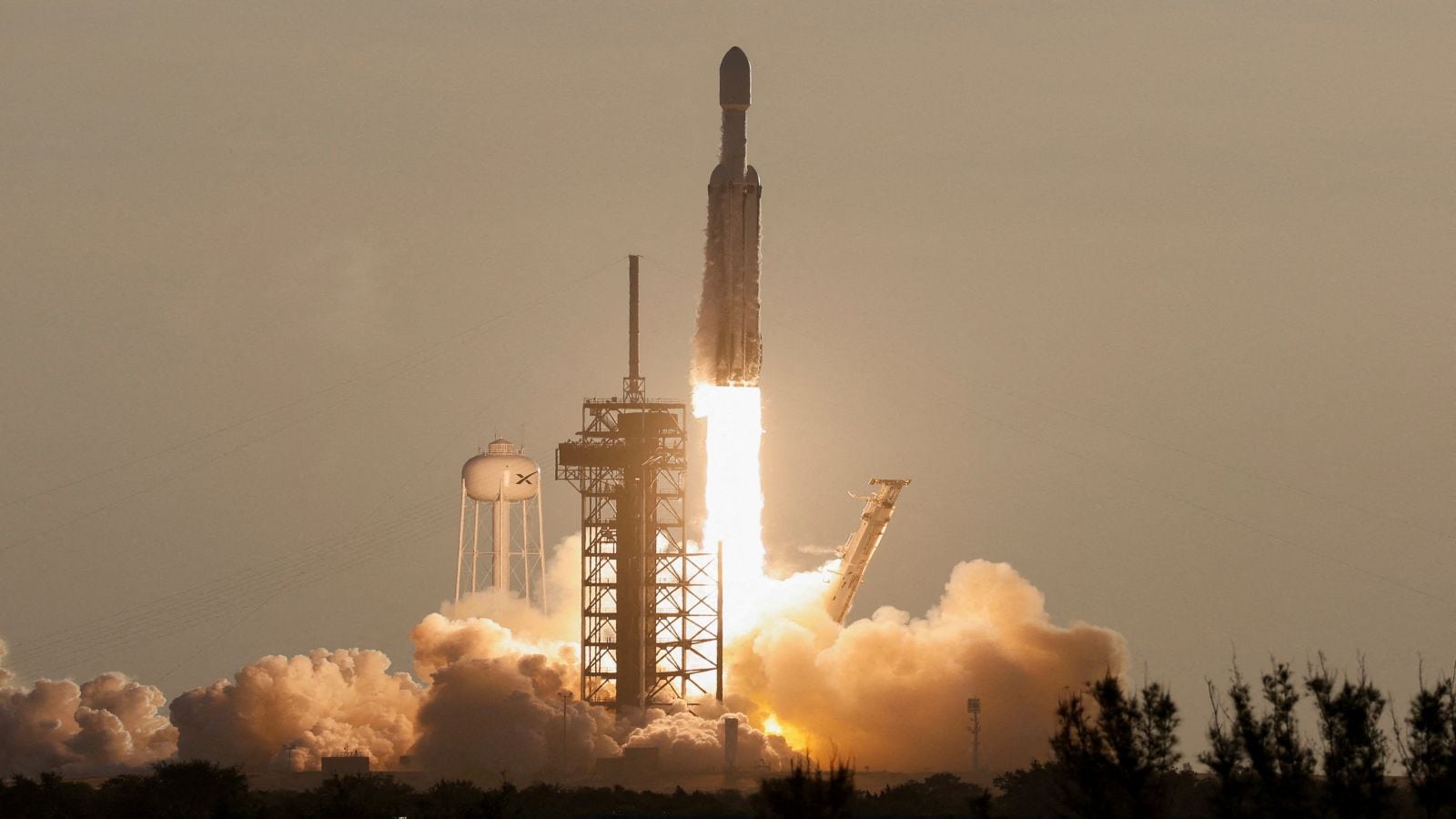
Capital allocation in deep space astrophysics follows a strict risk-reward curve where instrumentation throughput dictates scientific yield. When NASA executed the launch of the Nancy Grace Roman Space Telescope via a SpaceX Falcon Heavy from Kennedy Space Center, the $4.3 billion price tag represented more than an operational milestone; it marked a fundamental shift in how wide-field astronomical surveys manage the cost-per-pixel-collected metric. Understanding this observatory requires dissecting its design constraints, economic trade-offs, and the specific mechanics that separate it from predecessors like Hubble and James Webb.
The Structural Mechanics of Wide-Field Advantage
Traditional space-based optical architecture forces a strict trade-off between angular resolution and field of view. Instruments optimized for deep-field observation, such as the Hubble Space Telescope, operate with narrow viewing windows to maximize detail over minuscule segments of the sky. This creates a data collection bottleneck when mapping large-scale cosmic structures, tracking transient phenomena, or compiling statistical samples of exoplanets. For a different view, check out: this related article.
The Roman Space Telescope resolves this bottleneck through a structural design centered on a Wide-Field Instrument equipped with a 300-megapixel focal plane array. By utilizing a primary mirror identical in diameter to Hubble's 2.4 meters—initially manufactured as surplus hardware for reconnaissance applications—project engineers inherited a diffraction-limited optical baseline without incurring the compounding research and development costs of custom primary fabrication.
The core operational advantage lies in the field of view, which spans 100 times greater than that of Hubble's infrared instrument capabilities while maintaining equivalent spatial resolution. This multiplication factor changes the economics of spatial surveys. Where previous observatories required hundreds of discrete pointing operations to mosaic a nearby galaxy cluster, Roman captures equivalent area and photometric depth in single exposures. Similar reporting on this trend has been published by CNET.
Capital Allocation and Cost Efficiency
At a total lifecycle cost baseline of $4.3 billion, financial analysts frequently mischaracterize the observatory as an expensive deviation from streamlined commercial models. Evaluating the fiscal mechanics requires analyzing the cost per unit of scientific output rather than absolute nominal expenditure.
[Legacy Deep-Field Instrument] -> Narrow FoV -> High Pointing Overhead -> Low Statistical Volume per Dollar
[Roman Architecture]          -> Wide FoV  -> Low Pointing Overhead  -> High Statistical Volume per Dollar
The economic efficiency stems from three primary factors:
- Hardware Inheritance: Utilizing the donated NRO-class mirror chassis saved an estimated hundreds of millions in optical polishing and blank fabrication overhead.
- Launch Vehicle Cost Optimization: Transitioning to heavy-lift commercial launch providers like the Falcon Heavy lowered the mass-to-orbit capital expenditure relative to legacy expendable systems.
- Targeted Operational Scope: By focusing on pre-selected observational pillars—dark energy, exoplanet demographics, and infrared astrophysics—mission parameters restrict expensive, ad-hoc scheduling revisions.
This configuration shifts the cost curve downward per square degree of sky surveyed. The observatory is not designed to stare narrowly at isolated anomalies; it functions as a high-throughput data factory designed to generate statistically significant populations of astronomical bodies.
Dark Energy Measurement via Gravitational Lensing
Quantifying dark energy remains one of observational cosmology's most persistent challenges due to the subtle nature of its effects on cosmic expansion over billions of years. Roman approaches this through weak gravitational lensing and baryon acoustic oscillations, utilizing sheer sample size to overcome individual measurement noise.
As light from distant galaxies travels toward Earth, intermediate mass distributions—including dark matter halos—bend the light paths slightly. This produces coherent distortions in background galaxy shapes known as cosmic shear. Measuring shear across millions of individual galaxies demands exceptional PSF stability and wide-field coverage.
Roman's detectors record structural shapes with minimal optical distortion across an expansive survey area. By compiling multi-epoch imaging data of billions of galaxies, the mission isolates the statistical signature of dark energy's repulsive pressure. The precision of this measurement scales directly with the square root of the number of observed galaxies, making Roman's wide-field throughput the primary driver of its cosmological utility.
Exoplanet Demographics Through Microlensing
Detecting exoplanets via transit and radial velocity methods introduces severe observational bias. Transits favor planets with short orbital periods close to their host stars, while radial velocity favors massive planets exerting high gravitational tugs. Both methods struggle to detect cold, distant planets or rogue worlds floating untethered through interstellar space.
Roman addresses this sampling bias via gravitational microlensing. When a foreground star passes precisely in front of a background star from the observer's viewpoint, the gravitational field of the foreground system acts as a natural lens, magnifying the background light transiently. If the foreground star hosts an exoplanet, the planet introduces a sharp, secondary spike within the magnification light curve.
Because this microlensing effect depends entirely on mass rather than luminosity, the technique detects planets regardless of their host star's brightness or the planet's orbital distance. Positioned at the Sun-Earth Lagrange Point 2 (L2), Roman monitors dense stellar fields toward the galactic bulge continuously. This vantage point provides the uninterrupted baseline necessary to register transient microlensing anomalies that ground-based observatories miss due to atmospheric interference and day-night cycles.
Operational Constraints and Data Infrastructure
Deploying an observatory capable of generating petabytes of raw telemetry introduces severe computational and logistical bottlenecks. Roman's wide-field instrument generates data volumes that dwarf legacy missions, transforming the primary engineering challenge from hardware collection to ground-segment data processing.
The pipeline requires automated calibration algorithms capable of correcting detector persistence, cosmic ray strikes, and flat-field irregularities across hundreds of millions of pixels without manual intervention. Archival accessibility dictates the ultimate utility of the mission; the scientific return on investment relies on the rapid distribution of standardized data products to the global research community rather than exclusive access pipelines.
Furthermore, thermal management at L2 requires strict equilibrium. Infrared detectors must remain intensely chilled to prevent thermal self-emission from blinding faint astrophysical signals. Cryogenic management systems dictate the operational lifespan of the instruments, establishing a strict temporal ceiling on total data collection capacity.
Allocate compute resources toward automated anomaly detection algorithms within the ground segment prior to the full release of survey catalogs to maximize the velocity of transient follow-up observations by ground-based telescopes.