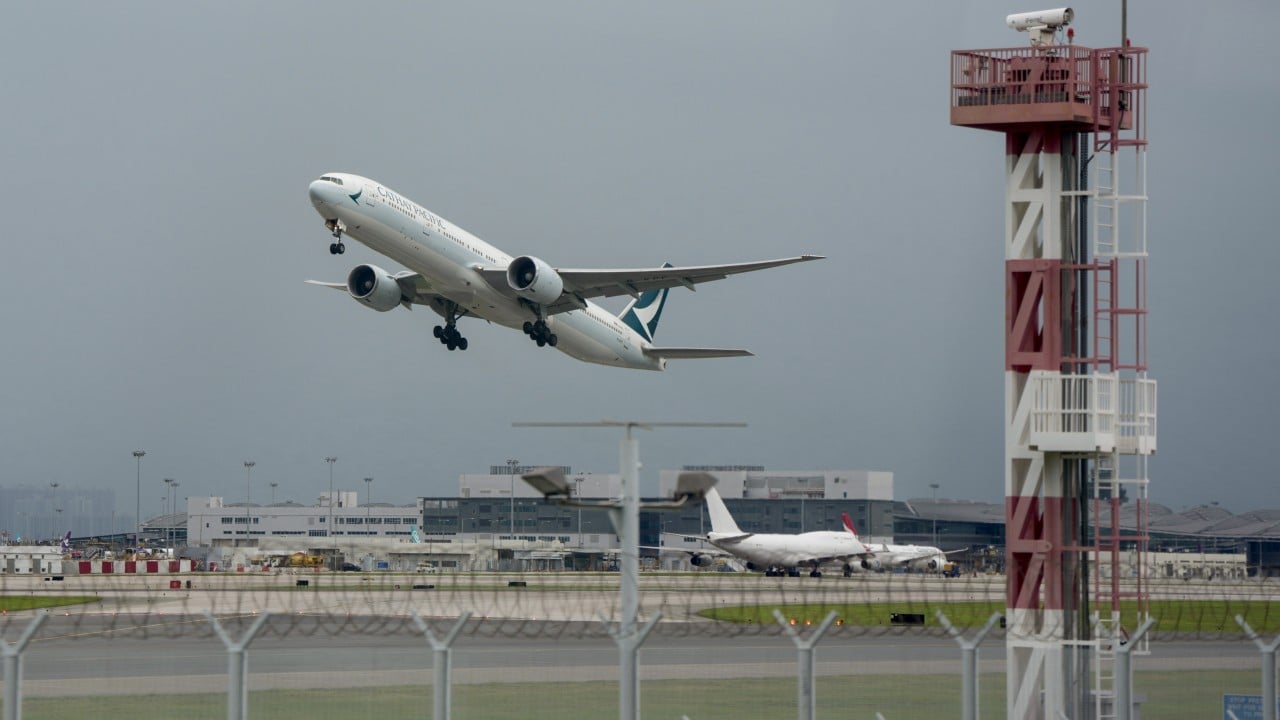
International aviation operates on the fiction of a borderless sky. When state actors exchange missile strikes, this fiction collapses, forcing airlines to convert geopolitical volatility into an immediate operational cost function. The decision by Cathay Pacific and its global peers to suspend, delay, or reroute flights through Middle Eastern corridors is not merely a reactionary safety measure. It is a complex optimization problem balancing kinetic threat mitigation against the hard boundaries of network elasticity, fuel economics, and crew duty regulations.
When air corridors close, the impact cascades across continents. To understand the structural shift occurring in global aviation, the problem must be disassembled into its core operational and financial vectors.
The Tripartite Risk Architecture of Airspace Disruption
Airlines do not evaluate geopolitical escalation through a purely qualitative lens. They apply a quantitative risk framework divided into three distinct operational layers.
1. Kinetic Risk and Threat Identification
The primary layer concerns the direct physical threat to the aircraft hull and passengers. This includes surface-to-air missile engagement, GPS spoofing, electronic warfare interference, and misidentification by military air defense systems. The historical precedents of Malaysia Airlines Flight 17 and Ukraine International Airlines Flight 752 demonstrate that commercial aircraft operating in active conflict zones face catastrophic identification errors.
When the United States and Iran engage in kinetic exchanges, the proliferation of long-range anti-aircraft assets and ballistic trajectories introduces an unacceptable variance in civilian flight safety. Airspace is rarely closed uniformly; instead, regulators like the Federal Aviation Administration (FAA) and the European Union Aviation Safety Agency (EASA) issue Notices to Air Missions (NOTAMs) and Conflict Zone Information Bulletins. Airlines must synthesize these directives with their internal corporate security intelligence to map exclusion zones.
2. Operational Viability and Routing Volatility
The secondary layer involves the physical mechanics of flying the aircraft. If a standard flight path from Hong Kong to Europe or the western Middle East is compromised, the flight planning system must calculate alternative Great Circle tracks.
This introduces three immediate variables:
- Airspace Congestion Premiums: When an entire region like Iraq or Iran becomes a no-fly zone, traffic is squeezed into narrow, adjacent corridors over Turkey, Saudi Arabia, or Egypt. This spatial compression causes immediate bottlenecks, leading to air traffic control (ATC) holding patterns and departure slot delays.
- Overflight Fee Escalation: Sovereign nations charge communication and navigation fees for using their airspace. Rerouting flights forces airlines to pay unbudgeted premiums to alternative countries, directly inflating the operating cost per block hour.
- Geographic Bottlenecks: For carriers based in the Asia-Pacific region, navigating around the Middle East requires either a deep southern routing over the Indian Ocean and the Horn of Africa or a northern diversion across Central Asia and China. Both alternatives fundamentally alter the flight profile.
3. Network Yield Degradation
The tertiary layer impacts the commercial engine of the airline. Hub-and-spoke carriers like Cathay Pacific rely on precise arrival and departure waves at their main hubs. A flight that arrives two hours late due to an airspace detour misses its connecting wave.
Passengers bound for onward destinations must be rebooked, baggage systems overflow, and high-yielding business travelers face schedule disruptions. The financial penalty of a disrupted network often outpaces the direct cost of the extra fuel burned on the diverted route itself.
The Cost Function of Airspace Avoidance
To quantify the exact penalty of bypassing a conflict zone, we can express the marginal cost increase of an altered flight path through a structured cost equation. The total economic penalty $C_{total}$ of a rerouted flight is determined by the summation of variable operational inputs over the extended flight time:
$$C_{total} = \int_{0}^{\Delta t} [C_{fuel}(t) + C_{crew}(t)] dt + \Delta C_{overflight} + C_{slot} + C_{downstream}$$
Where:
- $\Delta t$ represents the additional block time required by the detour.
- $C_{fuel}(t)$ is the dynamic rate of fuel consumption, which increases non-linearly as the aircraft carries more fuel weight to complete the longer journey.
- $C_{crew}(t)$ represents the hourly labor cost, factoring in overtime premiums and contractually mandated rest penalties.
- $\Delta C_{overflight}$ is the net difference in sovereign airspace transit fees.
- $C_{slot}$ is the financial penalty or structural loss associated with missing a designated arrival slot at a capacity-constrained hub.
- $C_{downstream}$ represents the cascading financial loss from missed passenger connections and disrupted aircraft rotations.
The Payload-Range Efficiency Tradeoff
The most severe constraint on ultra-long-haul routes is the payload-range tradeoff. Commercial aircraft like the Airbus A350-1000 or Boeing 777-300ER have a Maximum Takeoff Weight (MTOW) restriction.
If a flight path requires an additional 90 minutes of flight time to circumvent a combat zone, the aircraft must carry tons of additional fuel. Because the aircraft cannot exceed its MTOW, every kilogram of extra fuel loaded into the wing tanks requires a corresponding reduction in revenue-generating payload.
Airlines face a brutal choice: they must either bump high-yielding cargo off the flight or deny boarding to passengers. On ultra-long-haul sectors, a route extension of two hours can transform a highly profitable flight into a net-negative operation before the aircraft even leaves the tarmac.
Cathay Pacific's Hub Architecture and Geographic Exposure
Cathay Pacific operates out of Hong Kong International Airport (HKG), a geographic position that makes its European and Middle Eastern networks uniquely sensitive to airspace disruptions. Unlike Middle Eastern carriers (the "ME3" consisting of Emirates, Qatar Airways, and Etihad), which sit directly inside the affected geography and must maintain access to regional corridors to survive, Cathay Pacific treats the Middle East primarily as a transit corridor to Europe, alongside a selection of dedicated regional destinations like Tel Aviv, Riyadh, and Dubai.
The Closed Airspace Pincer
The operational challenge for Cathay Pacific is intensified by the ongoing closure of Russian airspace to Oneworld alliance carriers and western-aligned airlines following the war in Ukraine. Prior to 2022, flights from Hong Kong to Northern and Western Europe routinely utilized the Siberian corridor, avoiding the Middle East entirely.
With Russian airspace closed, Cathay Pacific was forced to shift its European network south, running heavily through Central Asia, Azerbaijan, Turkey, and Iran.
The escalation of hostilities between the United States, Israel, and Iran creates a pincer effect. The northern escape route (Russia) is locked by sanctions; the southern escape route (Iran/Iraq) is locked by kinetic threats. This leaves only a hyper-congested, narrow corridor running through Saudi Arabia and Egypt, or a highly inefficient northern routing that hugs the southern border of Russia through Kazakhstan and across the Black Sea.
Crew Duty Limitations and Hub Disruption
The prolonged flight times caused by these detours threaten the hard regulatory walls of Flight Time Limitations (FTL). Civil aviation authorities enforce strict rules regarding the maximum number of hours a flight crew can remain on duty without sleep.
A standard long-haul flight from Hong Kong to London or Frankfurt typically operates near the limit of a standard crew complement. If an unexpected airspace closure adds two hours to the flight time mid-route, the crew risks "exceeding their hours."
To mitigate this, airlines must pre-emptively station relief crews at intermediate stations or add an extra pilot and cabin crew member to the flight manifest. This drives up crew rotation costs and thins out the available labor pool at the home hub, constraining the airline’s broader operational reliability.
Strategic Mitigation Frameworks for Global Carriers
When an airline decides to delay or cancel flights to the Middle East, it is executing an optimization strategy designed to protect capital and network integrity. Carriers deploy three distinct tactical plays to handle prolonged structural disruptions.
[Airspace Disruption Detected]
       |
       v
[Evaluate Flight Path Viability]
       |
       +---> Alternative Route Available? (Within MTOW & Crew Limits)
       |        |
       |        +---> YES: Execute Rerouting & Pay Fuel/Overflight Premium
       |        |
       |        +---> NO: Proceed to Capacity Allocation Review
       |
       v
[Capacity Allocation Review]
       |
       +---> Re-route Fleet to Safe, High-Yield Markets (e.g., Transpacific/APAC)
       |
       +---> Consolidate Frequencies to Maximize Load Factors
Strategic Capacity Reallocation
Rather than flying long, fuel-inefficient detours to marginally profitable destinations in an active conflict zone, sophisticated airlines pull capacity out of the affected region entirely. The aircraft used for Middle Eastern routes are wide-body assets (Airbus A330s, A350s, or Boeing 777s). These assets are highly liquid from a network perspective.
An airline can pivot by canceling its daily frequency to a high-risk Middle Eastern destination and reallocating that specific airframe to a lower-risk, high-yield regional or transpacific market—such as Tokyo, Sydney, or Los Angeles. This protects the asset from kinetic risk while maximizing the utilization rate of the fleet in stable markets.
Dynamic Tactical Holding and Wave Adjustments
For routes that cannot be canceled due to strategic corporate commitments or critical cargo contracts, airlines implement a tactical holding strategy. Instead of operating on a fixed schedule, flight departures are delayed at the origin hub to coincide with specific daylight windows or periods of relative calm in the conflict zone.
While this disrupts the traditional hub wave system, it allows the airline to maintain the route without exposing passengers and crew to the heightened risks of night-time military operations or unexpected missile barrages.
The Structural Realignment of Air Corridors
The fragmentation of global airspace is transitioning from a temporary crisis into a permanent operational reality. Airlines can no longer build networks based on the assumption of optimal Great Circle routes. The long-term implication is a permanent balkanization of the sky, where airline profitability is dictated as much by geopolitical alignment as by fleet efficiency or passenger service.
Carriers that fail to build dynamic, algorithmic flight planning software capable of recalculating fuel-payload metrics in real time will face severe margin erosion. The future belongs to airlines that maintain high balance sheet liquidity and fleet flexibility, allowing them to shift capacity away from volatile geopolitical corridors within hours of the first warning shot. Carriers will increasingly favor versatile, ultra-efficient aircraft with long ranges—like the Airbus A350-900ULR—which provide the operational margin needed to bypass entire continents without requiring refueling stops or sacrificing revenue-generating payload.