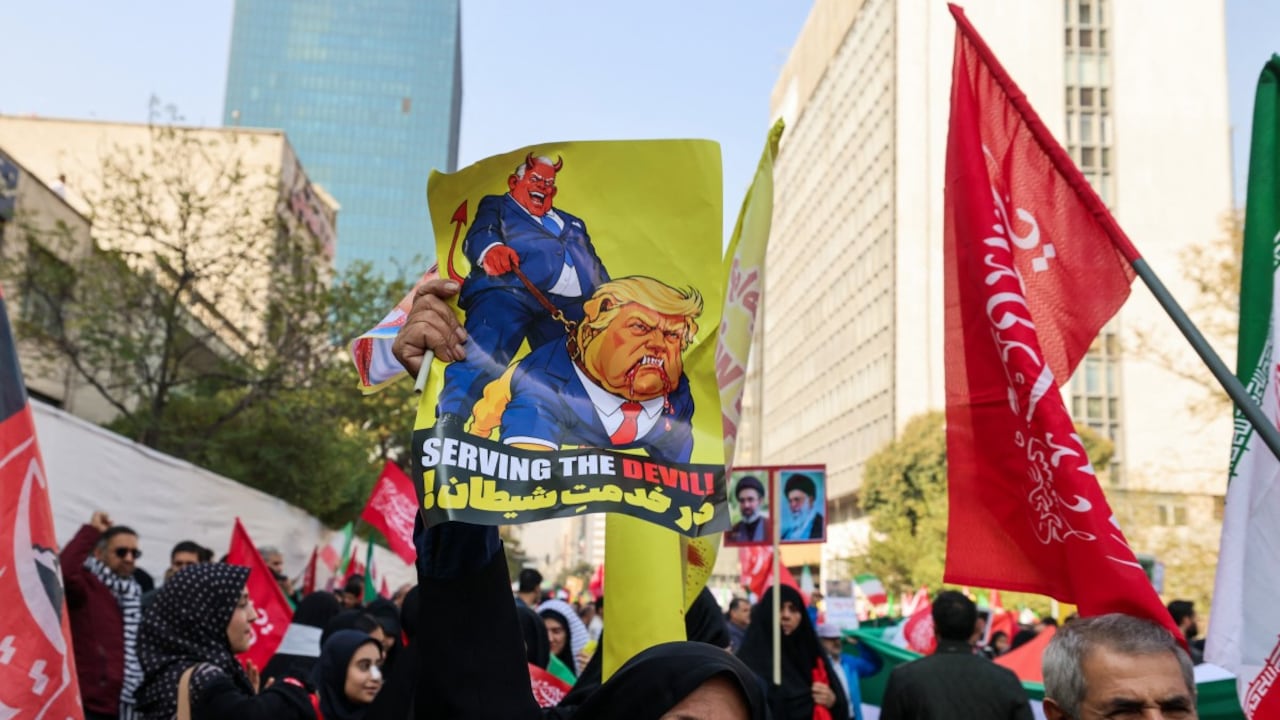
The tea in Tehran always tastes slightly of cardamom and dust by late afternoon.
If you sit near the cracked laminate tables of a café just off Enghelab Street, watching the grey exhaust of aging Peykans curl into the smog, you learn quickly that politics is never just a headline. It is the price of mutton. It is the sudden disappearance of insulin from the corner pharmacy. And on certain volatile mornings, it is the sound of rhythmic chanting spilling out from behind iron gates, bouncing off concrete walls until the words blur into a single, percussive roar.
Chants calling for the death of an American president are not new in the Islamic Republic. Since 1979, state-orchestrated rallies have turned anti-American slogans into a predictable liturgy of the street. Yet when those cries surge immediately following an American midterm election—specifically when the sitting president’s party loses control of Congress—the noise carries a very different frequency. To the casual observer scrolling past a sensational headline in Ohio or London, it looks like pure, unadulterated rage. A monolithic threat. A simple story of enemies celebrating a rival’s stumble.
Look closer, though. Listen beneath the loudspeakers. What sounds like uniform triumph is actually the sound of a high-stakes poker table shifting weight in the dark.
The Architecture of a Chant
To understand why a ballot cast in Pennsylvania triggers a roar in Tehran, you have to strip away the theater and look at the mechanics of survival.
Consider a hypothetical scene—one that plays out in variations across both capitals every two years. Picture Reza, a mid-level currency trader in Tehran’s Grand Bazaar, staring at the flickering green numbers on his phone as American precinct results trickle in. Four thousand miles away in Washington, a congressional staffer named Claire is packing boxes in a Rayburn House Office Building suite, knowing her boss’s committee gavel is about to pass to the opposition. Neither Reza nor Claire will ever meet. Neither holds a rifle. Yet the invisible thread connecting their futures just pulled taut.
When an American president’s party loses the midterms, Washington enters a familiar state of divided government. History shows this is the rule, not the exception; in nearly every midterm cycle over the past century, the party holding the White House loses seats in the House of Representatives, and frequently the Senate. For domestic voters, this means gridlock on tax bills, judicial confirmations, and infrastructure spending.
For the leadership in Tehran, however, divided American government reads like a structural fracture in the armor of their primary adversary.
Hardline factions within Iran’s political establishment—particularly figures aligned with the Islamic Revolutionary Guard Corps—rely on a specific narrative to maintain internal cohesion. That narrative requires an external monster that is simultaneously terrifying and weakening. When Donald Trump’s party suffers a midterm defeat, state media and clerical voices immediately frame the loss not as a routine democratic pendulum swing, but as a rejection of his maximum pressure policies and a sign of American internal decay. The chant "We will kill Trump"—a direct echo of the vows made after the January 2020 assassination of Quds Force commander Qasem Soleimani—serves a dual purpose. Externally, it projects defiance. Internally, it signals to an exhausted, inflation-battered population that the regime is winning a war of attrition without firing a shot.
The Weight of Unfinished Ghosts
There is a raw, unhealed scar sitting at the center of US-Iran relations, and pretending it is merely geopolitical strategy misses the human reality entirely.
When Qasem Soleimani was killed in a drone strike near Baghdad International Airport, the shockwave did not dissipate after a news cycle. In the West, foreign policy analysts debated deterrence theory and escalation ladders. Inside Iran’s security apparatus, the strike was experienced as a personal humiliation and an existential breach. Supreme Leader Ali Khamenei and senior IRGC commanders publicly vowed "hard revenge," explicitly naming Trump and senior members of his administration.
Think of this dynamic like two neighbors locked in a dispute over a burned fence, where one neighbor holds a sledgehammer and the other holds a megaphone. When the man with the sledgehammer trips on his own front steps, the man with the megaphone does not quietly go inside. He turns the volume to maximum so the entire block knows his enemy is off-balance.
For years, intelligence assessments from the U.S. Department of Justice and the Office of the Director of National Intelligence have documented persistent Iranian plots targeting former U.S. officials in retaliation for Soleimani. These are not idle street slogans; they involve real surveillance networks, hired intermediaries, and active counterintelligence operations. Yet there is a critical distinction between covert operational intent and public street theater.
When crowds chant death threats after a U.S. midterm loss, they are participating in state-sanctioned catharsis. Buses bring in civil servants, Basij militia members, and seminary students. Banners are printed overnight with matching typography. The cameras of Press TV and Tasnim News Agency are positioned at low angles to make hundreds look like tens of thousands. The roar is real, and the anger behind the Soleimani killing is genuine among regime loyalists, but the timing is pure political choreography.
Why Midterm Losses Fuel Foreign Misreading
Here is where the danger creeps in—quietly, invisibly, like carbon monoxide in a closed garage.
Authoritarian systems frequently struggle to read democratic messy-ness. Having spent years observing how political messaging travels between Washington and the Middle East, one pattern stands out above all others: autocrats consistently mistake American domestic dissent for American paralysis.
In the American constitutional system, a midterm defeat clips a president’s legislative wings, turning his final two years into a battle over budgets, subpoenas, and domestic vetoes. What it does not do is strip the Commander-in-Chief of executive authority over national security, intelligence operations, or military strikes. In fact, presidents facing a hostile Congress often lean harder into foreign policy precisely because it is the one arena where they retain broad unilateral power.
But in the echo chambers of Tehran’s hardline newspapers, a lost House majority looks like a wounded lion. The temptation for Iranian strategists—and their regional proxies—is to test the boundaries while they believe Washington is distracted by internal political warfare.
Consider what happens next when both sides operate on flawed assumptions:
- Tehran sees weakness: Hardliners assume a politically bruised president cannot rally domestic support for a major foreign confrontation, emboldening bolder rhetoric and riskier gray-zone maneuvers in the Persian Gulf or through regional militias.
- Washington sees provocation: American lawmakers across both parties, eager not to look soft on a regime openly chanting for the assassination of a U.S. president, respond with sharper sanctions, naval deployments, and bipartisan condemnation.
- The middle ground evaporates: Any quiet diplomatic backchannel—whether regarding nuclear enrichment limits, prisoner swaps, or regional de-escalation—becomes politically toxic in Washington the moment viral footage of death chants hits cable news.
The Invisible Casualties on the Pavement
Step outside the ministry buildings and away from the microphones, and the picture shifts again.
In northern Tehran, or in the dry, wind-scoured streets of Mashhad and Isfahan, the average twenty-five-year-old does not wake up thinking about the U.S. House of Representatives. They wake up checking the exchange rate between the Iranian rial and the U.S. dollar. Over the past decade, sanctions, mismanagement, and regional proxy spending have hollowed out the Iranian middle class. A university graduate working two jobs still cannot afford rent on a modest apartment.
When state television broadcasts crowds shouting "Will kill Trump" after a midterm election, millions of ordinary Iranians watch with a mixture of exhaustion and quiet dread. They know the script by heart. Every spike in aggressive rhetoric brings another tremor to the currency market. Every threat aimed at Washington translates, within forty-eight hours, into higher prices for cooking oil, imported medicine, and smartphone parts.
I remember speaking with an engineer from Shiraz during a period of heightened Gulf tensions a few years ago. He was not ideological. He loved Persian poetry, worried about his mother’s arthritis medication, and wanted nothing more than to visit Europe once in his life. "Whenever they shout about destroying America," he told me, rubbing his temples, "it is always our roofs that shake."
That is the human cost invisible in sensationalist coverage. When Western outlets run a headline focusing solely on the most inflammatory chant from a Tehran rally, they inadvertently hand hardliners in Iran the exact international amplification they crave, while erasing the millions of Iranian citizens who view those slogans as a prison wall separating them from the normal world.
Navigating the Fog Without Blinking
It is easy to feel overwhelmed or cynical watching this cycle repeat. On one side, a political establishment in Tehran weaponizing grief and anti-Americanism to project strength at home. On the other, an American political ecosystem where every foreign provocation is immediately fed into the domestic partisan grinder.
So how do we read moments like this without falling for the theater?
First, separate the microphone from the trigger. Street chants in Tehran are calibrated primarily for domestic consumption and regional signaling, especially when timed to an American election cycle. Taking them literally as an imminent declaration of war plays directly into the psychological warfare playbook of the IRGC.
Second, never confuse legislative gridlock in Washington with strategic surrender. American foreign policy apparatus—from the Pentagon to the Treasury Department—operates with institutional continuity that survives midterm swings. Historically, miscalculating American resolve during moments of domestic political division has led adversaries into catastrophic blunders, from Saddam Hussein’s invasion of Kuwait in 1990 to misreadings of U.S. posture during previous congressional turnovers.
Third, hold space for the complexity of the people living under the banners. A country is never identical to its loudest loudspeakers. Recognizing the real security threats posed by Iranian covert networks does not require pretending that eighty-eight million Iranians march in lockstep behind state-printed placards.
The Sound After the Crowd Disperses
By dusk in Tehran, the state buses idle along the curb, their diesel engines rumbling as the rally participants file back aboard, folding their placards and tucking away their flags. The loudspeakers are switched off. The streets return to their usual rhythm—horns honking, motorbikes weaving dangerously between sedans, shopkeepers pulling down corrugated metal shutters against the evening chill.
On Enghelab Street, Reza the currency trader closes his ledger for the night, calculating how much value his savings lost while Washington counted ballots and Tehran counted slogans. Four thousand miles away, Claire locks the door to her congressional office, stepping out into the crisp November air beneath the illuminated dome of the Capitol.
The chants have faded into the smog, yet the echo remains—hanging in the space between two nations that keep mistaking each other’s noise for the whole truth.


