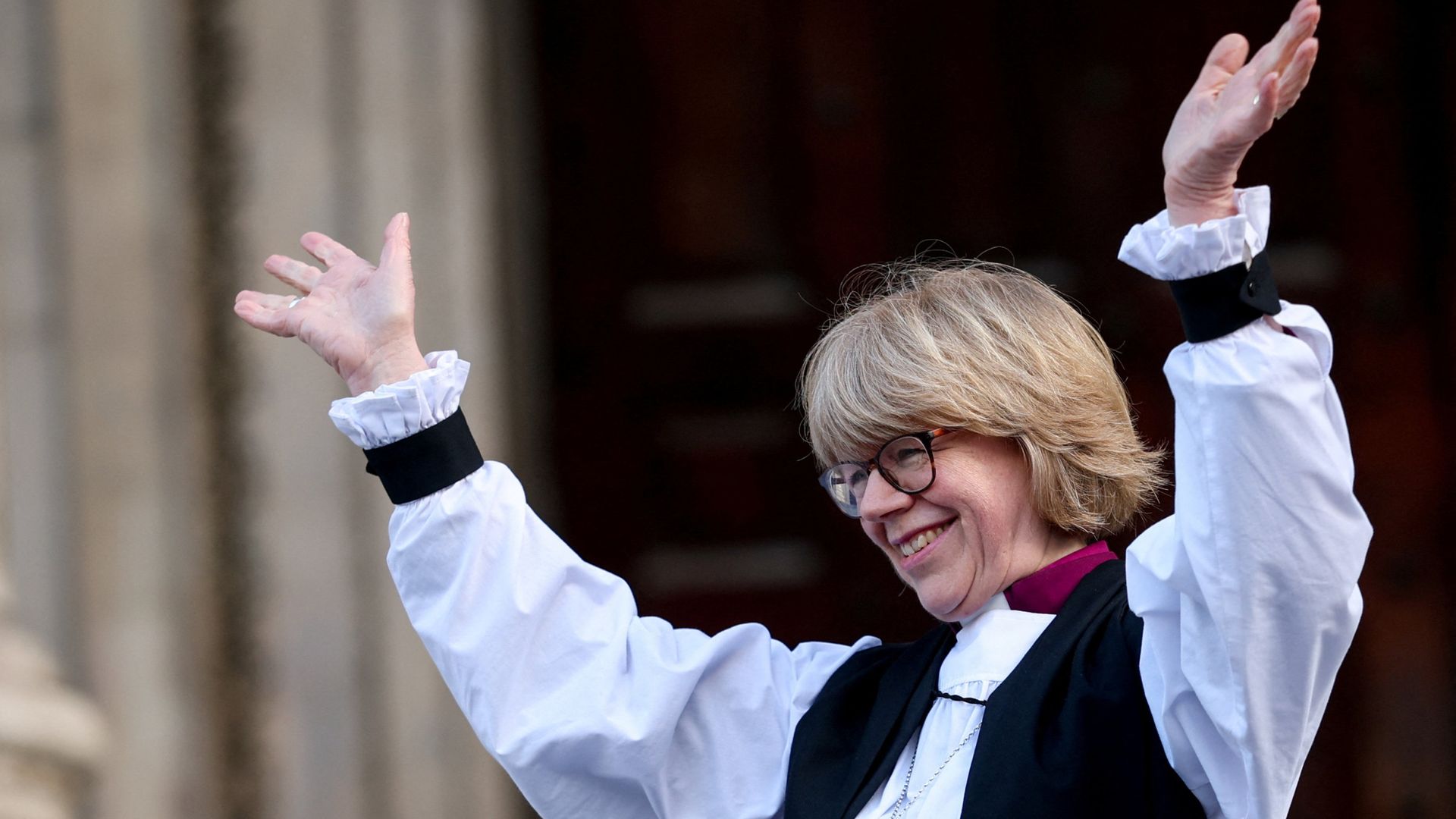
The appointment of the first female Archbishop of Canterbury is not merely a milestone in representation but a high-stakes management challenge involving the navigation of a fractured global franchise. The incoming Primate inherits a balance sheet of declining participation, systemic financial pressure, and a deep-seated ideological schism. Success is not defined by the optics of the appointment but by the ability to manage three specific vectors: the operational solvency of the Church Commissioners’ assets, the retention of the Anglican Communion’s international membership, and the internal cultural realignment of a 500-year-old institution.
The Tripartite Burden of the Primacy
The Archbishop of Canterbury occupies three distinct and often conflicting roles simultaneously. Each role carries a different set of Key Performance Indicators (KPIs) and risk profiles.
- Diocesan Bishop of Canterbury: Local administrative oversight of a specific geographic region.
- Primate of All England: The symbolic and political head of the established state church, requiring constant engagement with the UK Parliament and the Monarchy.
- Focus of Unity for the Anglican Communion: The titular leader of 85 million people across 165 countries, many of whom hold diametrically opposed views on social doctrine.
The "tough job" narrative typically centers on gender-based resistance. However, a structural analysis suggests that gender is a secondary variable compared to the primary friction: the irreconcilable gap between the liberalizing tendencies of the Global North and the conservative growth engines of the Global South (specifically Nigeria, Uganda, and Kenya).
Structural Schism and the Global South Bottleneck
The Anglican Communion functions as a voluntary association of autonomous provinces. Unlike the Roman Catholic Church, the Archbishop of Canterbury lacks supreme jurisdictional authority. The power is influential rather than executive.
The Global South Fellowship of Anglican Churches (GSFA) represents the largest demographic bloc of the church. Their rejection of the Church of England’s recent shifts toward blessing same-sex unions creates a "legitimacy deficit." If the first female Archbishop is perceived as a creature of the liberal establishment, she faces a high probability of a formal "broken communion" declaration from the GSFA.
The mechanism of this failure is a decoupling of the "Instruments of Communion." When the African provinces—which hold the highest growth rates—cease to recognize the Archbishop as the primus inter pares (first among equals), the office loses its global leverage. The strategic challenge is to maintain a "theological holding pattern" that prevents a total split while satisfying the legislative demands of the General Synod in London.
The Economic Reality of Declining Participation
Religious institutions operate on a membership-subscription model, even when subsidized by historic endowments. The Church of England is currently navigating a period of sharp "customer churn."
- Attendance Metrics: Average Sunday Attendance (ASA) has seen a consistent year-on-year decline, accelerated by the post-2020 shift in communal habits.
- The Maintenance Trap: The Church owns approximately 16,000 buildings, 12,000 of which are Grade I or II listed historical sites. This creates a massive "fixed cost" burden. The capital required for roof repairs and heating frequently cannibalizes the budget for "mission and ministry" (the growth-focused operations).
- The Demographic Cliff: The median age of regular churchgoers is significantly higher than the national average. Without a radical shift in the "value proposition" to Gen Z and Millennials, the institution faces a terminal liquidity crisis within the next 25 to 40 years.
A female Archbishop must lead a "right-sizing" of the physical estate. This involves the politically sensitive task of closing underperforming parishes and centralizing resources into "Minster Hubs"—a corporate-style consolidation that often alienates the core legacy donor base.
Navigating the Establishment Clause
The Archbishop is a "Lord Spiritual" in the House of Lords. This provides a platform for national influence but subjects the office to intense secular scrutiny. The first female Archbishop will be expected to weigh in on housing, migration, and economic inequality with more "moral clarity" than her predecessors.
This creates a tactical trap. Every public statement on secular politics risks alienating a segment of the domestic audience. If she moves too far toward political activism, she risks the "de-establishment" of the church—the removal of the Church of England’s special legal status. If she remains silent, she is viewed as an irrelevant relic. The optimal strategy is "Subsidiarity-Based Leadership," where the Archbishop focuses on local community resilience rather than national policy dictates, thereby rebuilding trust from the ground up.
The Internal Culture Constraint
The Church of England is not a monolith; it is a coalition of "tribes":
- Anglo-Catholics: Focused on liturgy and tradition; often the most resistant to female leadership on sacramental grounds.
- Evangelicals: Focused on scripture and growth; currently the most influential in terms of funding and church planting.
- Liberals/Broad Church: Focused on social justice and inclusivity; the primary advocates for the new Archbishop.
The incoming leader cannot afford to be a partisan for the liberal wing that elected her. To survive the first 1,000 days, she must perform a "Sacramental Pivot"—demonstrating an unexpected commitment to tradition or evangelical growth to co-opt her natural critics. This is a classic "Nixon to China" maneuver. If she only speaks to the liberal center, she will be unable to govern the wings of the church.
The Crisis of Spiritual Authority
In a data-driven world, "authority" is often conflated with "influence." For the Archbishop, authority is derived from perceived holiness and theological depth. The relentless focus on the "first female" descriptor can paradoxically undermine this authority by framing the appointment as a political victory rather than a spiritual calling.
The mechanism of authority in this context requires the Archbishop to move beyond the "managerial bishop" model. The Church has spent two decades adopting corporate jargon and strategic planning frameworks (e.g., "Renewal and Reform"). While these are necessary for solvency, they have failed to stem the decline in attendance. The new Archbishop must re-inject "transcendence" into the brand—offering something the secular market cannot, rather than trying to compete with NGOs on social service delivery.
Strategic Forecast: The Three-Phase Execution
To stabilize the institution, the Archbishop’s tenure must follow a rigorous sequence of operations.
Phase 1: The Trust Audit (Months 1-12)
Immediate diplomatic missions to the Global South primates. This is not for negotiation but for "active listening." The goal is to lower the temperature and delay any formal motions of schism. Domestically, she must visit "non-friendly" dioceses to signal that her gender is a settled fact of administration, not a point of ongoing debate.
Phase 2: Asset Rationalization (Years 2-5)
The Church Commissioners must move from a "preservation" mindset to a "deployment" mindset. This involves aggressive disinvestment from non-performing heritage assets and heavy investment in "digital liturgy" and church planting in high-density urban areas. The Archbishop must provide the political cover for bishops to close dying rural churches.
Phase 3: The New Settlement (Year 5+)
Establishing a "Differentiated Communion." This is a formal recognition that different parts of the Anglican world will move at different speeds on social issues. It moves the church away from the "Focus of Unity" being a shared set of rules to a "Shared Heritage" model—essentially a loose confederation rather than a unified corporation.
The "tough job" is not a glass ceiling to be broken; it is a crumbling infrastructure to be rebuilt. The success of the first female Archbishop will be measured by her willingness to be the architect of a smaller, leaner, but more ideologically coherent church. She must trade "breadth" for "depth," recognizing that an institution that tries to be everything to everyone in a polarized age ultimately becomes nothing to anyone.
The most effective move for the incoming Primate is to immediately appoint a "Shadow Cabinet" of conservative advisors. By intentionally surrounding herself with those who theoretically oppose her appointment, she nullifies the most potent weapon of the opposition: the claim that she is a partisan of a singular ideology. This creates a "Unified Front" that can weather the inevitable shocks of the next Lambeth Conference.