The sea does not change, but the shore forgets.
For thousands of years, the Mediterranean has slapped against the ancient stone walls of Tyre. It is a sound that Phoenician traders, Roman governors, Crusader knights, and Ottoman merchants all fell asleep to. Today, that same rhythm is punctuated by something entirely modern, brutal, and loud. The crump of airstrikes. The whine of reconnaissance drones circling in a cloudless blue sky.
When news alerts flash across phone screens reading "Israel strikes Lebanese city mentioned in Bible," the brain processes it as a headline. A data point in a decades-long ledger of geopolitical strife. But headlines are flat. They lack the smell of roasted coffee beans mingling with cordite. They do not capture the panic of an old man trying to coax a stubborn vintage Mercedes to start while the horizon turns black, or the specific, terrifying silence that falls over a neighborhood seconds before the ordnance hits.
Tyre is not just a coordinate on a military map. It is a living, breathing lung of history, and right now, it is inhaling smoke.
The Weight of the Stone
To understand what is being broken, you have to understand what was built. Tyre is a city that logic says should have vanished into the sand millennia ago. It survived the siege of Nebuchadnezzar. It forced Alexander the Great to build a massive, permanent causeway just to breach its island defenses—an engineering marvel that permanently altered the coastline of Lebanon.
In the books of Isaiah, Ezekiel, and Joshua, Tyre is cast as a glittering, arrogant merchant queen of the ancient world. Purple dye from murex shells made its kings rich. Cedar wood from the mountains funded its empires. It is the birthplace of Europa, the princess who gave her name to a continent. When you walk the narrow alleys of the Christian quarter today, under balconies draped in bougainvillea, you are walking on layers of discarded civilizations.
Consider a hypothetical resident named Youssef. He is seventy-two, with hands hardened by decades of pulling fishing nets from the sea. Youssef does not think about Alexander the Great when the sirens wail. He thinks about his grandfather’s house, built with limestone quarried from Roman ruins, featuring walls three feet thick that have kept out the summer heat for generations. He thinks about the small cafe near the old harbor where the tea is always too sweet.
When an evacuation order arrives via a social media post or a dropped leaflet, Youssef is not just being asked to move his body to a safer zone. He is being asked to untether himself from the earth. Where do you put seventy years of memory when you only have ten minutes to pack a canvas bag?
The conflict between Israel and Hezbollah has turned the south of Lebanon into a chessboard, but the chess pieces are made of flesh, blood, and irreplaceable heritage. The modern reality is stark. Militants operate from the shadows of ancient landscapes, and high-tech militaries strike from the sky, arguing that proximity justifies destruction. The logic is flawless on a whiteboard in a command center. It is devastating when the missile tears through an apartment block three blocks away from a UNESCO World Heritage site.
The Anatomy of an Alert
The routine of modern warfare is strangely bureaucratic. It begins with the warning.
An Arabic-language spokesperson for the Israel Defense Forces posts a map online. Red blocks shade out entire neighborhoods. The text warns residents to leave immediately, stating that Hezbollah facilities are targeted for destruction.
Then comes the exodus.
The streets of Tyre, usually a chaotic ballet of scooters, yellow taxis, and vendors selling boiled corn, choke with panic. People pack cars with mattresses strapped to the roof. Parents hold children by the wrist, walking briskly toward the north, toward Beirut, toward anywhere that is not red on the digital map. The wealthy leave in SUVs; the poor walk or pile into the backs of pickup trucks.
But some cannot leave. The bedridden grandmother whose oxygen tank cannot be easily moved. The stubborn shopkeeper who swears he will die before he lets another war ruin his inventory. The stray dogs that roam the Roman hippodrome, sensing the vibration of distant explosions before the human ear can register the threat.
The strike itself is a sensory assault that no news broadcast can replicate. First, the air pressure drops. Your ears pop. Then, a sound that is less of a noise and more of a physical blow to the chest. The earth shivers. The ancient dust of Phoenician mortar, Roman brick, and modern concrete rises into the air, turning the afternoon sun into a sickly orange ball.
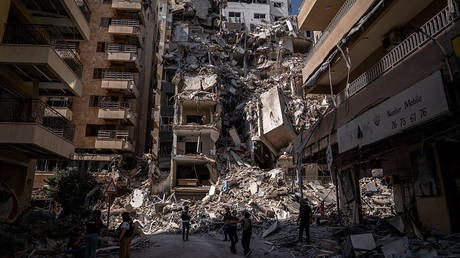
When the dust settles, a piece of the city is gone. A building that housed three generations of a family is reduced to a gray mound of pulverized stone and twisted rebar. Colorful curtains flutter from exposed living rooms that no longer have outer walls. Children's toys sit immaculate on balconies overlooking sheer drops.
The Invisible Fractures
The real tragedy of war in a place like Tyre is not just the immediate body count or the rubble. It is the slow, agonizing death of continuity.
When a historic city becomes a combat zone, the tourist industry—the lifeblood of the local economy—evaporates. The boutique hotels overlooking the fisherman's wharf close their shutters. The restaurants that served fresh sea bass to visitors from Beirut and Paris dismiss their staff. The economic collapse that has plagued Lebanon for years deepens its grip, turning an acute military crisis into a chronic human disaster.
There is a profound vulnerability in watching a landscape you love be disassembled by forces beyond your control. It breeds a specific kind of weariness. It is a fatigue that settles deep into the bones of the Lebanese people, who have spent the last fifty years rebuilding the same walls, replanting the same olive groves, and burying the same sons and daughters.
The world watches through a lens of desensitization. Another strike. Another ancient city threatened. Another geopolitical statement issued from Washington, Jerusalem, or Beirut. The regional narrative swallows the human reality whole. We argue about human shields, proportional response, and military necessity while ignoring the absolute terror of a mother hiding in a bathroom with her toddlers, wondering if the ceiling will hold.
The Water Remains
The sun begins to set over Tyre, painting the Mediterranean in shades of bruised purple and gold—the same purple that once made this city the envy of the ancient world.
The smoke from the afternoon's bombardment still hangs in the valleys behind the city, a dark shroud against the evening sky. The drones continue their monotonous, mechanical buzz overhead, an artificial cricket song for a broken century.
Down by the ancient harbor, the water still laps against the stone. A single wooden fishing boat, painted a bright, defiant blue, bobs gently in the wakes. Its owner is nowhere to be seen, likely displaced or sheltering in some crowded schoolroom miles to the north. But the boat remains, tied securely to a iron ring embedded in a wall that has seen empires rise, falter, and turn to dust.
The stone can be shattered. The buildings can be brought low. But the sea remembers the people who built them, and the tide always comes back.