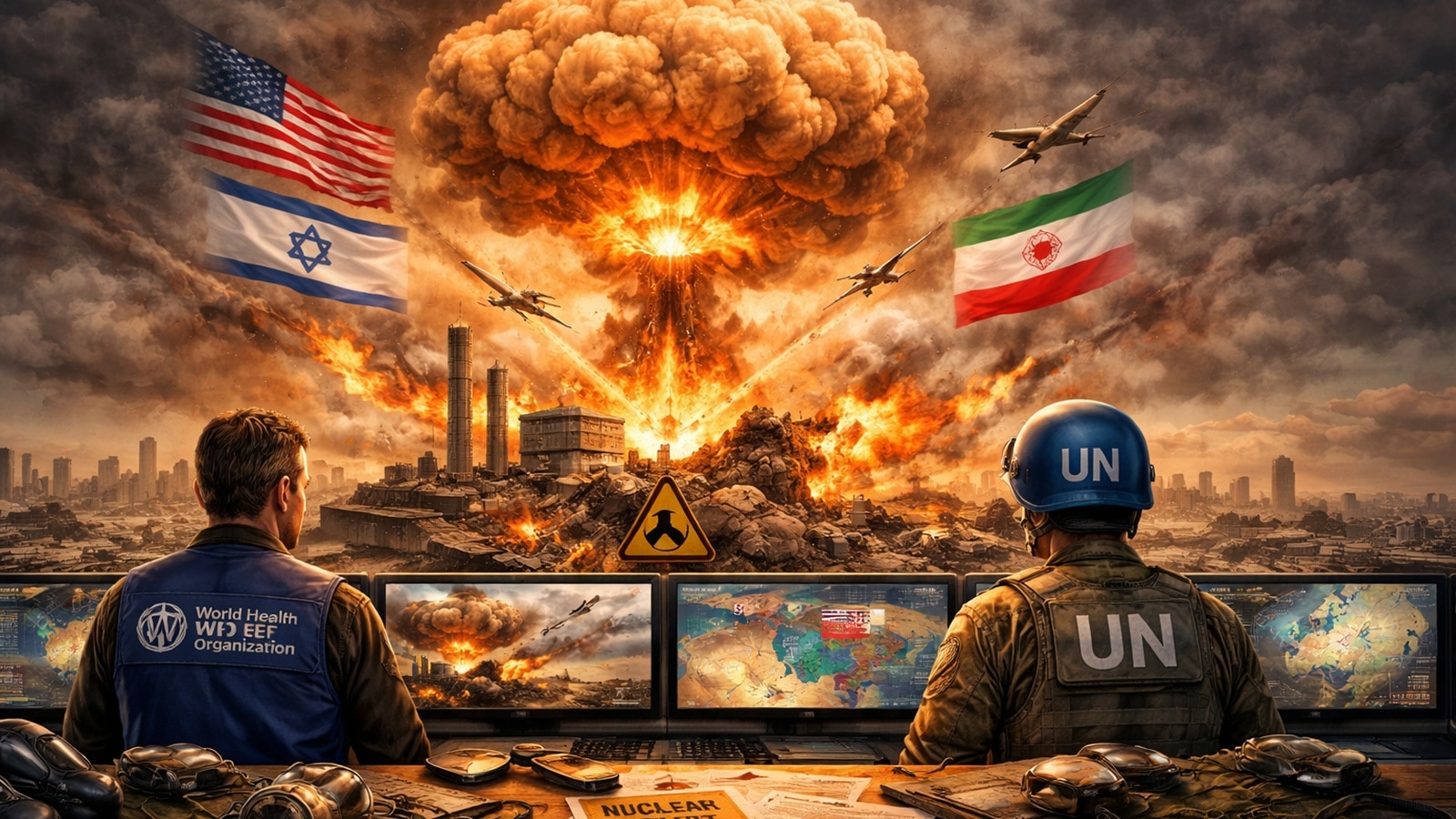
The ventilation system in a subterranean bunker doesn’t hum. It breathes. It is a rhythmic, artificial inhalation that reminds you, every few seconds, that the air you are currently consuming is a finite resource managed by a computer. In the quiet corridors of the World Health Organization’s strategic planning hubs, this is the sound of the "worst-case scenario."
It is a sound that feels increasingly loud.
For decades, the global health community operated on the assumption that the world was moving toward a more stable, albeit messy, diplomatic equilibrium. But the spreadsheets have changed. The variables are no longer just about polio or the next influenza strain. They are now about the specific, agonizing physics of ionizing radiation and the geopolitical tinderbox currently sitting beneath the skin of the Middle East.
The Midnight Inventory
Somewhere in a temperature-controlled warehouse, a technician is counting vials of potassium iodide. They are checking the expiration dates on Prussian blue, a pigment usually used by painters that doubles as a life-saving treatment for internal radioactive contamination. This is not a drill. It is an admission.
When the WHO recently signaled that it is formalizing preparations for a nuclear catastrophe linked to a potential escalation in Iran, it wasn't just a bureaucratic update. It was a white flag raised against the illusion of safety. To understand the weight of this, you have to look past the political posturing and the satellite imagery of enrichment facilities. You have to look at the human body.
Imagine a grandmother in Isfahan or a young teacher in Tel Aviv. They wake up to a world where the sky has changed color. They aren't thinking about uranium-235 enrichment percentages or the breakdown of the JCPOA. They are thinking about the metallic taste in their mouths. This is the sensory reality of the unthinkable.
The WHO’s job is to stare into that sun and not blink. Their preparation involves the "Global Network for Radiation Emergency Medical Preparedness and Assistance." It’s a long name for a terrifyingly simple task: figuring out how to manage a mass-casualty event where the very air, soil, and water become the enemy.
The Invisible Triage
The math of a nuclear event is cruel. It is a geometric progression of suffering. In a standard conflict, you treat the wounded. In a nuclear conflict, you have to decide who can be saved based on how much of the invisible fire they have swallowed.
Consider the logistics of "decontamination." It sounds like a car wash. In reality, it is a desperate race to scrub the skin of thousands of people before the particles penetrate deep enough to rewrite their DNA. It requires massive amounts of water—water that may itself be contaminated. It requires specialized suits for medical workers who are effectively walking into a slow-motion furnace to pull others out.
The WHO is currently updating its list of required medicines for these exact moments. They are stockpiling treatments for "Acute Radiation Syndrome."
ARS is not a disease in the traditional sense. It is the body’s systems failing in a specific, chronological order. First, the bone marrow gives up. The white blood cells vanish. The body loses its ability to fight even the mildest cold. Then, the gastrointestinal system begins to disintegrate. Finally, if the dose was high enough, the vascular and central nervous systems collapse.
This is the "core fact" that the dry news reports skip. When we talk about "preparing for nuclear catastrophe," we are talking about prepping for the systemic melting of human biology on a city-wide scale.
The Burden of the Unseen
The real tragedy of these preparations is the psychological toll on the people who have to make them. There is a specific kind of trauma reserved for the scientists who spend their Tuesdays calculating the fallout patterns of a strike on a nuclear facility.
They know that if an escalation occurs between Israel, the West, and Iran, the "theater of war" will not be confined to a map. It will drift on the wind. It will settle in the wheat fields. It will be found in the milk of cows grazing hundreds of miles away from the initial blast.
The WHO’s move to update its "National Strategic Stockpiles" for radiological emergencies is a quiet scream. It is an acknowledgment that the traditional guardrails of diplomacy are thinning. We are no longer talking about if a red line might be crossed, but what we do with the bodies once the line is gone.
In a world obsessed with the immediate—the next election, the next stock market dip—the health officials are looking at the deep time of radioactive isotopes. Cesium-137 has a half-life of 30 years. If a catastrophe occurs today, the children born in the year 2056 will still be living with the consequences of a decision made in a room they will never enter.
The Ghost of the Future
There is a certain irony in the fact that we have the medicine. We have the Prussian blue. We have the Filgrastim to stimulate white blood cell production. We have the logistics experts who can move these supplies across borders in hours. We are, as a species, incredibly good at cleaning up the messes we shouldn't have made in the first place.
But medicine is a poor substitute for peace.
The WHO’s preparation isn't a sign of strength; it’s a symptom of a feverish world. Every time a new shipment of radiation-countermeasure drugs is logged into a database, the shadow of the Doomsday Clock grows a little longer.
We find ourselves in a strange moment of history where the most important people in the room are the ones preparing for the end of the room itself. They are the architects of the last resort, building a safety net out of gauze and potassium tablets, hoping fervently that it never has to catch a single person.
The hum of the bunker continues. The inventory goes on.
We are left to wonder at what point the cost of preparation becomes a self-fulfilling prophecy, and whether the sheer effort of planning for the "worst-case scenario" blinded us to the path that led away from it.
Somewhere, a technician closes a ledger. The vials are safe. The world, however, remains dangerously fragile.
What if we spent as much energy mapping the path to de-escalation as we do mapping the drift of the fallout?