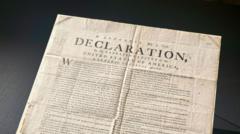
The air inside a county record office is different from the air outside. It smells of dried sheepskin, crumbling leather, and the heavy, still breath of centuries. It is the kind of quiet that makes you feel your own pulse. For most people, it is a landscape of profound boredom. But for a specific type of person, it is a treasure map where the X is never marked.
John was shifting through boxes in the West Sussex Record Office. He was a volunteer, the kind of person who spends his free time untangling the handwriting of dead clerks. The day was entirely ordinary. Outside, the British rain was likely tapping against the window. Inside, John was looking at the papers of the Dukes of Richmond.
Then, he moved a piece of parchment.
We tend to think of history as a series of monumentally deliberate acts. We imagine treaties signed by men with perfect posture, or battlefields preserved with pristine markers. We forget that history is mostly just paper. It gets folded, stuffed into drawers, mislabeled, and forgotten. It gets covered in the dust of old attics until someone with enough patience decides to look closer.
What John was holding did not look like ordinary British legal bureaucratic scrap. It was big. It was old. And as his eyes scanned the top of the parchment, the words began to hit him with the force of a physical blow.
In Congress, July 4, 1776.
It was the Declaration of Independence. Not a textbook copy. Not a souvenir bought in a Washington gift shop. A massive, official, contemporary parchment copy of the document that tore the British Empire in half.
Imagine the sheer absurdity of the moment. You are sitting in Chichester, England—a cathedral city deeply rooted in ancient British history—and you are holding the birth certificate of the United States. Your hands are suddenly shaking. The silence of the archive room becomes deafening.
This was not a common broadside print. This was a parchment manuscript, a twin to the famous document held in the National Archives in Washington D.C. Before this moment, only one such large-format parchment copy was known to exist. Now, because a volunteer decided to open a specific box on a specific Tuesday, there were two.
How does a nation’s foundational rebellion end up in the private files of a British aristocrat?
To understand that, we have to look past the grand speeches of Thomas Jefferson and into the messy, paranoid world of 18th-century transatlantic politics. The document found in Sussex is now known to researchers as the Sussex Declaration. It dates back to the 1780s, a time when the ink on the Treaty of Paris was barely dry and the global superpower of the day was trying to figure out how it had just lost a continent.
The third Duke of Richmond, Charles Lennox, was a man caught between two worlds. He was a British radical. He openly supported the American colonists during the Revolutionary War, earning him the nickname "the Radical Duke." While his peers demanded the total destruction of the American rebels, Richmond was arguing that the colonists had a point.
Think of him as a political insider hoarding the literature of the opposition. The parchment was likely produced in New York or Philadelphia, commissioned by someone who wanted to make a statement. It wasn't meant to be hidden. It was meant to be displayed, a grand piece of political theater rendered in ink and skin.
But when the war ended and the reality of a new global order set in, the grand statements became liabilities or, at best, strange souvenirs of a family's rebellious phase. The document was filed away. The Duke died. The boxes were packed. The family moved on. The world forgot.
The parchment itself tells a story of profound political maneuvering. When researchers from Harvard University came to examine the Sussex Declaration after John’s discovery, they noticed something strange about the names at the bottom.
On the famous Washington copy, the signatures are grouped by state. It is a declaration of a union, but one deeply segregated by local geographies. John Hancock signs large and proud in the center, and the rest fall into neat, regional columns.
The Sussex copy is different. The names are scrambled.
John Hancock’s signature is small, tucked away. The rest of the signers are listed in a single, continuous block, with no regard to whether they represented Massachusetts, Virginia, or Georgia. This wasn’t a mistake. In the high-stakes world of early American nation-building, this formatting choice was a massive political statement.
Alexander Hamilton and his Federalist allies were fighting a desperate battle to convince a fractured nation that they were one people, not thirteen separate countries. By scrambling the signatures, the creator of the Sussex Declaration was asserting a radical idea: the United States was a singular, unified entity. It was a visual argument against state sovereignty, written in the very names of the men who risked the gallows to create it.
It is a reminder that the past is never truly settled. We think of history as something carved in stone, but it is actually written on fragile, organic material that reacts to moisture, light, and the careless hands of time.
Consider what happens next when something like this is found. The discovery is just the beginning. Then comes the science.
Experts descended on Sussex with multi-spectral imaging equipment, looking at the document under wavelengths of light invisible to the human eye. They tested the ink. They analyzed the DNA of the parchment to determine what kind of animal had provided the skin. They looked for erased notes, faint pencil marks in the margins, anything that could trace the journey of this treasonous piece of paper across the Atlantic Ocean during a time of war and embargoes.
They found that the parchment was prepared in a way consistent with American manufacturing of the period. They found iron gall ink that had eaten slightly into the skin over nearly two and a half centuries. Every test confirmed the impossible truth.
The find reshapes our understanding of how the ideas of the American Revolution were distributed, preserved, and argued over in the years immediately following the war. It proves that the conversation about what America was supposed to be wasn't just happening in the halls of Congress. It was happening in London, in country manors, and in the private libraries of the very men who had lost the empire.
We live in an era where everything feels documented, tracked, and uploaded to a cloud. We assume that if something matters, it must be on a server somewhere, indexed and searchable.
John’s discovery breaks that illusion completely.
It reminds us that there are still massive, world-altering secrets sitting in cardboard boxes under fluorescent lights. It reminds us that the grand narratives of global history rely entirely on the quiet, unpaid labor of people who care enough to look closer at a piece of old paper.
The Sussex Declaration now sits in a secure environment, its climate carefully controlled, its preservation ensured for centuries to come. It is no longer just a forgotten relic of a Duke's eccentric political leanings. It is a monument.
But the true magic of the story isn't the document itself. It is the moment before the discovery. It is the image of a volunteer reaching into a box, lifting a piece of heavy parchment, and realizing that the entire world can change in the space between two heartbeats.


