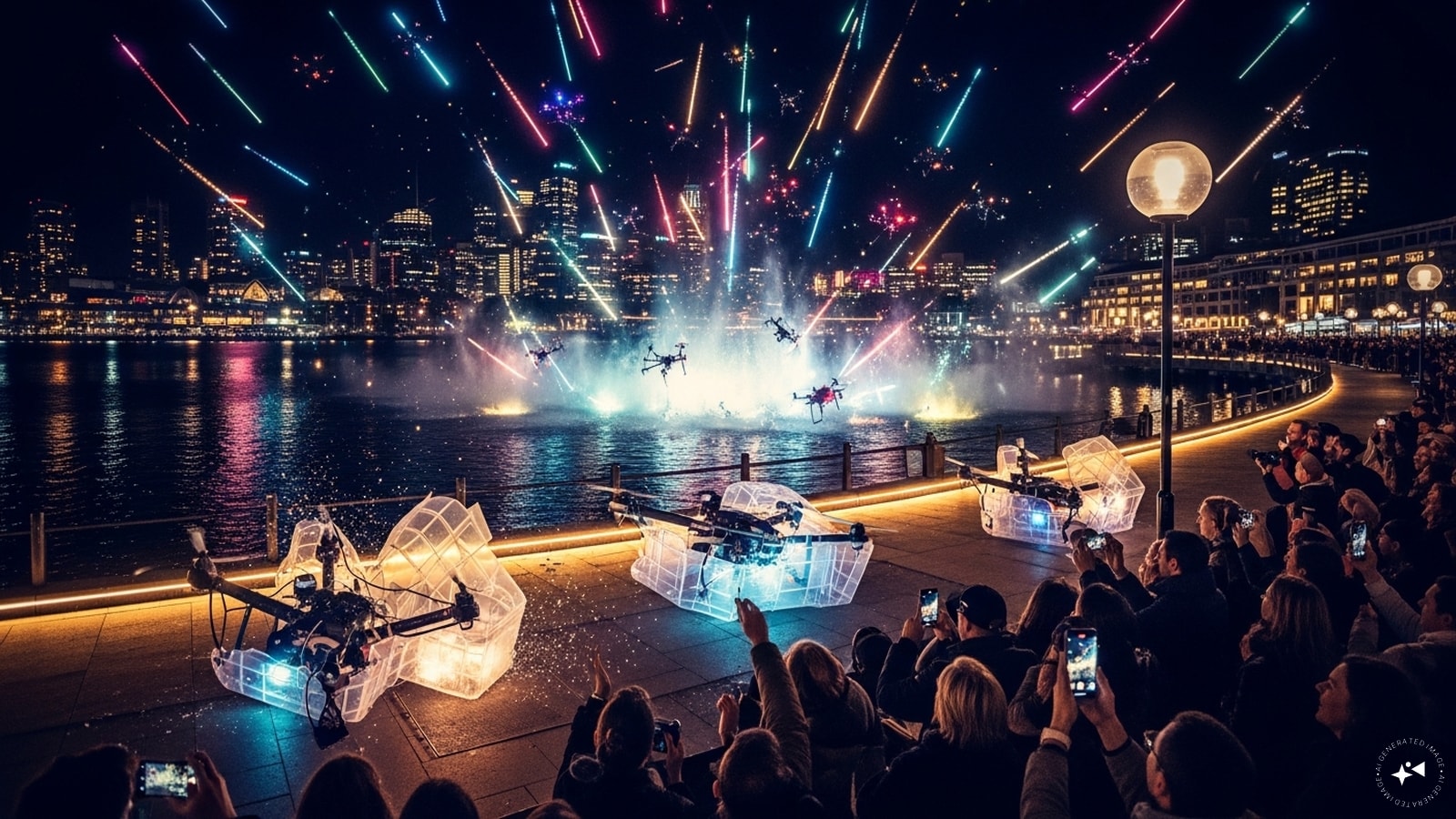
The media collective mind lost its composure when dozens of tech-loaded quadcopters plunged into Sydney’s Cockle Bay during a Vivid festival light show. Headlines screamed about "chaos," "starlight disasters," and "crowds left stunned." The consensus was immediate: drone shows are fragile, the technology is unready, and the spectacle failed.
That narrative is completely wrong.
Watching millions of dollars of hardware sink into the harbor isn't a failure of technology. It is a textbook demonstration of exactly why automated, decentralized entertainment systems are superior to every legacy alternative we have. The public, fed a diet of flawless digital curation, has forgotten what real-time engineering looks like.
I have spent fifteen years managing large-scale hardware deployments and dealing with automated fleet logistics. When a drone fleet falls out of the sky under controlled safety protocols, you aren't witnessing a disaster. You are witnessing a masterclass in automated risk mitigation.
The Myth of the Flawless Spectacle
Legacy entertainment thrives on artificial predictability. A pre-recorded video wall or a timed fireworks display operates on a binary: it works, or it blows up.
Drone light shows operate on a completely different paradigm of physics and software. A modern light show relies on Real-Time Kinematic (RTK) GPS, localized radio frequency communication, and constant spatial awareness algorithms. Hundreds of individual nodes must maintain position within centimeters of each other while battling unpredictable wind sheer, thermal drafts from the water, and urban radio frequency interference.
When the mainstream media covers a drone crash, they focus on the dramatic visuals of falling lights. They miss the engineering triumph happening beneath the surface.
Consider what actually happens during an in-flight termination event:
- Failsafe Triggers: The software detects a loss of positioning telemetry or a critical battery drop.
- Geofencing Enforcement: Instead of drifting into a crowd or striking a building, the unit executes a programmed kill-switch command.
- Controlled Descent: The drone drops directly down into a designated, pre-vacated safety zone—in this case, the water.
The Sydney incident showed the systems working exactly as designed. The software recognized an anomaly and chose asset destruction over human risk. If a firework shell malfunctions, it explodes in a crowd. If a drone show fails, it takes a swim. That isn’t a failure; it’s a feature.
The Problem With "People Also Ask" Logic
Look at the questions flooding search engines after every major drone incident: Are drone shows safe? Why do drone shows crash? Will drones replace fireworks?
These questions are fundamentally flawed because they assume a baseline of zero-risk that has never existed in live production.
Are drone shows safe?
Yes, precisely because they can fail dynamically. A traditional scaffolding rig holding tons of lights can suffer structural fatigue and collapse without warning. A drone fleet uses distributed risk. If five drones fail out of five hundred, the show continues, and the danger is contained to a localized grid. The fact that we can lose 10% of a performance asset mid-show without injuring a single spectator proves it is arguably the safest form of mass entertainment ever devised.
Why do drone shows crash?
The primary culprit is rarely mechanical failure. It is radio frequency congestion. In dense urban environments like Sydney's harbor, thousands of audience members are carrying smartphones with active Wi-Fi and Bluetooth scanning. Add in local maritime radar, emergency services communication, and hotel networks, and the 2.4 GHz and 5.8 GHz spectrums become a warzone. When the signal-to-noise ratio drops below a critical threshold, the drones do the smart thing: they stop guessing and ground themselves.
The Hard Truth About Hardware Investment
Corporate boards and city councils routinely get cold feet after high-profile incidents. They see a video of drones hitting the water and want to claw back their budgets, retreating to the safety of traditional lasers or pyrotechnics.
This is a massive strategic mistake.
I have seen companies blow millions trying to build "uncrashable" systems. They over-spec the hardware, add redundant sensors that increase weight, and end up with a bloated, expensive product that still fails when the laws of physics demand it.
The smartest players in the industry accept a structural loss rate. They treat drones as semi-consumable assets. If you run a fleet of five hundred drones, you should budget for a 2% to 5% attrition rate per year due to environmental anomalies. The math still favors automation.
| Entertainment Medium | Environmental Risk | Human Risk Profile | Iteration Speed |
|---|---|---|---|
| Traditional Fireworks | High (Fire/Smoke) | High (Explosives handling) | Zero (Single-use asset) |
| Heavy Staging/Light Rigs | Low (Static structural) | Medium (Crush hazards) | Low (Long teardown) |
| Automated Drone Fleets | Medium (RF interference) | Low (Geofenced failsafes) | High (Instant reprogramming) |
Stop Fixing the Wrong Variables
The instinct after a public failure is to over-regulate or over-engineer. Regulatory bodies want to push flight zones further away from audiences, while software developers scramble to write patch after patch.
Both approaches miss the mark.
If you want to build a resilient live entertainment brand, you need to change how you communicate risk to your audience and your stakeholders. Stop promising perfection. The allure of live performance has always been the tightrope walk—the knowledge that things can go wrong.
Instead of hiding the mechanics, lean into the complexity. The future of tech-driven entertainment belongs to operators who treat the unpredictability of the medium as part of the draw.
If your fleet drops twenty units into the ocean, you don't issue an apology. You release the telemetry data. You show the public the sheer volume of data those machines were processing before they made the algorithmic decision to sacrifice themselves. Turn the failure into a validation of your safety protocol.
Stop designing systems that pretend the world is a sterile laboratory. Embrace the chaos of the environment, account for the loss in your profit and loss statements, and keep flying.
The sky isn't falling. The future is just hitting a few waves.