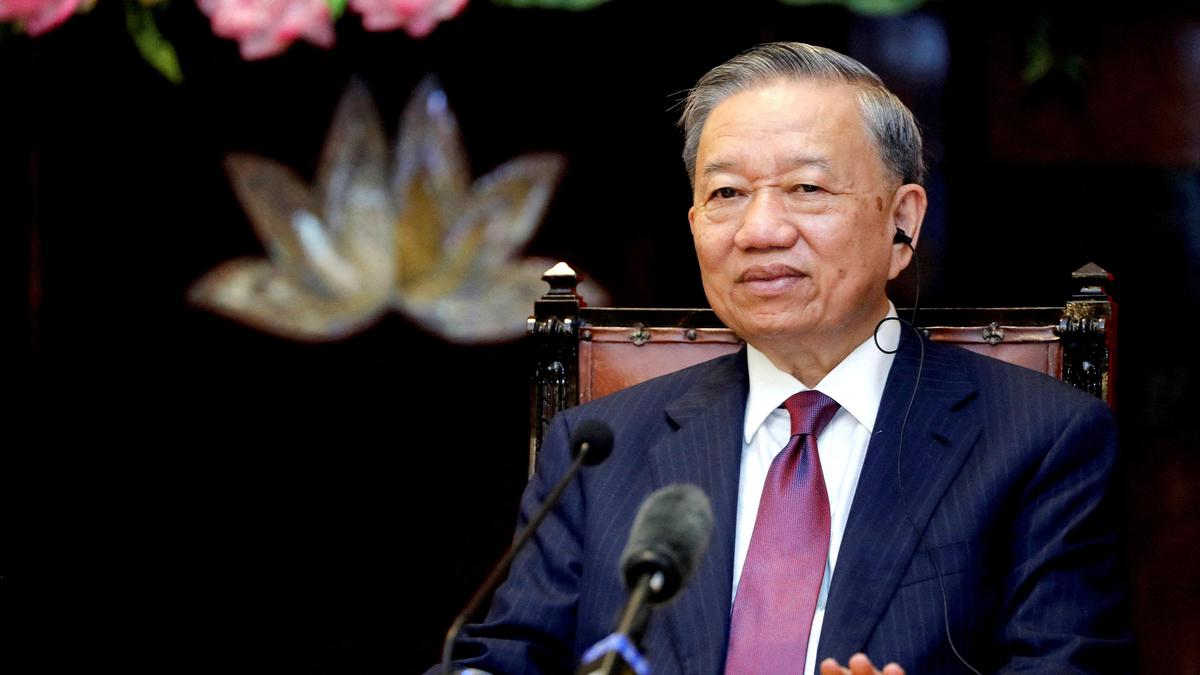
When the wheels of a state aircraft touch down on the tarmac of New Delhi, the sound is usually lost in the city's perpetual roar. But when To Lam, the President of Vietnam, steps onto Indian soil this coming week, the vibration will carry far beyond the runway. It is a meeting of two civilizations that have spent centuries looking over their shoulders, wondering if they are being followed.
To Lam does not just carry a diplomatic briefcase. He carries the weight of a nation that has become the world’s favorite alternative. For years, the narrative of global manufacturing was a solo performance. Now, it is a duet. Vietnam and India are no longer just "emerging markets" in the eyes of a boardroom executive in New York or London. They are the twin pillars of a new architecture, built to withstand the tremors of a fracturing world.
The stakes are not found in the official communiqués or the stiff handshakes in front of velvet curtains. The stakes are in the silicon. They are in the shipping lanes of the East Sea. They are in the quiet anxiety of a factory manager in Hanoi who realizes his supply chain is too fragile, and a software engineer in Bengaluru who knows his code is the only thing keeping the lights on.
The Geography of Anxiety
Maps are lying to you. They show borders as solid lines, static and unmoving. In reality, borders are breathing things. For Vietnam, the border to the north is a constant, heavy presence. It is a relationship defined by thousands of years of conflict and trade, a delicate dance where one wrong step leads to a bruised ego or a blocked trade route.
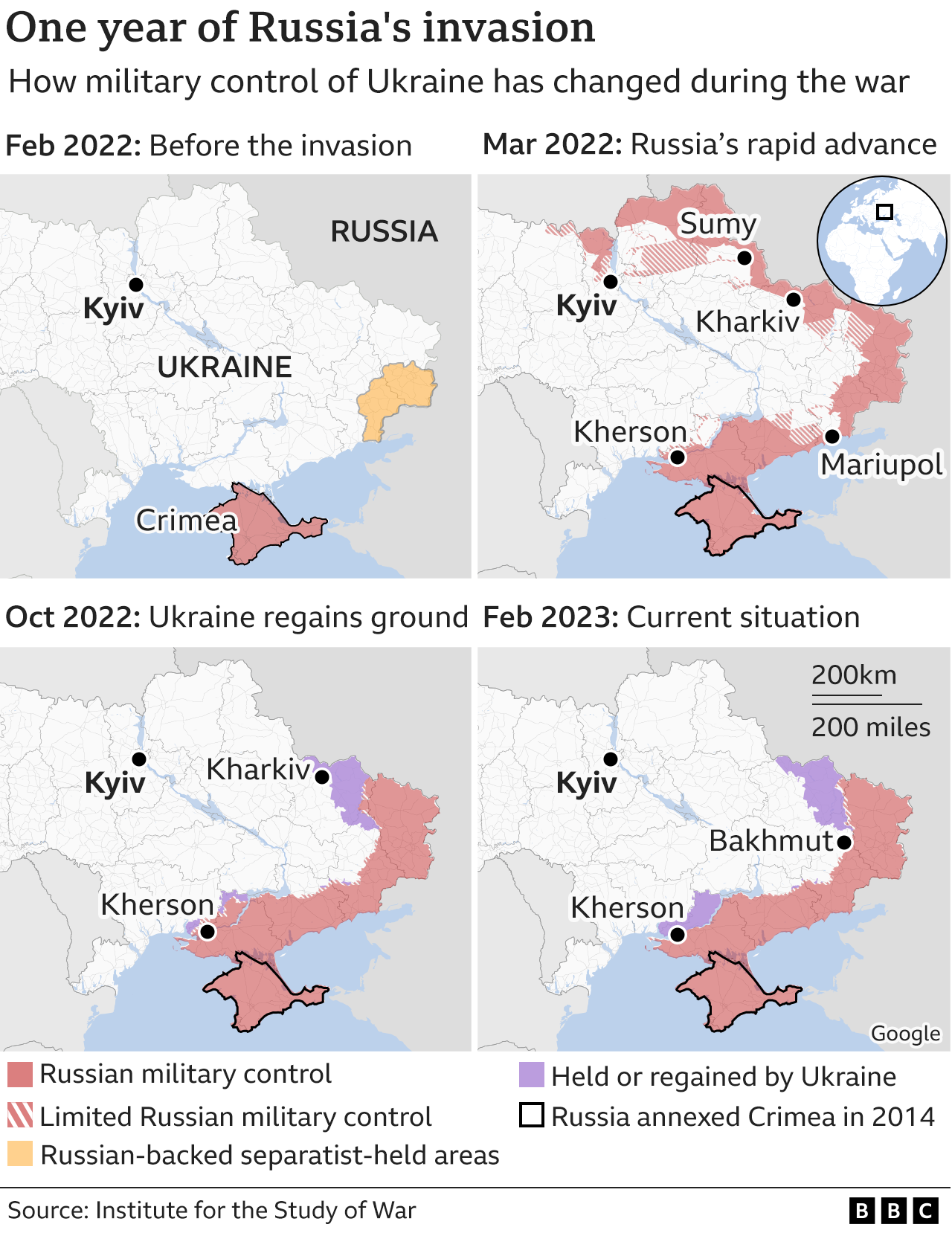
India understands this better than perhaps any other nation on earth. Both countries share a neighbor that is growing increasingly assertive, turning the South China Sea into a chessboard and the Himalayan heights into a standoff. This isn't just about "regional tensions," a phrase so dry it practically turns to dust. This is about the fundamental right to exist without permission.
When To Lam meets Prime Minister Modi, they won't just talk about defense contracts. They will talk about the silence of the sea. Vietnam needs BrahMos missiles and Indian naval technology not because they want war, but because they want the peace that comes with being too expensive to touch. India, in turn, needs a Vietnam that is strong enough to stand its ground. If Vietnam wobbles, the entire strategy of a "Free and Open Indo-Pacific" starts to look like a house of cards.
The Silicon Lifeline
Consider a hypothetical worker named Minh. Minh works in a high-tech industrial park outside Da Nang. Ten years ago, his father was farming rice. Today, Minh spends his shift assembling components for smartphones that will end up in pockets in Berlin and San Francisco. His livelihood depends on a world that stays connected.
But the world is splintering. The "China Plus One" strategy—where companies move production out of the mainland to diversify risk—has made Minh’s job possible. Yet, Vietnam is a small country. It has limits. It has a labor pool that is filling up and an infrastructure that is straining under the weight of its own success.
This is where India enters the frame.
India is the scale that Vietnam lacks. India is the software brain to Vietnam's hardware heart. The "fortification of ties" mentioned in news briefs is actually a desperate, brilliant attempt to create a closed loop of democratic production. If India provides the raw materials and the digital architecture, and Vietnam provides the precision manufacturing and the gateway to Southeast Asia, the dependency on a single, volatile neighbor begins to evaporate.
It is a marriage of necessity. They are two survivors of the Cold War who have realized that in the new era, the most valuable currency isn't gold or oil. It’s reliability.
The Ghost of the Non-Aligned Movement
There is a deep, historical resonance here that most Western observers miss. Both India and Vietnam share a DNA of fierce independence. They spent the 20th century refusing to be pawns for Washington or Moscow. That spirit hasn't vanished; it has just traded its olive-drab fatigues for a business suit.
To Lam’s visit is a signal that the "Global South" is no longer a collection of victims waiting for a handout. It is a power bloc that is tired of being told where to buy its energy or how to secure its borders.
When they sit down in New Delhi, the conversation will inevitably turn to the Comprehensive Strategic Partnership. To a casual reader, that sounds like bureaucratic filler. To the people living it, it means joint oil exploration in waters that others claim as their own. It means Indian technicians training Vietnamese sailors to operate Kilo-class submarines. It means a shared refusal to be bullied.
The Invisible Stakes
Why should a farmer in Uttar Pradesh or a shopkeeper in Ho Chi Minh City care about a diplomatic visit? Because the price of their fertilizer, the speed of their internet, and the safety of their children are all tied to this specific alignment.
We are witnessing the birth of a middle-path. If the world is a see-saw with the United States on one end and China on the other, India and Vietnam are trying to build a platform right in the middle. They are creating a space where trade can happen without ideological purity tests.
But this path is narrow. It is slippery. One mistake in New Delhi this week—a poorly worded statement on a sensitive border issue, a failed agreement on semiconductor tariffs—can send ripples through the stock markets of Asia.
The reality of 21st-century diplomacy is that it is no longer about winning. It is about not losing. It is about the quiet, grueling work of building redundancies. You don't build a friendship with a country like India just because you like their movies or their food; you build it because, in a storm, you want to be tied to a very large rock.
The Quiet Room
Behind the photo-ops and the ceremonial guards, there will be a quiet room. In that room, To Lam and his Indian counterparts will look at satellite imagery. They will look at trade deficits. They will look at the aging demographics of their workforces.
The vulnerability is real. Vietnam is small and exposed. India is vast but complicated by its own internal gravity. They are both betting that the other is the missing piece of their own puzzle.
This isn't a story about a "visit." It’s a story about the end of an era where a single superpower could dictate the flow of goods and the fate of nations. It’s about two ancient cultures looking at the horizon and seeing the same clouds gathering.
The Dragon and the Tiger are walking together because the woods are getting dark, and neither wants to be the one who has to face the shadows alone. They aren't just fortifying ties. They are building a fence against the wind.
The true test of the coming week won't be in the signed documents. It will be in the silence that follows—a silence where, for the first time in a long time, both nations might finally feel a little less like they are being watched.