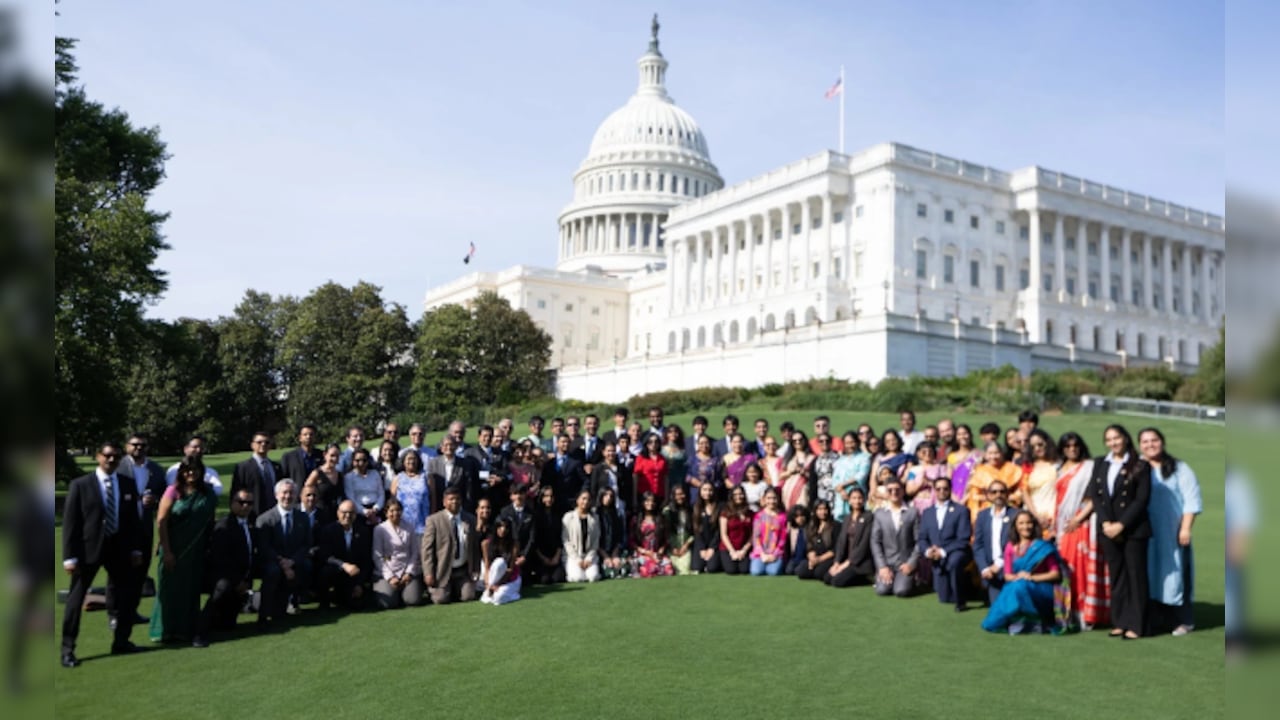
The room smelled faintly of marigolds and damp wool. Outside, a sharp Washington wind rattled the heavy glass windows, but inside the historic briefing room, the atmosphere was thick with a strange, dual energy. On one side of the podium stood a small, crisp American flag, its fifty stars catch the overhead fluorescent light. On the other, a traditional brass lamp, its wick dipping into clear ghee, cast a warm, flickering glow against the wood-paneled walls.
More than one hundred people sat packed into the rows of chairs. Some wore tailored suits; others wore heavy silk sarees that rustled whenever they shifted in their seats. They had gathered to mark a milestone that most of the country was celebrating with fireworks and parade floats: the two hundred and fiftieth anniversary of the United States.
But these families did not come just to wave flags. They came because they were uneasy.
For the Hindu-American community, this grand American milestone is wrapped in a complicated truth. They are an extraordinary success story—highly educated, economically prosperous, and deeply woven into the fabric of every major American industry from Silicon Valley to rural medicine. Yet, beneath the surface of the model minority narrative, a quiet fracture is growing. As the nation reflects on two and a half centuries of liberty, a hundred distinct voices in the nation's capital are asking a raw, uncomfortable question: Does that liberty truly extend to them, or is their faith becoming a liability in the country they call home?
The Anatomy of an Invisible Friction
To understand what brought these hundred citizens to Washington, you have to look past the spreadsheets of economic achievement. You have to look at the kitchen tables.
Consider a hypothetical teenager named Aarav. He lives in a comfortable suburb of Chicago, plays varsity tennis, and spends his weekends volunteering at a local food pantry. He is as American as a teenager can be. But last month in his AP World History class, a casual discussion about ancient civilizations turned into a trial. A classmate, reading from an outdated textbook, made a derogatory joke about sacred cows and many-armed deities. The teacher chuckled. Aarav sank into his chair, his face burning, suddenly feeling like a stranger in the room he had sat in every day since September.
This is not an isolated incident of schoolyard bullying. It is the frontline of a subtle, pervasive form of prejudice known as Hinduphobia.
The people who gathered in Washington are not professional grievance-mongers. They are engineers, doctors, small business owners, and teachers. They are people who traditionally prefer to keep their heads down, work hard, and let their contributions speak for themselves. But the strategy of quiet assimilation is breaking down. When your sacred symbols are routinely desecrated on social media, when your community temples are vandalized with graffiti, and when your children are made to feel ashamed of their heritage in public classrooms, silence stops looking like dignity. It starts looking like permission.
The numbers back up their anxiety. Over the last few years, hate crimes targeting Asian Americans and religious minorities have ticked steadily upward. But while other communities have established advocacy groups and clear legal definitions to combat bias, Hindu Americans have largely operated without a shield. Their faith is ancient, decentralized, and deeply misunderstood by a Western mainstream that often views it through a lens of colonial-era stereotypes or cartoonish pop-culture caricatures.
The Long Journey to the Capital
The celebration of America’s semiquincentennial served as both a shield and a megaphone for the attendees. They did not gather to protest America; they gathered to claim it.
Speakers took turns at the microphone, their voices echoing off the high ceilings. They spoke of the deep alignment between traditional Hindu philosophy and the founding ideals of the American republic. The ancient Sanskrit phrase Vasudhaiva Kutumbakam—the world is one family—mirrors the core promise of E Pluribus Unum. The idea that divinity resides within every individual aligns perfectly with the self-evident truth that all people are created equal, endowed by their Creator with unalienable rights.
But the real problem lies elsewhere. It rests in the gap between high-minded philosophy and the messy reality of daily life.
Many of the older attendees in the room arrived in the United States during the immigration waves of the late twentieth century. They remembered an America that was mostly curious, if slightly ignorant, about their traditions. They were asked if they spoke "Indian" or if India had televisions. It was benign ignorance. It could be corrected with a conversation or an invitation to dinner.
The modern reality is different. Today’s bias is sharper, digital, and ideological. It is fueled by internet echo chambers where ancient traditions are weaponized or stripped of their context to fit contemporary political narratives. A sacred symbol like the swastika—which meant peace and auspiciousness for thousands of years before it was stolen and inverted by European fascists—becomes a source of terror and misunderstanding for a Hindu child carrying a traditional talisman to school.
How do you explain thousands of years of theology to a school principal who only knows what they see on a thirty-second viral video?
Reclaiming the Narrative from the Ground Up
The gathering in Washington was an exercise in collective vulnerability. Men and women stood up to share stories they had previously hidden from their neighbors, and sometimes even from their own children.
One woman spoke of her temple in the Midwest being defaced with slurs. Another described the exhaustion of constantly defending her dietary choices to corporate colleagues who treated her vegetarianism as a bizarre dysfunction rather than a deeply held spiritual practice. A third explained the fear of seeing her faith systematically scrubbed from public discourse or redefined entirely by academic institutions that refuse to invite practicing Hindus to the table.
It is terrifying to admit that the place you ran to for safety might not be as safe as you thought.
The solution discussed by the attendees was not a retreat from American life, but a deeper dive into it. They called for better educational standards that accurately represent Eastern faiths without falling back on colonial tropes. They urged lawmakers to recognize Hinduphobia as a distinct form of religious bigotry, giving law enforcement and civil rights organizations the tools they need to track and combat it effectively.
Most importantly, they recognized that the burden of education falls on their own shoulders. No one else is going to tell their story correctly if they do not tell it themselves.
The Promise of the Next Two Hundred Years
The afternoon faded into twilight, and the cold Washington sky turned a deep, bruised purple. Inside the room, the brass lamp continued to burn, its flame steady against the draft.
This gathering was not an ending. It was a beginning. A hundred citizens left that room and headed back to their respective states—back to Texas, New Jersey, California, and Ohio. They went back to their clinics, their laboratories, and their classrooms. But they went back changed. They had looked into a mirror and realized that their survival as a distinct, respected cultural community requires more than economic success. It requires civic courage.
America’s two hundred and fiftieth anniversary is a celebration of an ongoing experiment. It is a reminder that the nation is never truly finished; it is constantly being rewritten by the people who have the audacity to believe in its foundational promises.
An older man stopped near the door as the crowd began to disperse. He adjusted his coat, looked at the small American flag still resting on the podium, and then down at his hands. He did not speak to anyone in particular, but his words carried the weight of the entire afternoon.
We built the roads, he murmured. We built the hospitals. We built the software. Now, we have to build the understanding.
He turned and walked out into the chilly night, his footsteps echoing down the marble corridor of the capital, blending into the vast, unfolding noise of a nation still trying to find its soul.