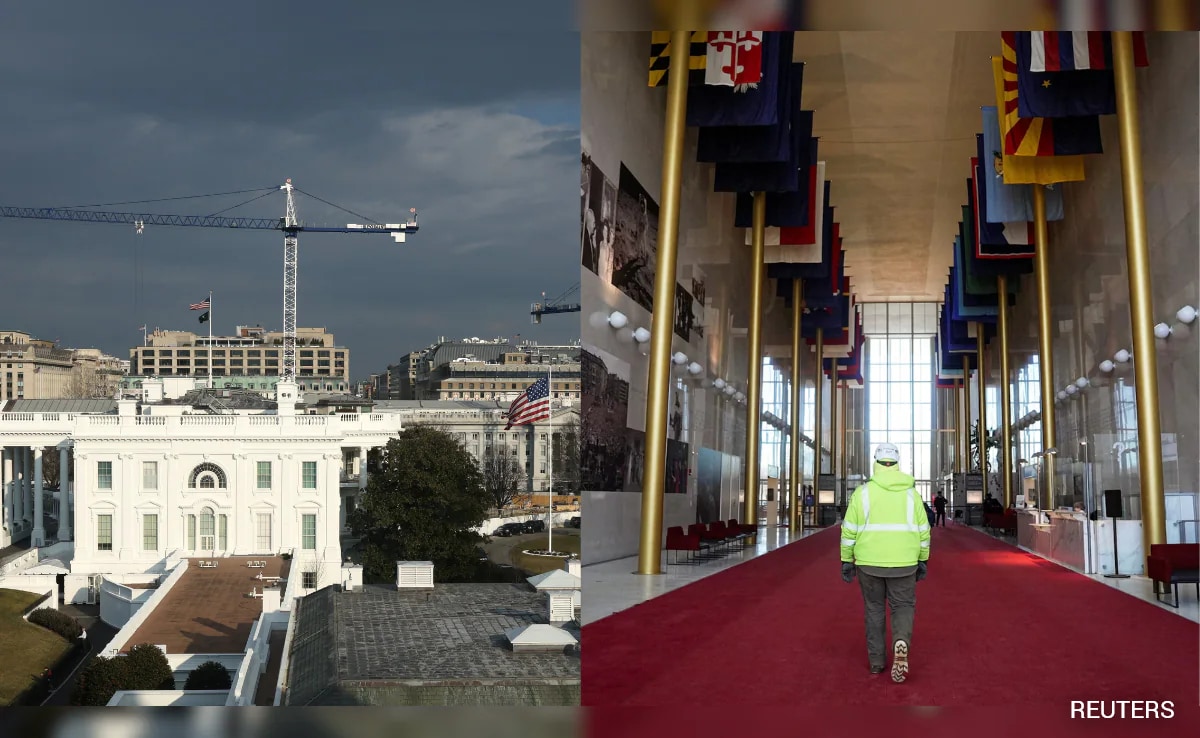
Donald Trump’s vision for a physical overhaul of the White House is not a mere renovation project. It is a strategic deployment of real estate as a tool of statecraft. By proposing a $400 million ballroom and a 250-foot triumphal arch, the former president is signaling a shift away from the "people's house" toward a monument of imperial executive authority. These structures are designed to do more than host dinners; they are intended to dwarf foreign dignitaries and solidify a legacy of scale over substance.
This isn't about paint colors or new curtains. When a developer moves into the Oval Office, he views the architecture as an extension of his brand and his power. The proposed makeover seeks to solve a perceived problem of "smallness" in American diplomacy by replacing historical modesty with overwhelming physical presence.
The Architectural Ego of the 250 Foot Arch
The centerpiece of this proposed transformation is an arch that would stand nearly half the height of the Washington Monument. To understand the gravity of this, one must look at the history of triumphal arches. From Constantine to Napoleon, these structures have always served as markers of conquest. They are not built for domestic comfort. They are built for the history books.
Architecturally, a 250-foot arch on the White House grounds would fundamentally break the skyline of the capital. Washington D.C. is governed by the Height of Buildings Act of 1910, a law designed to keep the city's profile horizontal and democratic. Placing a massive stone gateway in the middle of this creates a visual hierarchy where the executive branch literally rises above the legislative and judicial branches. It is a play for dominance written in limestone.
Critics argue that such a structure would turn the executive mansion into a theme park. However, from a branding perspective, it serves a different master. It creates a "Trumpian" landmark that would be visible from almost every vantage point in the city, ensuring that even after his tenure, his physical footprint remains inescapable. It is the ultimate real estate play: permanent occupancy through architecture.
The Economics of a 400 Million Dollar Ballroom
Renovating a historic building is never cheap, but $400 million for a single room suggests a level of opulence that rivals the halls of Versailles. To put that number in context, the entire 1948-1952 Truman reconstruction of the White House cost approximately $5.7 million—about $70 million in today’s currency. Trump’s ballroom alone would cost nearly six times the price of gutting and rebuilding the entire mansion.
The "why" behind the ballroom is rooted in the theater of the deal. In the world of high-stakes real estate, the environment dictates the terms of the negotiation. If you bring a world leader into a cramped, historic dining room, you are bound by tradition. If you bring them into a cavernous, gold-leafed arena designed for spectacle, you control the psychological space.
- Capacity Expansion: The current State Dining Room caps out at about 140 guests. A massive ballroom allows for thousands, turning every state event into a campaign-style rally or a high-society gala.
- Privatization of Public Space: High-end materials and restricted access reinforce the idea of the White House as an exclusive club rather than a public office.
- Infrastructure Stress: The cost includes more than just aesthetics. Supporting a structure of that size on the South Lawn requires massive subterranean reinforcement and security upgrades that would likely double the initial budget once the Secret Service weighs in.
Aesthetics as a Weapon of Diplomacy
The American presidency has traditionally leaned on "Republican Simplicity." This was the idea, championed by Jefferson, that the leader of a democracy should not live like a king. Trump’s makeover is an explicit rejection of that value. He views the existing White House as "small" and "rundown," a sentiment he has expressed to guests and staff alike for years.
By introducing gilded aesthetics and massive scale, the goal is to project a specific type of American strength—one based on wealth and visible excess. It is the "Goldman Sachs" of diplomacy. It assumes that foreign adversaries and allies are more impressed by a $400 million ceiling than by the weight of the office itself.
There is a deep-seated belief here that the physical environment can force respect. It is the same logic used in the construction of Trump Tower or Mar-a-Lago. If the room looks like it belongs to a winner, the occupant must be a winner. This ignores the fact that the White House’s power has always come from the stability of its institutions, not the height of its arches.
The Logistics of a Construction Site at 1600 Pennsylvania Avenue
Building a 250-foot arch and a massive ballroom isn't just an expensive dream; it’s a logistical nightmare. The White House sits on some of the most sensitive soil in the world. Beneath the lawns lies a web of bunkers, communications lines, and security tunnels.
Any major excavation would require:
- Total Relocation: The President would likely have to move out for years, possibly to a temporary "Western White House" or a private residence, further blurring the lines between government and private enterprise.
- National Security Risks: Bringing in hundreds of contractors and massive machinery to the most secure 18 acres in the country creates a counter-intelligence headache that few in the intelligence community are willing to stomach.
- Environmental Impact: The North and South Lawns are historic landscapes. Replacing green space with massive concrete footprints alters the drainage and historical integrity of the site permanently.
The sheer audacity of the plan acts as a distraction. While the public debates the height of the arch, the actual work of governance is reshaped around the spectacle. It is a classic developer move: propose something so massive that even a "compromise" version is still larger than anything that came before it.
The Hidden Cost of Maintenance and Legacy
A building of this scale requires an army to maintain. The National Park Service already struggles with a massive maintenance backlog for federal monuments. Adding a gold-trimmed, oversized ballroom adds millions in annual recurring costs to the taxpayer.
But the real cost is the shift in the American brand. For over two centuries, the White House has stood as a symbol of continuity. It has been renovated, yes, but its profile has remained largely the same since the 1820s. To radically alter that profile is to suggest that the current era is more important than the entire history of the republic.
This is the central tension of the Trump makeover. It is a clash between the "Preservationist" view—that the building belongs to the ages—and the "Developer" view—that the building is an asset to be maximized for the current occupant.
History shows that when leaders build monuments to themselves while in office, those monuments often become the focus of public resentment during times of economic hardship. A $400 million ballroom built while the average American struggles with inflation creates a visual disconnect that no amount of gold leaf can hide.
The Political Reality of Federal Construction
The President does not have a blank check to rebuild the White House. He must contend with the Commission of Fine Arts, the National Capital Planning Commission, and, most importantly, Congress. Funding for such a project would require a massive appropriation that would face stiff resistance from both sides of the aisle.
However, the proposal itself serves a purpose. By demanding the "best" and the "biggest," Trump sets a new baseline for what is considered acceptable. Even if the arch is never built, the conversation has shifted. We are no longer talking about fixing the roof or updating the HVAC; we are talking about the White House as a platform for monumentalism.
The project isn't really about the arch or the ballroom. It’s about the assertion that the Executive branch has the right to reshape the physical world in its own image. It is an attempt to turn a temporary lease on a public office into a permanent monument of stone and steel.
The architectural plans for the White House are the ultimate Rorschach test for the American public. To some, they represent a return to national grandeur and an unapologetic display of success. To others, they are the physical manifestation of an ego that has outgrown the constraints of the democratic system. Either way, the message is clear: the era of the modest executive is over.
If the bulldozers ever do arrive at 1600 Pennsylvania Avenue, they won't just be moving dirt. They will be burying a centuries-old tradition of restraint in favor of a new, towering reality. The arch doesn't just span a driveway; it spans the gap between a presidency of service and a presidency of spectacle.
Observe the floor plans of the proposed ballroom. Notice how they prioritize stagecraft over conversation. This is the blueprint for a different kind of government, where the visual "wow factor" is the primary metric of success. Whether it ever gets built is almost secondary to the fact that it was imagined in the first place. The intent is the monument.


