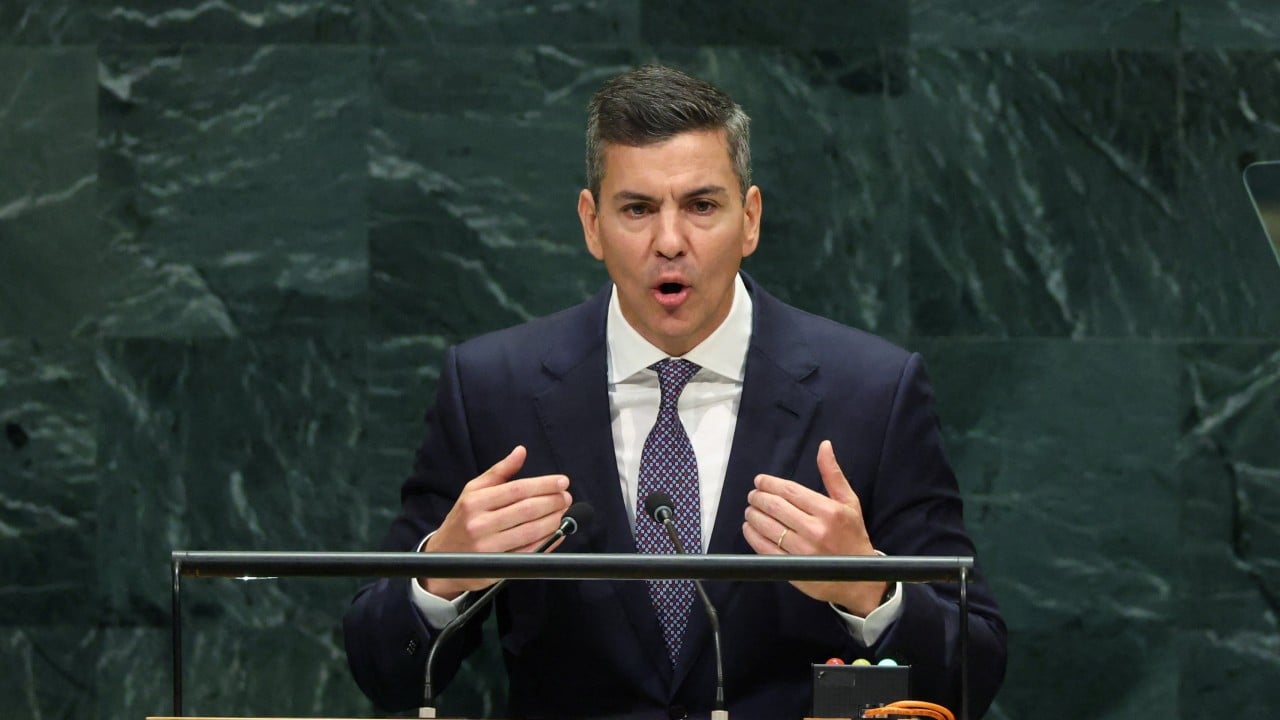
Paraguay’s insistence on bringing Taiwan’s political status to the floor of the United Nations General Assembly highlights a persistent structural fracture within multilateral diplomacy. When executive leadership uses sovereign platform time to indict the exclusion of a de facto governing entity, the intervention operates on two distinct planes: domestic diplomatic signaling and systemic international friction. To evaluate this intervention beyond standard geopolitical commentary, one must examine the institutional architecture of the United Nations, the mechanics of sovereign recognition, and the asymmetric trade-offs embedded in diplomatic alignment strategies.
The Architecture of Recognition and Exclusion
The foundational premise of United Nations membership is governed by Chapter II, Article 4 of the Charter, which restricts admission to peace-loving states that accept the obligations contained in the Charter and are able and willing to carry out those obligations. In practice, admission requires a recommendation by the Security Council followed by a decision of the General Assembly. Resolution 2758, passed in 1971, recognized the representatives of the Government of the People’s Republic of China as the only legitimate representatives of China to the United Nations.
This legal baseline creates a zero-sum structural constraint for any administration attempting to advocate for Taiwan's integration into specialized agencies or plenary sessions. Because the legal architecture binds international recognition to a single-seat configuration for China, advocacy for Taiwan must bypass formal Charter mechanisms and rely on political pressure, observer status lobbying, or advocacy within specialized technical bodies like the World Health Organization or the International Civil Aviation Organization. Paraguay’s framing of this exclusion as a moral or systemic stain deliberately attacks the rigidity of this institutional design, contrasting the operational reality of Taiwan's advanced economy and democratic governance with its total disenfranchisement from formal global forums.
The Cost Function of Bilateral Alignment
For a middle-income developing nation like Paraguay, maintaining official diplomatic relations with Taipei rather than Beijing carries a distinct economic and diplomatic cost function. Diplomatic exclusivity clauses enforced by Beijing dictate that no nation can maintain formal diplomatic ties with both the People's Republic of China and the Republic of China on Taiwan.
The opportunity cost of this policy can be modeled through three variables:
- Foreign Direct Investment and Infrastructure Capital: Beijing deploys immense capital through state-directed financial institutions for large-scale infrastructure, logistics, and resource extraction projects. By maintaining ties with Taipei, Asunción foregoes direct access to these sovereign credit lines and large-scale bilateral development packages.
- Agricultural Market Access: Paraguay is a major net exporter of primary commodities, specifically soybeans and beef. The global market demand driven by Chinese industrial consumption and domestic protein demand represents a massive addressable market. Official non-recognition creates friction, forcing Paraguayan commodities to enter the mainland market indirectly through third-party intermediaries, capturing lower margins.
- Diplomatic Capital Allocation: Advocacy at the United Nations incurs political capital. Every speech demanding structural reform regarding Taiwan’s status draws finite diplomatic attention away from regional security issues, Mercosur trade negotiations, or climate finance access.
Conversely, the retention of ties with Taipei yields distinct, localized capital flows. Taiwanese development assistance is typically structured around high-impact, transparent technical cooperation projects, educational scholarships, and targeted grants in healthcare and technology transfer. More importantly, maintaining this alignment preserves Paraguay’s strategic bargaining position as one of the few remaining sovereign states in South America recognizing Taipei, granting its executive branch disproportionate geopolitical leverage relative to its economic size when engaging Western allies.
Strategic Objectives of Executive Advocacy
When a head of state utilizes the United Nations General Assembly to criticize multilateral exclusion, the action serves strategic domestic and international functions.
Internationally, it reinforces credibility within Western security and political networks. By positioning Asunción as an unwavering defender of democratic norms and institutional inclusivity, the administration aligns its foreign policy brand with liberal internationalist states, securing intangible diplomatic goodwill that can be leveraged during international financial institution voting or trade negotiations with the United States and the European Union.
Domestically, the posture projects sovereign agency. In smaller economies, foreign policy is frequently perceived as reactive to external superpowers. A vocal, values-driven foreign policy narrative allows the executive to project leadership, satisfying domestic constituencies that prioritize ideological alignment over purely transactional mercantilism. However, this strategy exposes the state to vulnerability if the economic costs of market exclusion begin to outweigh the diplomatic returns, particularly during economic downturns when agricultural sectors lobby aggressively for direct trade normalization with the world's largest import markets.
Systemic Limitations of Multilateral Moral Diplomacy
Moral advocacy within international organizations faces a hard ceiling imposed by great power politics. The United Nations is not a neutral arbiter of ethical governance; it is a reflection of distributed global power dynamics.
When Paraguay characterizes Taiwan's exclusion as a stain, the critique targets the fundamental hypocrisy of a system that champions global health, aviation safety, and economic integration while systematically barring a technically proficient jurisdiction of 23 million people due to geopolitical vetoes. Yet, systemic critique without structural leverage yields no institutional reform. Resolution 2758 remains anchored by the veto-wielding permanent members of the Security Council and the voting bloc of member states bound directly or indirectly to Beijing's economic orbit.
Consequently, advocacy must pivot from broad plenary demands to functional functionalism. Rather than seeking sweeping political recognition within the General Assembly—an outcome structurally blocked by international law and power distribution—efforts directed toward functional integration in technical standard-setting bodies offer a higher probability of marginal success.
The trajectory of this diplomatic stance depends entirely on the domestic political calculus of successive administrations in Asunción and the willingness of major Western democracies to offset the opportunity costs borne by Paraguay for maintaining its lonely diplomatic posture. Until the structural incentives of global trade and capital shift, such speeches will remain high-visibility moral declarations constrained by the unyielding mechanics of international geopolitics.